
Aziz (Tansu Biçer), celebrated playwright and professor of dramaturgy in Ankara, is confronted with an obviously far-fetched but no less threatening charge of insulting the president and promoting terrorism. When he turns around again as he walks into the courthouse, he sees a memorial on the other side of the street with the year “1933” engraved in large numbers.
A German audience in particular immediately understands the connection that this attitude is intended to make to the Nazis' takeover of power at the end of the Weimar Republic. But what significance does the year “1933” actually have in Turkey that it is so prominently displayed in front of a court in Ankara? This is where one of the special features of “Yellow Letters”, İlker Çatak’s first film after his Oscar nomination for “The Teacher’s Room”, comes into play.

At the theater, as authors and actresses, they criticized the system together. But now even their marriage is threatening to collapse under the ever-increasing pressure.
It is becoming increasingly common for one city to duplicate another. For example, hardly anyone can afford to film in New York anymore, which is why Toronto in particular has to serve as a replacement – and in fact, the metropolises look similar enough architecturally that it doesn't even become noticeable without a deeper look. Such city doubles are now also available in “Yellow Letters”. However, Çatak not only doesn't shy away from including such landmarks as the Oberbaum Bridge or the Elbphilharmonie…
… he even shows this twice in bold: “Berlin as Ankara” and later “Hamburg as Istanbul”. And so the trial is taking place in the Hanseatic Higher Regional Court on Sievekingplatz, where the memorial “Here + Now – to the victims of National Socialist justice in Hamburg” designed by Gloria Friedmann with the “1933” engraving was inaugurated in 1997.
Anyone can really understand that
The obvious thoughts are clear: Can such a story really no longer be told in Turkish cinema, so that it has to be staged abroad instead? Or maybe it just has to do with film funding, which is certainly easier to access when filming in Germany? But for director and co-screenwriter İlker Çatak, another consideration took center stage.
Because he himself is not one of the Turkish artists who were brought to justice for flimsy reasons between 2016 and 2019, he felt like a tourist in his own story – until his Turkish producer Enis Köstepen advised him to simply send the film into exile too. “Yellow Letters” ended up in Berlin and Hamburg, with the local abstraction giving the story a universal appeal.
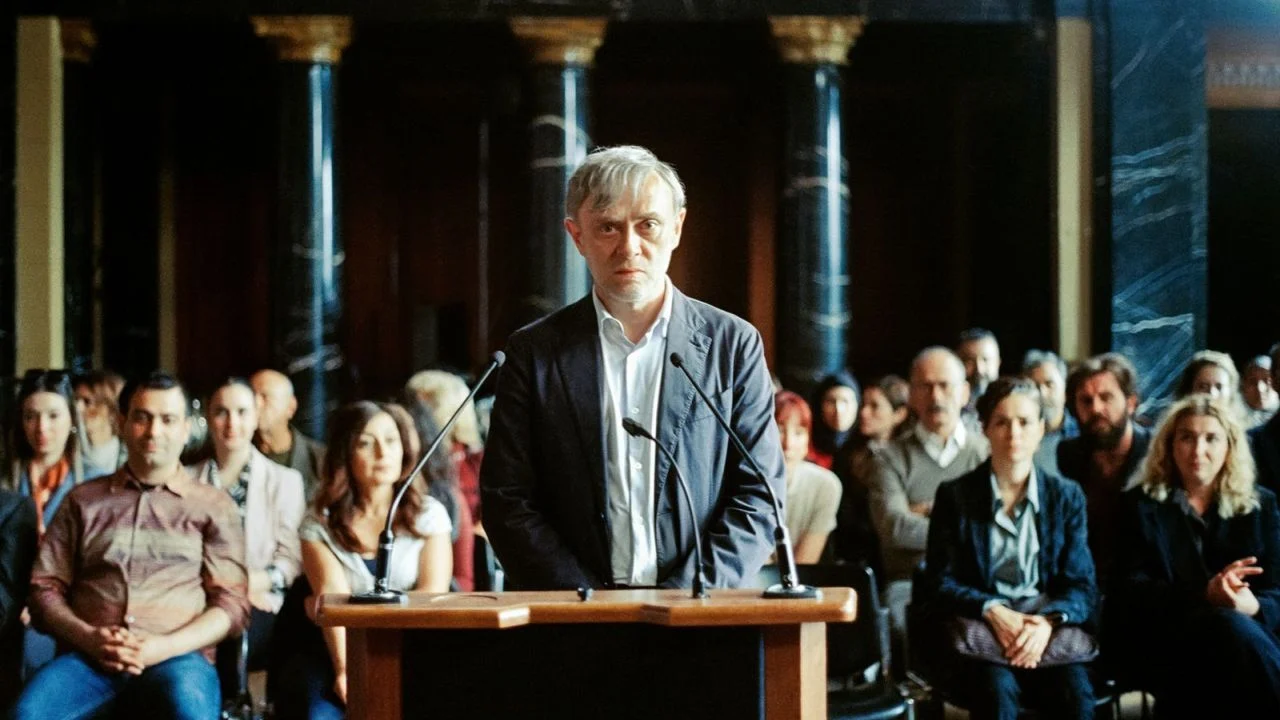
In the show trial, Aziz (Tansu Biçer) only gets three sentences to defend himself against the charges – ostensibly due to time constraints.
Of course, this fits like a glove, especially now that a lot has happened since the first idea for the film in 2019: Not only was there an open call for a MAGA fight against academic institutions in the USA, but in Germany teachers and artists alike repeatedly found themselves in the political and media barrage in the wake of the Gaza protests. So a film comes at exactly the right time that shows us how to do it right, that provides us with the right role models as a moral instruction manual for these difficult times. But puff cake!
Because that brings us to the second special feature and the greatest quality of “Yellow Letters”: Aziz and his wife Derya (Özgü Namal), who, even as the shining star of the state theater, is not safe from the eponymous termination letters, fundamentally have a freedom-seeking, solidarity-based attitude. But that doesn’t mean they always do the “right thing” even under pressure. Job loss, intimidation, paranoia, threats of punishment – the autocratic apparatus acts facelessly and is therefore so effective when it sets everything in motion with anonymous letters and then the vicarious agents, from the theater manager to the bank employee to the judge, do the actual dirty work.
No easy answers
It happens without a big bang, but still very quickly, that the couple and their teenage daughter Ezgi (Leyla Smyrna Cabas) are no longer in the chic condominium in Ankara, but as guests in the cramped apartment of Aziz's mother (İpek Bilgin) in Istanbul. The constant blows in the neck are not simply put aside just because you can continue to cling to your own convictions when you stage a particularly system-critical piece on a small private stage. No, it eats away at you and at some point the autocracy brings (almost) everyone to their knees.
If not for your own sake, don't you have to at least betray yourself to some extent for the future of your own daughter? Or isn't it a betrayal of the next generation, who are collecting signatures at school against expensive food in the canteen, if you don't show some backbone now? İlker Çatak doesn't even pretend to have easy answers (as long as they exist). Instead, he brutally honestly dissects the effects of constant pressure not so much on society as a whole, but above all on a marriage – together against everyone, that can hardly last long in the real world.
Conclusion: İlker Çatak tells about (surviving) life in an autocratic society, but not didactically or morally, but painfully honestly – and so the noose tightens inexorably not only for the family at the center, but also for the audience.
We saw “Yellow Letters” at the Berlinale 2026, where it celebrated its world premiere in the official competition.