
The Parisian director Carine Tardieu is known for her dramatic comedies with depth. She made her breakthrough in 2017 with “a Breton love”, four years later, “in the heart of young” followed with the long-time Truffaut Muse Fanny Ardant. Tardieu often and passion tells of “impossible” loved ones, that is, of relationships that cause all kinds of turbulence and emotional chaos among those affected due to complicated family interference or the great age difference.
Tardieu also likes to present her characters with huge challenges and confronts them with difficulty to be managed. The concentration on this content is also shown in “What connects us“, Tardieu's fifth feature film. It quickly becomes another distinguishing feature of Tardieu's work. Even in“ In the Heart of Young ”, the 70-year-old protagonist (played by Ardant) was about a confident female figure. We now see a strong, independent woman in her more mature years, who lives freely and far from social conventions.
Family member overnight
Sandra (Valeria Bruni Tedeschi) is in her mid -50s and loves nothing more than her unboundness. She fulfills her work as a bookseller, and she also has a stable network of long -time friends. One day their neighbors, Alex (Pio Marmaï) and Cécile (Mélissa Barbaud), have to go to the hospital. The birth of your second child is imminent. Sandra, who has no experience with children, spontaneously offers her support – and thus takes care of Alex 'six -year -old stepson Elliot (César Botti). In the meantime there is a tragedy in the hospital: Cécile does not survive the birth of her daughter Lucille.
Sandra is unexpectedly found in a role that she would never have expected. She is taking a way that has been unimaginable so far and spends more and more time with her “new family”. For Elliott and Alex, Sandra is increasingly developing into an important caregiver. It will be difficult, as a new, confusing feelings that are increasingly burdening the relationship between Sandra and 15 years younger Alex …

From one moment to the other, Sandra (Valeria Bruni Tedeschi) is suddenly part of her neighboring family.
As a spectator, we follow the emotional hustle and bustle and everyday life around Sandra and her neighbors, whose relationship will soon go beyond a purely neighborly. The events are accompanied by a driving soundtrack that is strongly crossed by swing elements. Accordion, mandolin and plucked guitar culminate in a restless but rousing mix of jazz and world music-a successful allusion to the emotionally unstable Alex, whose preference for this “Gypsy-Jazz” species is mentioned in the film.
The plot unfolds over a period of two years and includes more and more supporting characters with increasing term. Many of them are very interesting, including David (Raphaël Quenard), Céciles ex-partner and the father of Elliot. Or the doctor Emilia (Vimala Pons), whose relationship with Alex is the focus in the last third. Carine Tardieu admits to all of them, as well as the main characters, and a penchant for fluctuating moods. This makes them human, tangible and authentic – one of the great strengths of “what connects us”.
Adults never have time
An overwhelming due to the professional and private burdens and summons of everyday life can be identified in almost all figures. There is the permanent -stressed Alex, who – with the newborn Lucille on the arm – makes professional phone calls and also makes the dishes. Or Sandra, who sticks to the smartphone far too often and never comes to rest at all. Finally, as the owner of a specialized bookstore (focus: feminist literature), she fights with fluctuating sales and annoying publishing staff. Relaxation usually only gives you the cigarette.
Emilia also seems too much – between her own doctor's office and a temporary job in the clinic. It is obvious that the protagonists gradually harm themselves with all the permanent overlaps and that relationships with their loved ones suffer. In a rousing scene of this scenario and the bustle that is going on around him, Elliott brings to the point: “Adults never have time!” “What connects us” can therefore be read as a cinematic inventory of a society suffering from chronic stress. The feeling that despite all the efforts are not enough, makes these attempts difficult. “I am never strong enough,” says Sandra and summarizes this dilemma with this sentence precisely.
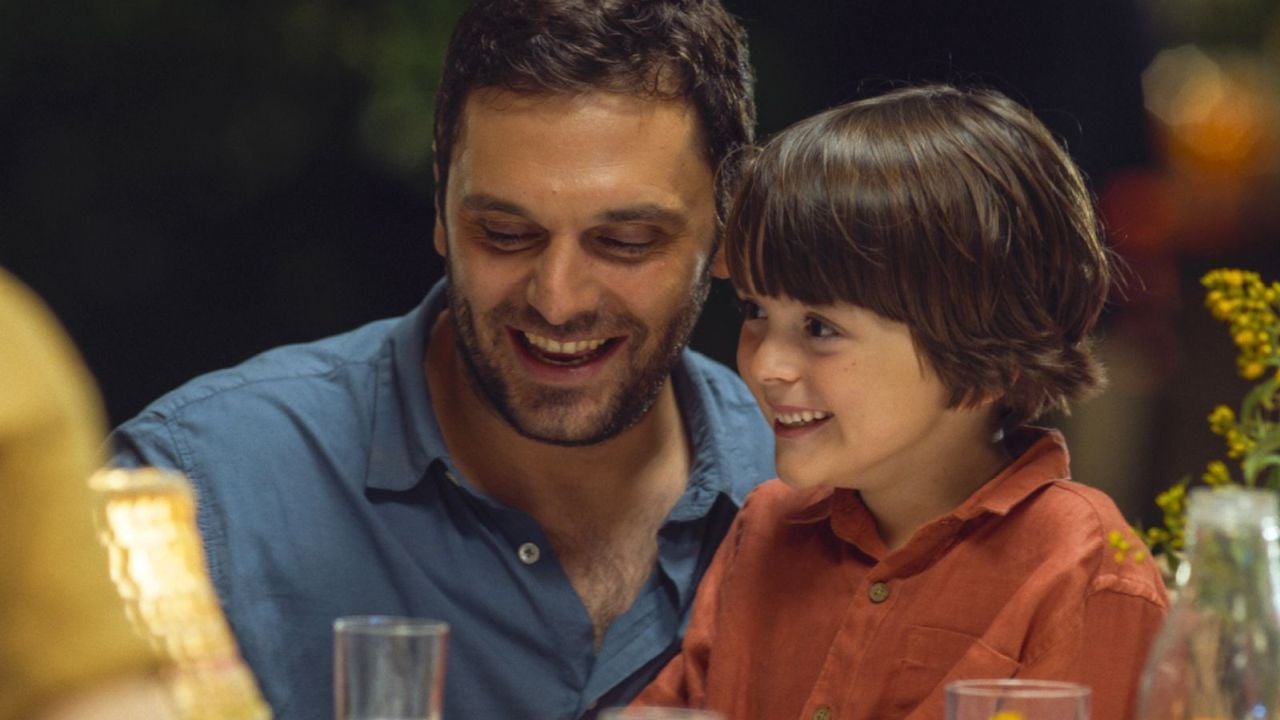
Alex (Pio Marmaï) unfortunately gets a lot on the script.
In her everyday observation, Tardieu proves a fine feeling for small gestures as well as for incomprehensible events and tragic events that completely reorganize life. “What connects us” is essentially a film about finding yourself and your role in life – despite or perhaps because of all the non -weigheability and setbacks. In the last 25 minutes, however, some situations and turns come to strive. If the events feel like it is overturned every minute and the conflicts appear too calculated and programmatic, then the credibility suffers. This is also reflected in some dialoglinia that seem too forced and placed in places. So much additional drama and emotional ballast would not have been needed, there was enough of that in the 80 minutes earlier.
In addition, some difficult -to -understand behaviors stand out negatively, such as Emilia and Alex. The figures sometimes get bogged down in less believable, contradictory behavior. Alex tends to have a certain famility in his decisions right from the start, and he is often irritated, which is also due to the extreme situation after the partner's loss. Nevertheless: A lot can be explained with an emotional imbalance due to the tragic events – but not everything automatically excuses.
Valeria Bruni Tedeschi is terrific
Alex actor Pio Marmaï, who acts devoted and precisely, is guiltless. It is the screenplay that his figure and another questionable decisions and such a rash (drive-controlled?) Proceed on the other way again that one wonders from a neutral observation perspective: Would that have really been?
This weakness is balanced by the impeccable cast. The (main) performers truly the emotional vulnerability of the characters thanks to a sensitive, expressive game. Above all, Valeria Bruni Tedeschi (“The Line”) is brilliant than Sandra, who never knows exactly how much closeness she can and what is perhaps too much. She plays this woman, who has to set up her own limits due to the changed circumstances, with no sorporation.
Conclusion: With sensitivity and precise everyday observations, the French-Belgian melodrama “what connects us” designs the image of an independent, unbound woman, whose life suddenly changes. Unexpectedly, she takes on the supportive role for a grieving neighboring family. The film, worn by a stabbing soundtrack, relies too much on calculated script incorrect in the final act, but previously convinces with an exciting, complex view of contemporary topics. It is about finding identity, overwhelming, coping with loss and trying to go your own way despite all social expectations.