
In the intense last half hour of Alex Garland's terrifyingly realistic civil war dystopia “Civil War”, it crashes huge: the units of the Western Forces To the Washington, DC, have penetrated to finally overthrow the dictatorial US President, who enters the White House with his last confidants. In an explosive battle, the troops work bit by bit under the protection of armored military vehicles.
Last but not least, the fact that these sequences of war appear surprisingly realistic is the participation of a person: As a military-technical consultant, ex-soldier Ray Mendoza, who had previously been involved in a similar function in “Act of Valor” and “The Outpost”, gave the stars on the set of clear instructions in terms of military tactics and behavior. The expert appearance of the expert also gave Alex Garland a lot of impression – and so he has Mendoza in his latest project “Warfare“Shouted to his co-director.
As authentic as possible down to the smallest detail
The war film is based on an actual commitment that Ray Mendoza experienced in the second Iraq war himself – in a way you don't know it from the cinema: Mendoza and Garland have done everything in their script together to reconstruct the events with the help of old photo recordings and interviews with the participants as well as possible. Even the smallest details, such as the identity of the primary supplier of a soldier with a broken leg, were researched as meticulously as possible, even though they don't actually play a major role. In some cases, the soldiers of that time were finally able to process traumatic experiences through the conversations.
Some of them even looked at the set on an old airfield outside of London with plenty of reunion, where production designer Mark Digby has reproduced a total of 13 (!) Buildings using operations and satellite shots. Appropriately, “Warfare” celebrated his world premiere in Los Angeles in front of an audience of war veterans and military members. Many critics have therefore described him as particularly realistic and honest – if not the superlative of the “realistic war film ever” was unpacked. But the refreshingly different concept also has some weaknesses.
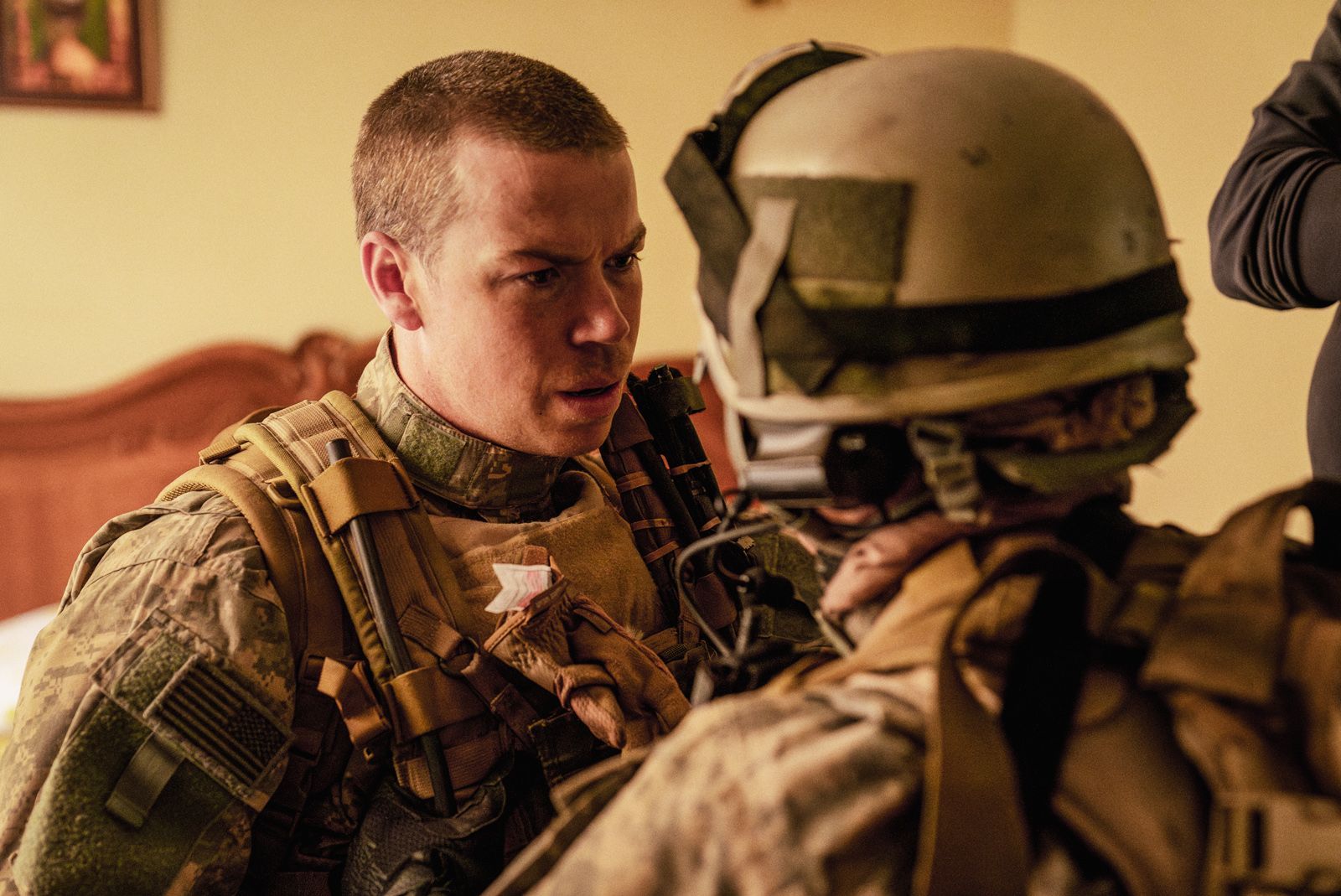
Captain Eric (Will Poulter) does everything to somehow pull his unit out of shit …
November 19, 2006, the second Iraq war rages: In the city of Ramadi, a Platoon from Navy Seals is to secure a commitment of the Marines. The squad around the young Captain Eric (Will Poulter) takes a position in a house and observes how the team in the house is spied on by potential enemies. These will soon be an attack, with the sniper Elliott Miller (Cosmo Jarvis) being hit in the hail of bullets. A so-called “Bradley” combat vehicle is requested, but destroyed by a explosive load immediately before the injured is removed. A total of two soldiers are seriously injured and have to endure with their comrades in the tense situation and surrounded by enemies in the house …
After a prologue in the meeting and setting up the position, the remaining film act of “Warfare” runs in real time-and the director's duo also rely on the greatest possible realism, which is also reflected in its sober production. This dispenses with glorifying pathos, heroic close -ups, slow motion and participation – which is why there is no film music between the ball hages. They also attach great importance to authentic behavior of the Navy Seals. So that certain routines, strategic understanding, military language or the handling of the weapon could be practiced, the actors had to go through a three -week boot camp before the filming started. Apparently, this welded together so much that in the first days of training they shaved each other the skull, as they were in interviews about the premiere.
As objective and unadorned as possible
But even if you can feel the comradeship of the troops created in the boot camp in “Warfare”, the characteristics of the soldiers from unity are very rudimentary. Tommy (Kit Connor) joined the unit at the last and just talks too much; Elliott is an experienced Haudegen with a preference for chewing tobacco – and Erik misses his blue hoodie. Much more personal can be learned between the steadfast radio sayings with position reports. D'Pharaoh Woon-A-Tai, known from the “Reservation Dogs” series, is most likely to stick out under the comrades as a radio operator Ray because he later has to grow beyond himself. Still noticeably shocked by an explosion and its devastating effects, he plays his despair in the treatment of a heavily bleeding comrade as committed as it is emotionally.
Overall, however, Garland and Mendoza mercilessly subordinate their claim to their claim after an objective-lively reconstruction of the events. For example, if even a room that is actually already abandoned is checked again and again on the equipment that is still lying around, even if it runs into nothing dramaturgically, but underlines the redundant care of the military. Elsewhere, however, they miss this consequence: How the position in the house in dawn set up and whoever had to die on the part of the Iranians is left out by a time jump – nor is the fate of the imprisoned Iraqi family after deducting the Navy Seals.
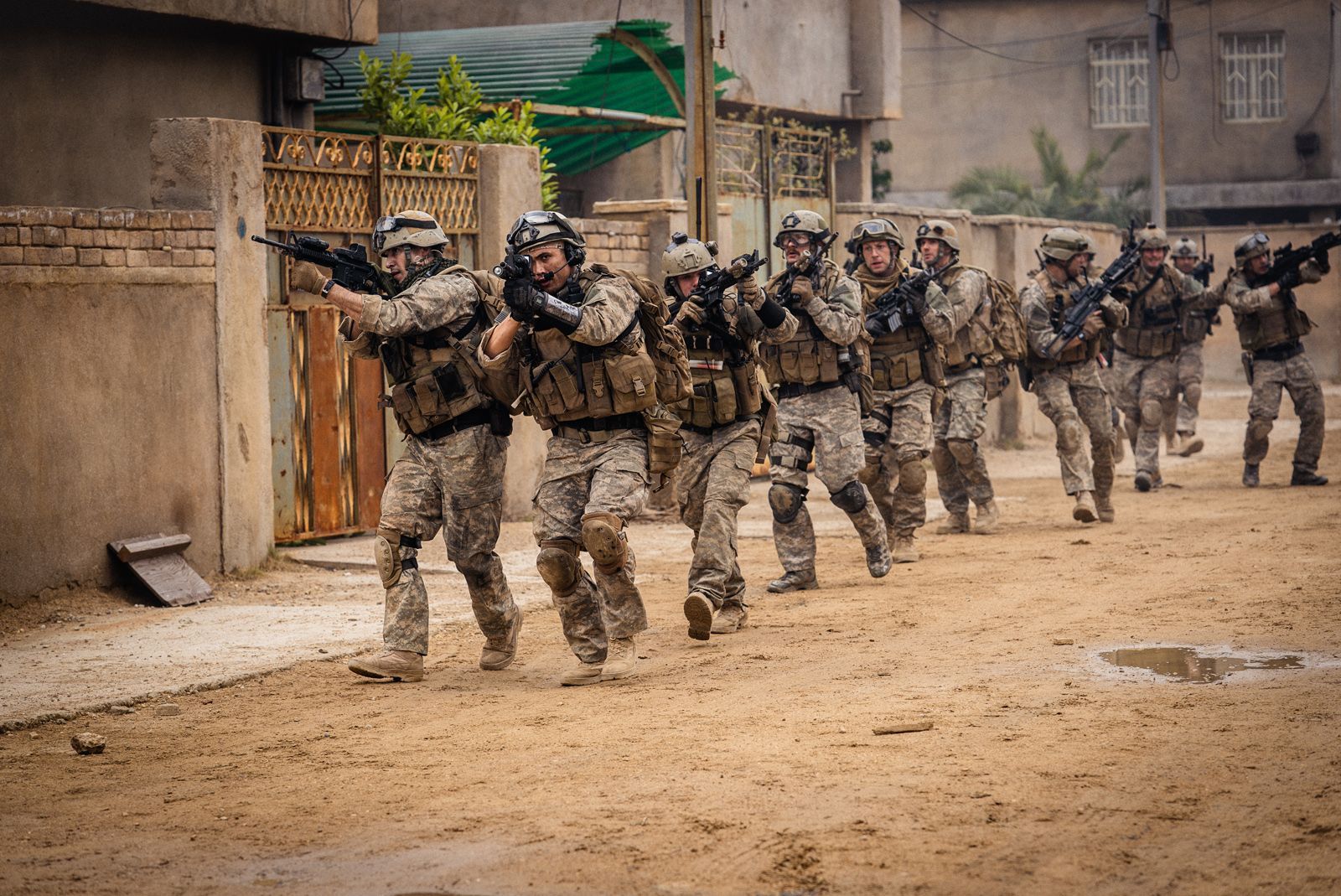
As in a real war situation, every movement should also sit perfectly on the set – this was necessary for this to prepare a multi -week boat camp as preparation.
“Warfare” is still stirring, especially if the film increasingly openly opened the ugly and brutal sides of the war after a first half of the first half. Cameraman David J. Thompson was already there at “Civil War” as a camera operator. Now he catches up with a perfectly timed sound cut on great immediacy, literally tangible war events with hail of balls and artillery fire in movable, but never nervous images. “Right in the middle of it, instead of just there”, seems to have been the motto here much more than in “Civil War”. The exposed radio sayings about possible evacuation strategies relentlessly reveal how cold, brutally and calculating war is waged – and in most cases it is not decided by heroes how Hollywood would like to know us.
Conclusion: his realism concept consistently pulls through the regio duo in its hem that exciting war film-this is how Alex Garland and Ray Mendoza in “Warfare” succeed in an impressively sober, sometimes even somewhat too detailed reconstruction of a dramatic stamp in the Iraq war.