In 1978, Theodore John Kaczynski addressed his first explosive mail to Buckley Crist, a professor of materials engineering at Northwestern University in Evanston, Illinois. It was the start of an 18-year series of bomb attacks in which three people died. The anarchist initially sent his bombs to university professors and airlines, and later also to other representatives of what he saw as the destructive progress of industrial society. To date, the investigation to capture the “Unabombers,” who lived hermitically in a forest hut, is considered the most expensive in the history of the FBI, involving up to 150 investigators and agents and costing around $50 million. It’s no wonder that this exciting chapter in US criminal history has already been reviewed several times.
While the four-part documentary series “The Crazy Truth About the Unabomber” uses archive footage to create a comprehensive psychogram of the radicalization of the former assistant professor into a serial perpetrator, the feature film “Ted K” (2021) fails because of a lack of a compass in terms of content. Three years after the death of the real Ted Kaczynski in prison, the fictionalized Netflix production “Unabomber” now tries to approach the topic primarily through suspense. The plot comes to a head in a long-distance duel between a profiler and the serial perpetrator.
Although “Star Wars: Andor” director Janus Metz masters action and suspense solidly, the thriller drama is too overambitious with its two time levels. The author team Sam Chalsen and Nelson Greaves, who already worked together on the series “Sleepy Hollow”, tells on the one hand about the investigations that ultimately lead to Kaczynski’s capture. On the other hand, “Unabomber” looks back on his Harvard years and looks for the psychological and ideological roots of his later development. Despite the frighteningly committed performances from “The Life Of Chuck” star Jacob Tremblay and Oscar winner Russell Crowe, these two different parts of the film never quite come together.
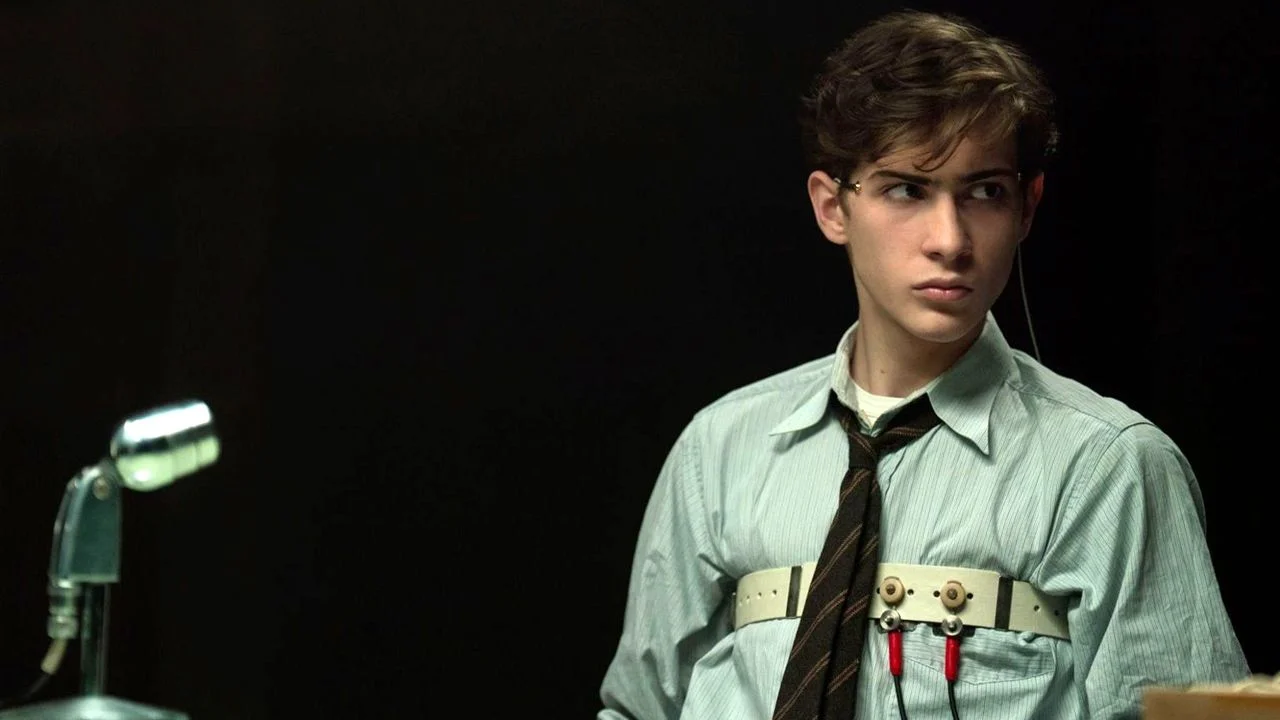
Jacob Tremblay is frightening, but his performance doesn’t answer the question of how this young man became the Unabomber.
Shortly after the “Unabomber’s” manifesto was published in several newspapers in September 1995, the FBI received an explosive tip: David Kaczynski (Matthew Kevin Anderson) claims to have recognized parallels in the writing style to the essays of his brother Ted (formerly: Michael Laurence), who has been living in seclusion in a small cabin in the forest near Lincoln, Montana, for years. While her colleagues dismiss this evidence as unfounded and pursue a different perpetrator profile, linguistic profiler Joanne Miller (Shailene Woodley) is convinced that she has found the perpetrator. On her own initiative, she begins to target him…
This exciting hunt is interrupted by continuous flashbacks to the early years of the young and reserved mathematics student Ted Kaczynski (young: Jacob Tremblay), who in 1958 at the elite Harvard University followed the charisma of the eloquent psychology professor Henry Murray (Russell Crowe) he is lying. Under the pretext of a debate competition, he secretly uses the philosophically interested student as a test subject for a multi-year study commissioned by the CIA using the humiliating Thematic Apperception Test (TAT), which increasingly causes Ted to suffer psychologically.
There is no answer to the most exciting question
The flashbacks show how the shy and socially awkward Ted increasingly changes. He becomes more aggressive, loses himself more and more in his social theories and ultimately alienates his family environment. For example, at the dinner table he angrily belittles his father, a butcher, when he criticizes his grades. But there are almost 20 years between this development of the young Kaczynski, which ends in his outright turning away from life in civilization, and his first attacks with the mail. How did the psychologically damaged and increasingly ideologically hardened young man finally become the violent assassin? How did the later assistant professor of mathematics become so radical that he started sending bombs? This exciting question remains largely unanswered in “Unabomber”.
What “Unabomber” actually shows from Kaczynski’s early years, however, exerts a disturbing fascination in the dark images with a sepia look. This is also thanks to the strong cast in this second level of action. The extremely versatile Jacob Tremblay traces in a nuanced way how young Ted becomes increasingly involved in philosophical constructs and social theories and increasingly loses his footing. Opposite him is Russell Crowe, who seems to have taken a liking to smug and cunning characters after his role as Hermann Göring in “Nuremberg”. Between eloquent lectures on the metaphors in Herman Melville’s “Moby Dick”, jovial receptions and selected sleaze – for example when he is caught in flagrante delicto with his long-time colleague – Crowe gives his character an attractive ambivalence.
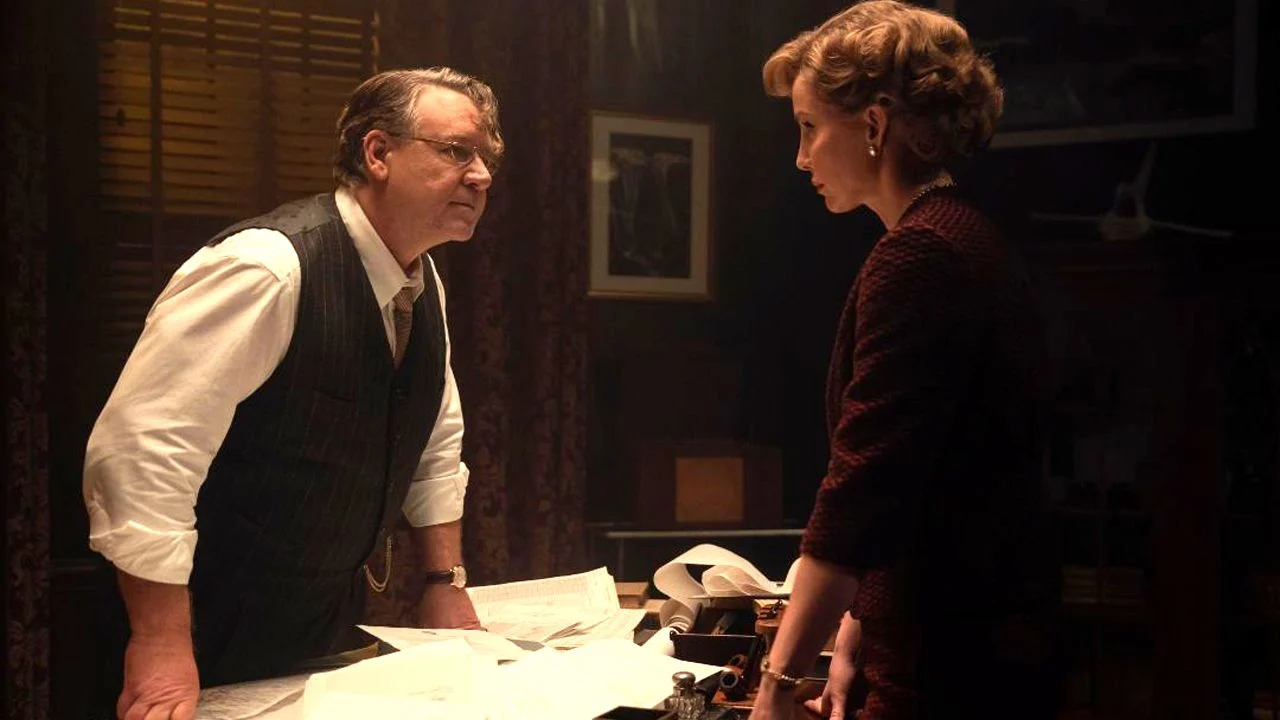
Russell Crowe can play big again.
But real connections between the two levels of action rarely emerge. The young Kaczynski is increasingly convinced of the ruin of industrial progress and runs with his convictions just as vehemently against all resistance and critics as the fictional FBI linguist Miller did decades later. Beyond that, the parallels remain manageable.
Above all, the character, who acts here as a replacement for the real profiler James R. Fitzgerald, who managed to convict Kaczynski, remains surprisingly interchangeable. The narrative freedom of a fictional character is hardly used: there is no discussion of their motivation, nor is there a closer look at their private life. As a result, it has little profile, which contributes to the fact that the entire thriller plot set in the 90s remains overly functional and accordingly generic. This is also reinforced by the thick, dramatic string score by Marco Beltrami (“Scream 7”).
Conclusion: The hunt surrounding the capture of one of the most notorious serial criminals in the USA is recounted according to plan F, while the flashbacks to Ted Kaczynski’s younger years develop much more depth and fascination. So the balancing act between exciting thriller and oppressive psychogram only succeeds in phases, despite the playfulness of Jacob Tremblay and Russell Crowe.