
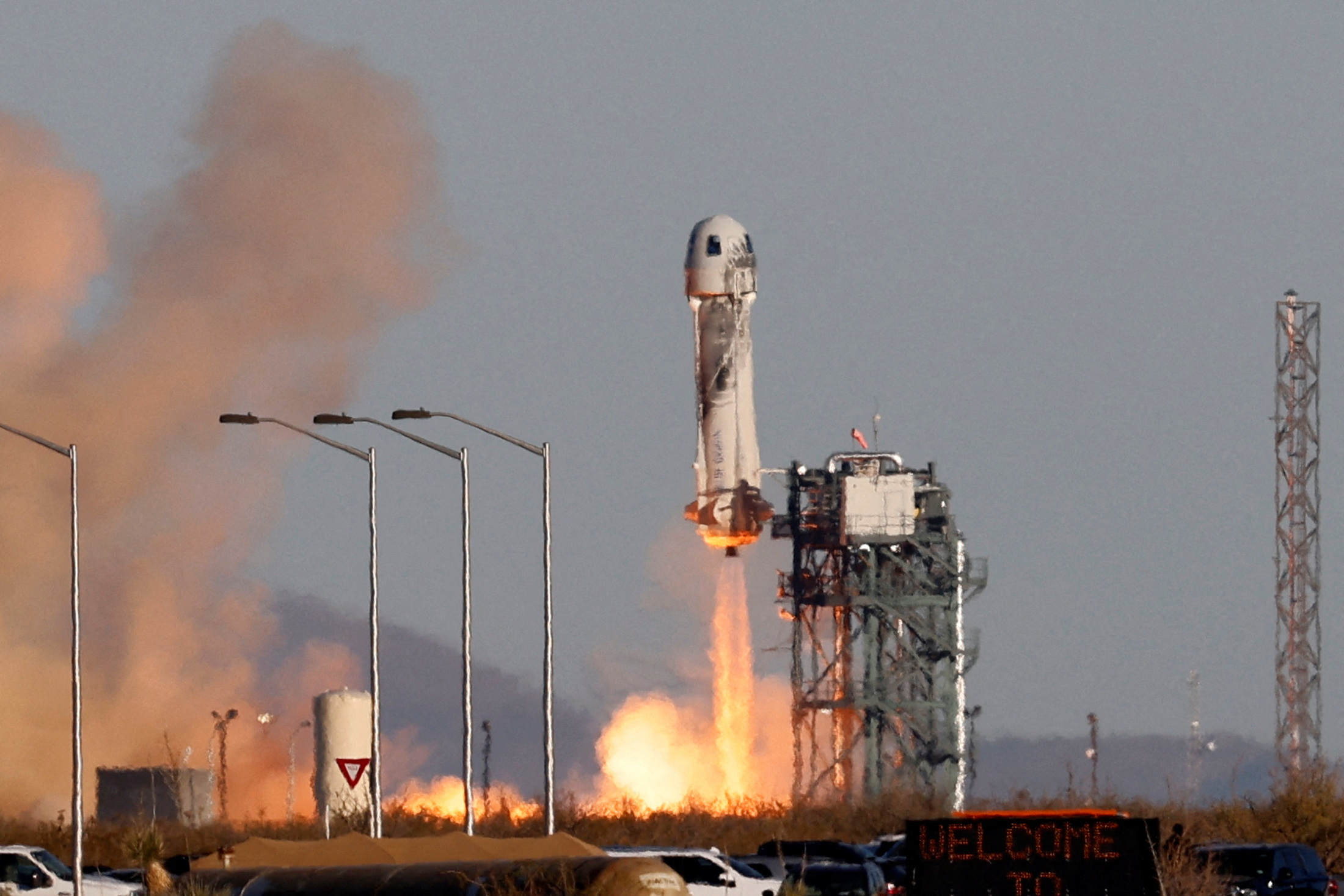
Celebrities such as William Shatner, Jesús Calleja and now Katy Perry, have not wanted to miss the opportunity to travel to space, generating media interest and contributing to the normalization of space tourism.
Last week, Blue Origin confirmed that singer Katy Perry will travel to space aboard the New Shepard. The news, without a doubt, opens the door to reflect on whether these trips are just a luxury reserved for millionaires or are the first step towards a new era of space exploration that, eventually, can be accessible to all.
Perry thus adds to a list of celebrities who have already experienced the ingrability on the border of space, such as actor William Shatner, famous for his role as Captain Kirk in Star Trekwho with 91 years became 2021 in the oldest person to travel to space.
“It was the deepest thing I have lived. Seeing the earth from space is a reminder of how fragile and beautiful our existence is,” said Hollywood star.
More recently, the Spanish television and adventurer Jesús Calleja also completed this experience, which he described as “one of the most shocking of his life.”
“Looking at the earth from above changes your perspective. You realize how fragile our planet is and how we are all connected. It is an experience that makes you value life and the world in which we live,” he said after his return.
The rise of space tourism
“What we are seeing now is the birth of an industry. It is not very different from what happened with commercial aviation in its beginnings, when only the richest could afford to fly,” said Manu Mazzanti, editor of Explorationspacial.news and one of the most authorized voices in the United States on the dissemination of space missions.
“At that time, flights were an unattainable luxury for the majority. Today, taking a plane is something everyday. The same will happen with space trips,” he told the Voice of America.
The expert emphasizes that the role of celebrities on these trips also meets a strategic purpose.
“When a famous character like Katy Perry goes to space, great media attention is generated. That can arouse the interest of new generations for space exploration and science. It is not just a matter of money; it is part of a strategy to normalize these trips and make the public see them as something attainable,” he said.
Accessible, for now, only for some pockets
Although the price of a suborbital trip with Blue Origin around one million dollars, the physical requirements to participate are not as restrictive as one might think.
“A astronaut training is not needed. If you do not have serious heart problems and you can endure forces like that, you can do it. Jesús Calleja, for example, said that the most shocking moment of the trip was the transition between ingrability and the return to terrestrial gravity, something that described as' a brutal, but unforgettable shake,” Mazzanti recalled.
Suborbital trips of companies such as Blue Origin and Virgin Galactic offer only a few minutes of anxiety, but there are already plans for longer experiences in orbit. “We are seeing how Spacex, for example, is working on missions of several days that could carry tourists around the earth without having to attach to the International Space Station,” said Mazzanti.
“These orbital missions are still extremely expensive, but they mark the way so that in the future space tourism is common,” he added.
The role of the private sector
In addition, in recent years the private sector has played a key role in space exploration. Companies such as Spacex, Blue Origin and Virgin Galactic are adding efforts to boost new projects outside the Earth, something that from the Aeronautics and the United States space (NASA (in English) have received with pleasure.
“NASA has acknowledged that it needs the support of private companies for its missions. Spacex, for example, not only transports NASA astronauts, but also offers commercial flights and private missions, such as the future Fram2, which will be the first to orbit on the land poles,” said Mazzanti to show how this sector has been growing in recent times.
Private missions have also opened the door to new opportunities. “In the coming years, we will see commercial stations operated by companies such as Axiom Space, Starlab and Vast. NASA even plans to rent modules in these stations to continue its investigations when the International Space Station stops operating in 2030,” said Mazzanti.
“It would not be unreasonable to think that a hotel chain could install a space module for tourists. (The Hilton chain) has already shown interest in it,” he predicted.
Future plans
Space companies insist that their goal is to democratize access to space in the relatively close future. “We want anyone to travel to space in the future,” Blue originated in several communications. Virgin Galactic, on the other hand, emphasizes that “each launch brings us closer to make space a habitual destination.”
According to Mazzanti, the trend becomes increasingly evident. “Right now, these trips are reserved for a few, but that will change. As technology progresses and economies of scale are achieved, costs will decrease. In about 20 or 30 years, it could be as common as taking a plane,” he said.
Even the expert consulted by the Voa He said that it would not be so far -fetched that in a not so distant future, it could be normal for space travelers to even reserve their tickets in tourism agencies and choose between different experiences of experience in space. “What seems crazy today, in a few decades could be part of everyday life,” Mazzanti concluded.
But it will be time to wait. For now, space trips remain a luxury.