
What if war were imminent in an already broken Europe? Director Nicolas Ehret already dealt with the aftereffects of social upheaval in his short film “The Red Bicycle”. His debut feature film “Tomorrow Was War” follows on from this atmospherically and thematically, but expands the view to an oppressive vision of the future in which private conflicts and political radicalization fuel each other.
Instead of showing larger social connections, Ehret concentrates on the fate of a family that is overwhelmed by developments. From this conscious limitation, the film develops a permanent threat that is expressed not in explosions but in an omnipresent fear of the future. The dystopia in which democratic certainties are eroding while mistrust, violence and mutual surveillance determine everyday life seems less like science fiction than like a (only slightly) shifted version of the present.
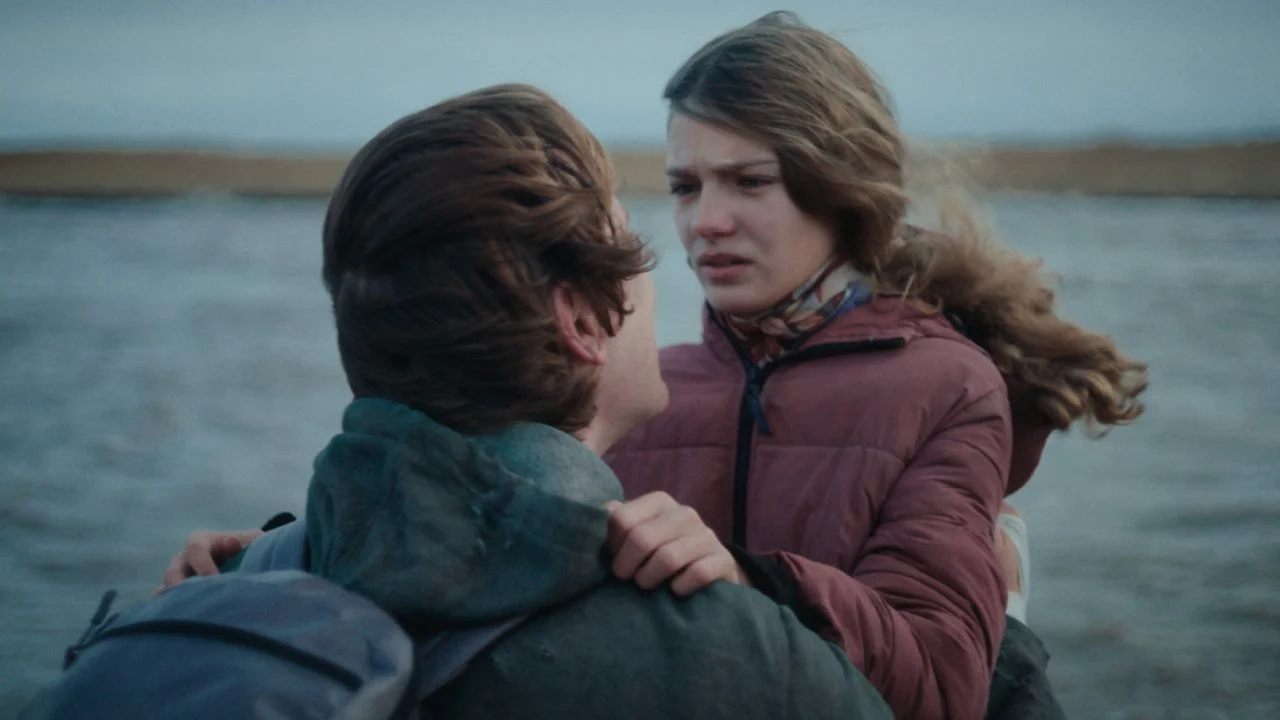
Jonas (Enno Trebs) is on the run from military service with his little sister Leonie (Naila Schuberth).
Germany is on the verge of war. After the collapse of the European Union, a right-wing populist government took power and is mobilizing the population for the impending emergency. When 33-year-old Jonas (Enno Trebs) is about to be drafted into military service, he decides to escape with his eleven-year-old half-sister Leonie (Naila Schuberth), for whom he has been responsible since the death of their parents. He seeks refuge with his father Stuber (Ulrich Matthes), with whom he has not had any contact for many years.
The nagging grandfather lives in the attic as a nursing case. Meanwhile, Stuber’s partner Wibke (Susanne Bredehöft), who is active in the local vigilante group, supports the construction of the border fence on the Oder. Tensions within the family and between generations are therefore constantly increasing. When refugees finally show up at the border river, moral convictions and family bonds are finally put to the test…
Everything is getting tighter and tighter
“Tomorrow Was War” has its greatest impact through the desolate atmosphere that surrounds the film like a thick fog. Nicolas Ehret and “Looking into the Sun” cameraman Fabian Gamper create a gloomy Germany whose social decay is already noticeable in the images. The square image format condenses the claustrophobic atmosphere, while desaturated colors and cool interiors paint a world from which all forms of security have disappeared. Dramaturgically, however, Ehret does not consistently succeed in developing an equally captivating story from his exciting scenario.
As the melancholic protagonist, Enno Trebs (“Miroirs No. 3”) convincingly embodies the uncertainty and restlessness of his character. His Jonas is not a classic hero, but a man who feels powerless and hopeless in the wake of social upheaval. With a lowered gaze and a questioning facial expression, Trebs conveys the insecurity of a generation that is being overwhelmed by political developments and is increasingly losing its moral compass. Susanne Bredehöft (“Lovers”) portrays Wibke particularly impressively. It gives her a perpetual unpredictability. Friendliness and latent threat are close together in their gestures and words.
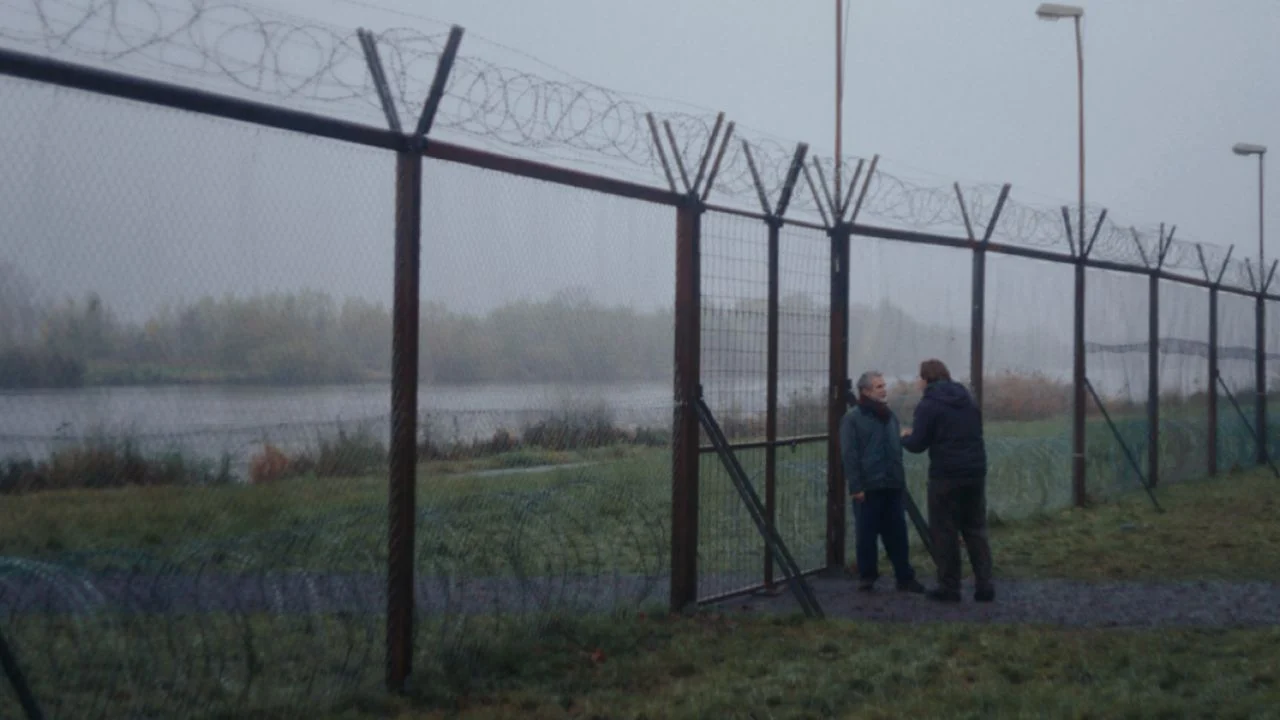
A new border fence is to be built not on the border with Mexico, but on the Oder.
Ulrich Matthes (“Downfall”) uses his usual reserved playing style to give his Stuber nuances. Emotional moments arise particularly in the interaction with Naila Schuberth (“Dear Child”). While the others are increasingly broken by the omnipresent mistrust, a cautious closeness develops between the old ferryman and the young Leonie, which briefly gives rise to hope for mutual understanding. After the strong opening, however, the film repeatedly loses itself in individual encounters, which contribute to the general disorientation but slow down the narrative flow.
The fact that Jonas himself wanders through this world is clearly reflected in the narrative. At the same time, the larger social picture falls out of focus. How the political system works, who is actually fighting against whom and why the escalation can hardly be stopped, remains deliberately vague. This increases the feeling of chronic uncertainty, but also makes the future scenario seem somewhat arbitrary.
A lot of things are (too) clear
The characters also sometimes seem less like independent characters than like representatives of different generations and attitudes. The war here doesn’t just run along political fronts, but also through a family. Jonas’ generation is described several times as one that only experienced peace and prosperity. However, this symbolism is sometimes formulated a little too clearly in the script and takes away some of the characters’ ambivalence.
The moments in which Ehret trusts the images alone are all the more impressive. After refugees are stopped by a vigilante group, the camera remains almost motionless on a fog-covered street. Between scattered luggage and motionless bodies, a tableau-like image emerges in which guilt and uninhibited violence simply stand and work for themselves without a single explanatory word.
Conclusion: With his dystopian feature debut “Tomorrow Was War,” director Nicolas Ehret draws an oppressive warning scenario in which trust and understanding are lost even within the family. With its ominous atmosphere and references to current political and social developments, the meandering film explores the speechlessness between generations and the hopelessness of a time of imminent war.
We saw “Tomorrow Was War” as part of the Munich Film Festival 2026, where it celebrated its world premiere.