
When it comes to film adaptations of historical events, one often wonders what they say about today – and so some film critics also notice an effort to create a connection to the present. But in the case of the peasant uprising blockbuster “The Uprising” the references are obvious. After the project has been haunting Hollywood for years as “The Hood” with Benedict Cumberbatch and “The Rage” with Matthew McConaughey, it is now hitting theaters at just the right time. A number of the most liked comments under the trailer, which collected 100,000 thumbs up on YouTube in the first month alone, point to the undeniable topicality of the material.
Shortly after the top-ranked dad-joke statement that Andrew Garfield (“The Amazing Spider-Man”) can finally be seen in a real “Field,” the realization follows: “The timing of this film couldn’t have been more perfect!” And in fact: Precisely because you can’t help but constantly think about the global protest uprisings of the past few years and the simmering that seems increasingly threatening in almost all societies, “The Uprising”, which was largely shot in Germany and features 5,000 (Bavarian) extras, immediately captivates you – even if “The Bourne Conspiracy” director Paul Greengrass makes it worryingly easy in some places with his long-legendary hand-held camera immersion makes.
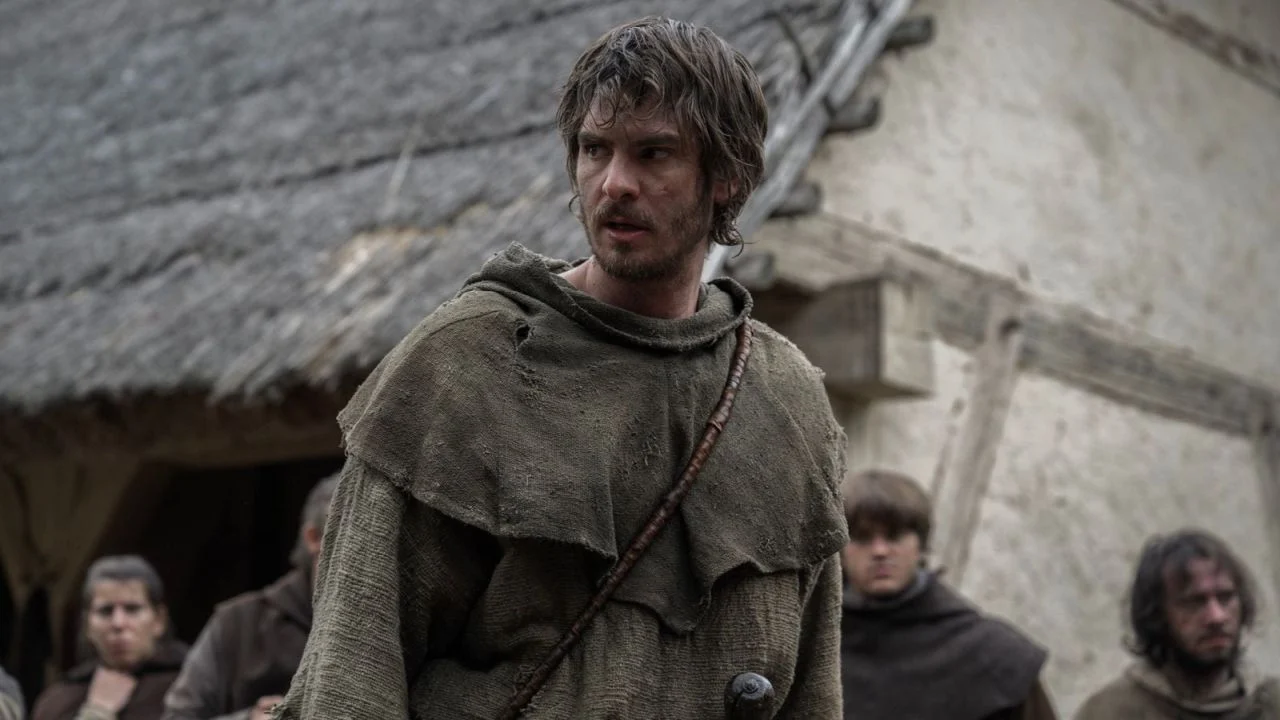
The nameless protagonist (Andrew Garfield) represents thousands of ordinary people who marched towards London in 1381.
After his wife and children are killed by the plague, the farmer (Andrew Garfield), known to everyone as “Plowman,” has nothing left to lose anyway. When the royal tax collectors want to collect the once again increased poll tax – including for the rest of his family, whose death he cannot provide written proof of – Plowman’s collar bursts. Normally such a freak out would cost him his head, but this time the whole village gets behind him – and the soldiers who soon follow are also killed or forced to flee. There is finally no turning back…
… and so Plowman joins the peasant rebellion led by the charismatic craftsman Wat Tyler (Cosmo Jarvis) and the radical priest John Ball (Jamie Bell). The revolutionary group grows ever larger on its march to London, although not all sub-groups pursue the same goals. Their plan: They want to personally present their proposals for fairer laws to the 14-year-old King Richard II (Woody Norman), because in the eyes of the insurgents, who still believe in the monarchy, he is essentially being held captive by his own, power-hungry advisory staff and shielded from the real events outside in his country…
The straw that breaks the camel’s back
As a reminder of his dead family, Plowman made straw dolls – one larger and two smaller ones. And when the tax collectors not only bag the last of the village’s food supplies, but also reach between the legs of all the young women to check whether they too are mature enough for the tight poll tax, it is clear after the first ten minutes why only one last little spark was missing to make the people explode. Paul Greengrass doesn’t spend long on the derivation, but instead plunges straight into the medieval crowds. Always with you: a shaky camera that expresses its authenticity!
As in “Bloody Sunday” about the Northern Irish Bloody Sunday of January 30, 1972, or “Flight 93” about the terrorist attacks of September 11, 2001, the British director also treats the farmers’ revolt as a contemporary historical event, which he tries to get as close as possible with his documentary-like gesture. “Right in the middle of it instead of just there,” is how the marketing department of a German sports channel might describe the style. And even if the events in this case happened not a few years ago, but more than six centuries ago, this direct approach fits so well because the omnipresent anger also feels so contemporary.
A clean man in the bloody mud
In contrast to the storming of the Capitol, Greengrass leaves not the slightest doubt from the outset that the storming of London is fully justified. Even the mass murder of Flemish merchants and their families, which was motivated by xenophobia, is briefly mentioned but then quickly dismissed as a seemingly necessary evil. Nevertheless, you keep your fingers crossed for the insurgents – especially if you don’t immediately have the real outcome of the historical events ready. “Come On, Come On” discovery Woody Norman also embodies the child-like ruler as a mixture of traumatized ally and power-hungry psycho, so that you can never be sure how he will act in the end just based on the events on the screen.
However, one looks in vain for a similar ambivalence in the Plowman: as a fictional identification figure for the audience, he only ever does exactly what is morally required. In addition, the simple farmer, exhausted from the march, later turns out to be a film hero who is both sophisticated and physically superior in battles with well-trained and heavily armed soldiers. And because Greengrass doesn’t want to let his audience leave the cinema in a worse mood than necessary, he finally makes a daring turn to a completely different English folk legend with Plowman. For how muddy, bloody and all around chaotic the whole thing was, this is literally overkill.
Conclusion: “The Bourne Conspiracy” mastermind Paul Greengrass plunges into the turmoil of the peasant revolt in 14th century England with his documentary-like handheld camera – a stylistic hit that immediately conjures up fascinating parallels to today’s uprisings from the Arab Spring to the storming of the Capitol. Only the all-too-clean hero drawing of the protagonist embodied by Andrew Garfield doesn’t really fit into this all-encompassing, bloody, muddy chaos.
PS: After completing this review The US distributor has revealed the final twist of the film itself – through a new subtitle as well as social media clips that preview the final three minutes. Apparently the hope is that this will generate greater public interest. However, the film itself is obviously designed so that you don’t know this part in advance. We will therefore continue to refrain from going into the twist – even if almost everyone has noticed it by now anyway.