
There was a phase in the 80s in which body swap films were very popular: Films like “Big” or “Finally 18 Again” varied this idea and sometimes let children grow up overnight or older people slip into younger bodies. While these were mainly enjoyable genre games, in more sophisticated cinema, directors such as Michelangelo Antonioni (“Profession: Reporter”) or Alfred Hitchcock (“Vertigo – From the Realm of the Dead”) also worked with doppelganger motifs or the desire to be someone else. One can assume that the French author and director Arthur Harari sees himself more in the tradition of these film artists when he lets his characters change bodies in his third directorial work “The Unknown”.
But the work of the filmmaker, who is best known to us as the Oscar-winning co-author of “Anatomy of a Case” (directed by his wife Justine Triet), lacks the class of great role models. He therefore neither succeeds in elevating the exalted construct philosophically, nor does he show any real interest in genre films in order to tell the promising approach in an exciting way.
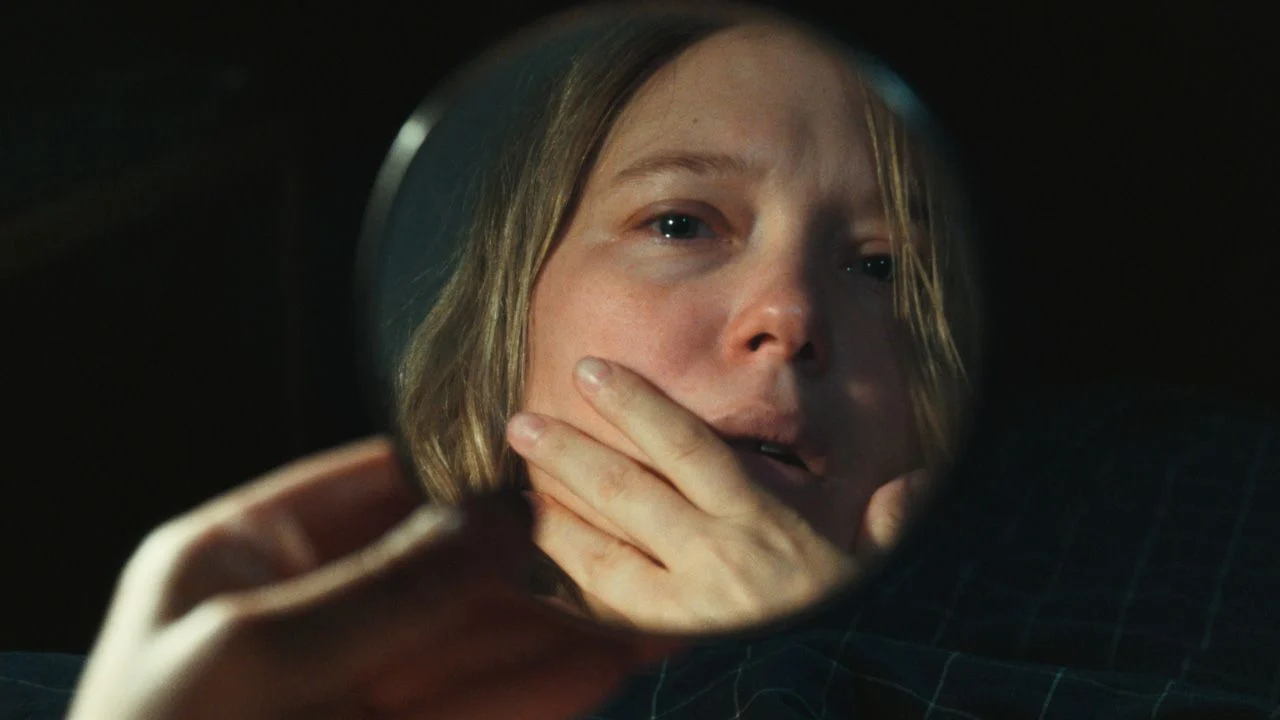
David uses a mirror to explore his new female body (Léa Seydoux).
The artist David Zimmermann (Niels Schneider) lives in modest circumstances in Paris and photographs places that his father once depicted in order to capture the changing times. David only leaves his apartment for his art. When his friends persuade him to go to a masked party, he doesn’t just seem out of place there because he’s the only one not wearing a costume. He still takes a drug that was offered to him before he discovers a fascinating woman (Léa Seydoux) in the crowd. He follows her and sex ensues.
But after the act, David finds himself in the woman’s body, which he only realizes when he wakes up the next morning with a hangover. He remembers having seen her before and even photographed her. The search he begins then reveals her identity quite quickly: her name is Eva and she comes from Germany. Soon he can even track his own body. But it is not Eva who is in there, but a young woman named Malia, who also had sex and then swapped bodies with a stranger and now no longer dares to go home to her father (the celebrated director Radu Jude in a supporting role).
A thriller start without a thriller
From now on, when the duo sets out on a search together, you believe for a brief moment that the hunt for a mysterious creature that only changes bodies through sex begins. That sounds like the start of a genre film – but that’s not what Arthur Harari had in mind. What instead? This is never clear in the film, which is far too long at 139 minutes. Harari scatters many signs and distributes rows of hints. But in the end, the individual parts don’t add up to a big whole – at least not a convincing one.
It becomes clear that the filmmaker wants to tell about memories, about the psychological consequences when you (or a woman) suddenly find yourself in a different body – even a different gender. David curiously explores his femininity. Later, Malia, trapped in David’s body, will complain about the smell of her new appearance, which repulses her so much that she doesn’t even want to shower. Things get particularly bizarre when David realizes that the body he is carrying is Eva’s pregnant – presumably from having sex with himself.

When photographer David (Niels Schneider) sees a woman at a party, everything begins.
So did David essentially impregnate himself? Would he be father and mother in personal union? The extreme construct of “The Unknown” allows us to raise such strange but exciting questions again and again. But Harari has no interest in taking his approach even remotely to a concrete point. Unlike, for example, the “Anatomy of a case“, where the question of guilt of the main character played by Sandra Hülser remains unanswered until the end, the failure to answer central questions has no narrative added value. Instead, the conscious foregoing of answers, of a concrete dissolution of the construct, seems like an escape, perhaps also like the inability to play with genre patterns, to lead them to a narratively satisfying end, but still to charge them philosophically.
Conclusion: Arthur Harari plays with genre patterns in “The Unknown”, but is actually not interested in them. The construct of identities changed after sexual encounters remains a gimmick that seems interesting in the beginning, but ends up being nothing.
We saw “The Unknown” at the 2026 Cannes Film Festival, where the film had its world premiere as part of the official competition.