
There is a record to record: 2 meters and 75 centimeters! That’s how big Wal-Traut, one of the characters from “The Rainbow Fish,” is. The nine kilo whale, dubbed by Hella von Sinnen, is the largest puppet in the history of the Augsburger Puppenkiste. And that’s not the only reason to be amazed! When the famous wooden flaps of the doll’s box open at the beginning and reveal a view of an artificial sea, it should immediately exude nostalgic retro charm for all adults. But the real magic begins with the dive: in the underwater world, the film proves that it also has what it takes to inspire new generations for this impressive fusion of cinema and puppet theater.
In its long tradition and success story, the Augsburger Puppenkiste has repeatedly worked with the film and TV industry. Since the 1950s, a long list of short and long puppet theater films and television productions has been made. The adaptations of “Jim Knopf” and “Urmel aus dem Eis” are just two iconic examples. However, none of it has been shown in cinemas recently. The last production “Ghosts of Christmas” was around eight years ago. For the comeback of the doll box on the big screen, a real children’s book classic has been chosen: “Rainbow Fish”.
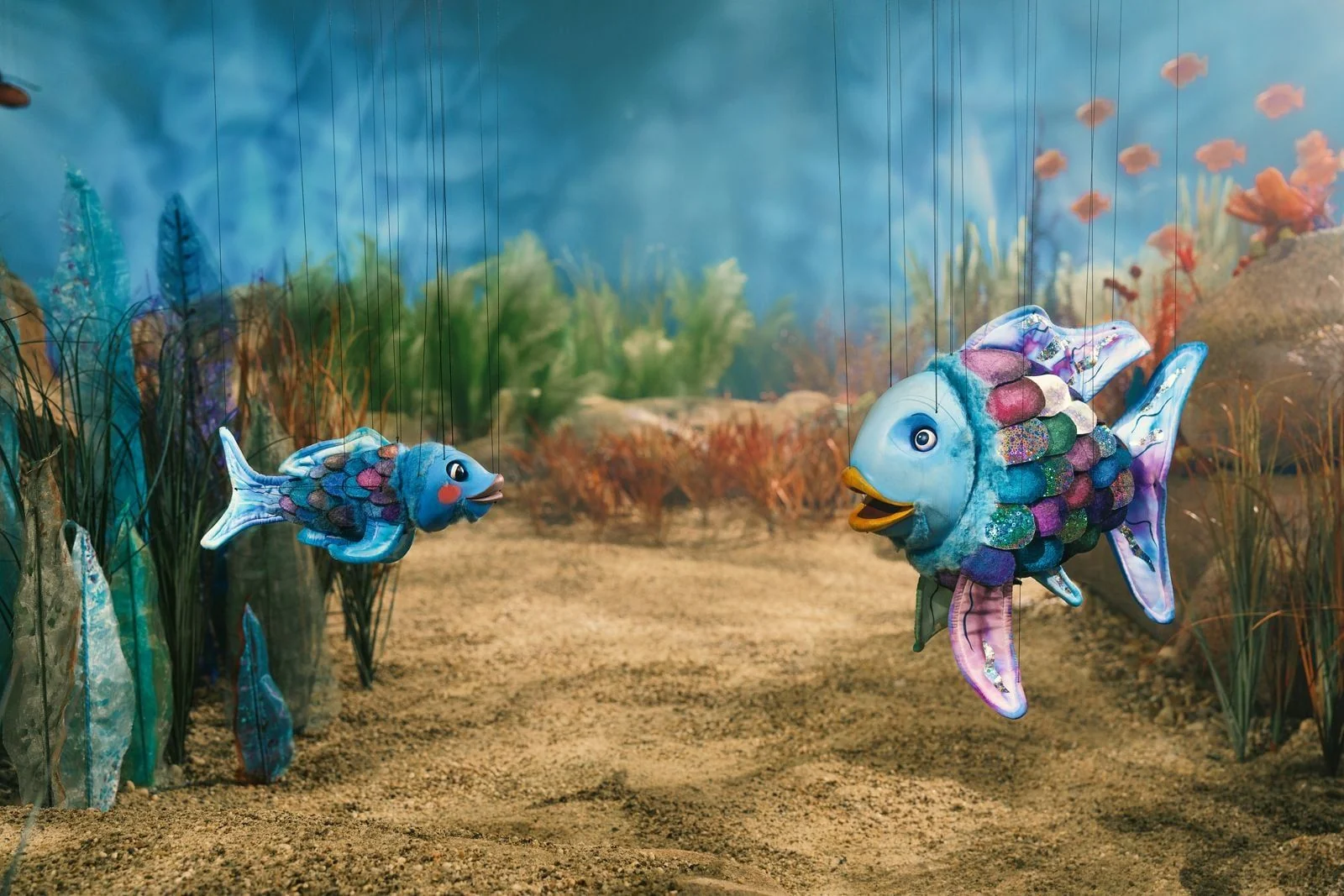
The visible threads are a trademark of the Augsburger Puppenkiste – fortunately no one came up with the idea of removing them using CGI.
An entire franchise grew out of Marcus Pfister’s template from 1992. The picture book has sold millions of copies. The rainbow fish appears in other books, radio plays, several films and an animated series. However, the new film adaptation by director, author and puppet maker Florian Moch now has a big hurdle to overcome. After all, the literary source is only a few pages long. So you have to be inventive to embellish the material and stretch it into a good hour film.
First of all, the problem of vanity remains. The rainbow fish (voice: Jannik Schümann) cares little about the other sea creatures. At least he has problems connecting with their social activities. He doesn’t take part in games. He also has a hard time helping because he doesn’t want to damage his beautiful scales. He loves looking at himself in the mirror and finds himself, as he sings, “super duper sparkly fantastic.” But then misfortune happens: the rainbow fish loses one of its scales. So he sets off on a journey into the deep sea with the fish Little Blue (Luna Wedler) to find the gem again…
The threads are quickly forgotten
Visually, “The Rainbow Fish” is gorgeous to look at! Not only the different animals, but also the landscapes on the seabed are a feast for the eyes. The first, sliding tracking shot, which gradually introduces individual places and figures, is an incredibly fascinating immersive spatial exploration. Ultimately, the film is above all an elaborate handicraft, an old-fashioned but by no means hackneyed hand-made cinema. You can see the immense attention to detail and the processed material in every shot. The theatricality of the puppet box itself becomes part of the game when another stage for musical theater suddenly opens up on the underwater stages. Singing interludes are also elementary for this “rainbow fish”. Theater within a theater, you could say.
And yet, of course, it is precisely the cinematic aspect that shows its charm when it comes to the various changes in perspective, the experienced size and closeness to the small-scale creatures and stage sets. To dismiss all of this as just filmed theater would be far too short-sighted. Six circular backdrops with a diameter of six meters were used here, each of which was played with the puppets from a bridge. And even in adulthood, you can be amazed at how quickly you get caught up in the whole illusion, how quickly you forget that there is actually just some wood, felt and silk fidgeting on visible strings in front of the camera.
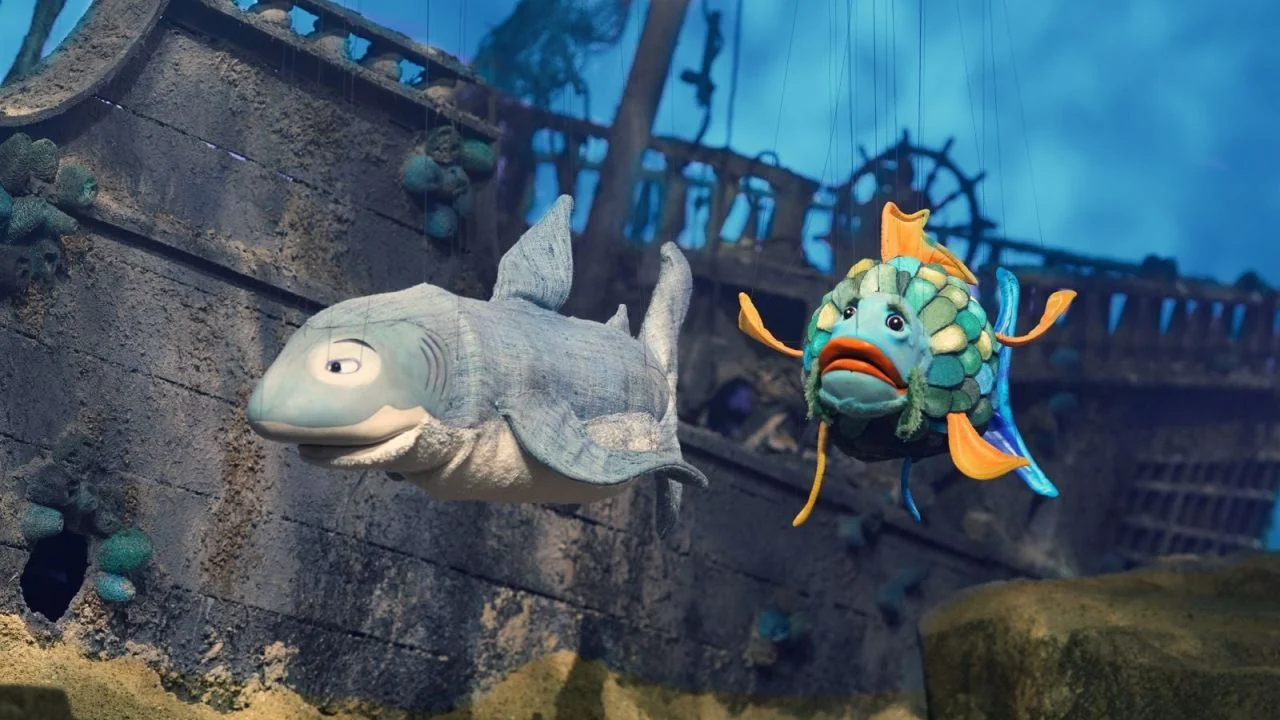
Even the appearance of a shark does not prevent “The Rainbow Fish” from being suitable for even the youngest cinemagoers.
But how does the short story read work in feature film length? Well, the decoration is not 100% convincing. One can give the film positive credit for the fact that, as a children’s and family production, it is told in a pleasantly calm, calm, decelerated manner, but there could have been a little more conflict. There are a few dangers, such as an encounter with a shark or a confrontation with a poisonous jellyfish in the neon-colored, fluorescent deep sea, but you won’t find any real climax or excitement in the loosely arranged stations.
That wouldn’t be a huge problem in itself if it was mainly about getting lost in the hand-made imagery and simply watching everyday life underwater. But “The Rainbow Fish” tries to tell the story of a character transformation through the journey of its title hero, as in the original. You don’t want to break away from narrative cinema. This is exactly where the shaky framework of the plot begins to falter.
The criticism of the template is skillfully avoided
This story is about forming a community. Friendships are formed. You learn to open yourself up to others and throw old enemy images overboard. You question your own thinking and isolation. Ultimately, on the theater stage you sing and dance about what is special and the value of the individual. “The Rainbow Fish” has always been a didactic material about sharing, giving away and redistributing privileges to the less privileged.
What is interesting is that in recent years there has been criticism of the classic as to whether it promotes buying friendships too much. The film adaptation of the Augsburger Puppenkiste now skilfully avoids this area of attack by simply tweaking the sequence of events a little. Everything appears in a new light. But how forgiveness and morality are supposed to be constructed from now on seems a bit clumsy and knitted with a hot needle.
Conclusion: With its thin dramaturgy, “The Rainbow Fish” struggles to reach its final moral about tolerance and the value of sharing. That’s why the limitations of the project of adapting such a narrow literary source into a feature-length film cannot be completely overcome. Aesthetically, you can only fall in love with the great puppet show of the Augsburger Puppenkiste and all the beautifully crafted underwater worlds.