
According to a list from FILMSTARTS – surprise! – “Die Hard” ranked number 1 among the best Christmas films of all time. “The Little Lord” barely landed at number 10, for many the epitome of a humorous and at the same time cheesy Christmas film, which always leaves you amazed at what a great actor Alec Guinness was to be able to hold his own alongside his little colleague Ricky Schroder. Surprisingly, the two long-running Christmas favorites “Love Actually” and “Three Nuts for Cinderella” are missing from the list.
“The Perfect Gift” by Raphaële Moussafir and Christophe Offenstein is unlikely to make it onto the list of the best Christmas films of all time. At least the beginning is promising and puts you in a good mood: It starts with short clips of children and adults opening packages and parcels to receive gifts with sometimes more and sometimes less enthusiasm. Charlotte (Camille Lellouche, “My Beloved Unknown”) then talks about how her mother still gives her children’s bed linen. When the picture opens, you can see that Charlotte is currently seeing her psychiatrist (Jean-Jacques Vanier), who is very committed to looking after her. Because it quickly becomes clear that she has a lot of problems with herself and the world.
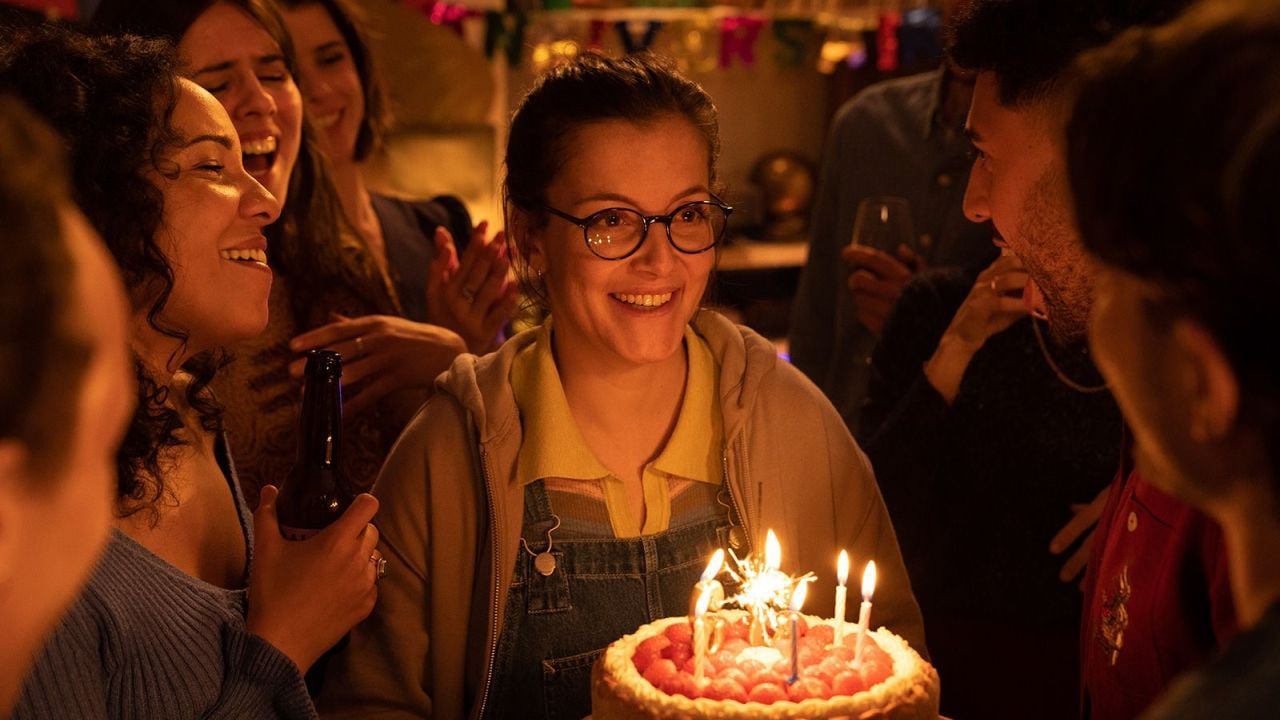
Charlotte (Camille Lellouche)'s birthday is December 22nd. That's why many friends and family members who are already stressed out about Christmas have their holiday neglected…
One of the smaller ones is that her birthday is on December 22nd, today. As anyone born around Christmas and New Year knows, this is particularly challenging. Her sister Julie (Mélanie Doutey), whose marriage is currently in crisis, just quickly congratulates her on her cell phone. Her brother Jérome (Max Boublil) is currently snogging his new flame, the pop star Océane (Vanessa Guide). He wants to introduce her to his aunt Rivka (Liliane Rovère), a concentration camp survivor who he claims only weighed 17.2 kilos when she was liberated – with particular emphasis on the number after the decimal point. Stop, wait a minute: is it becoming tasteless now? The answer is clearly: yes!
Little by little, the entire large family is introduced, including the farting grandmother and the parents Françoise and Michel, played by the tried and tested comedy dream couple Chantal Lauby and Gérard Darmo (“The Big Lot”). Others involved are Julie's husband and Charlotte's birthday present from her friends: a handsome stripper who not only takes off his clothes, but stays the night until Charlotte finally hires him to accompany her to Christmas dinner with the family…
Unearthed clichés
Until that happens, the gag machine is turned on, it starts up with a rattle and doesn't stop for anything or anyone. Instead, clichés that were thought to have been forgotten are dug up again: the stupid blonde = Océane, the old hypochondriac = Papa Michel, or the elderly wallflower = Charlotte. What, as a Jewish-born, spirited family in which everyone has their quirks, may be reminiscent of the family scenes in the early Woody Allen comedies, but remains more in the realm of Monsieur Claude and his even less funny epigones. Instead of building a coherent, coherent plot, sketch-like scenes with the respective family members are strung together. A rather arbitrary combination of absurd situations that often deal with giving and receiving gifts:
Julie and her husband are at loggerheads over the wrong gift, while her little daughter fights to get Océane merchandise as a Christmas present using practically every means at her disposal. When the pop singer then sings a concentration camp hit called “Daughter of Auschwitz” that was composed especially for her at Aunt Rivka’s, the momentary peak of embarrassment has been reached. After all, Jérome and the old lady are also shocked by the clumsy faux pas. Later the picture is put into perspective, which also applies to almost all other bad tastes. But the shock is quite deep.
A stuffed marten steals the show
In contrast, Charlotte's birthday presents, which open the series of presents, are almost nice. She gets a bunch of dildos – Ha! Is this perhaps intended to point out her lack of sex life? But there's a misunderstanding when it comes to humor: one dildo might be funny under certain circumstances, but three at once definitely isn't. Unfortunately, more dildos don't necessarily mean more laughs. “Too much is not enough,” says an old stage saying. Translated to this film it could be: “Klamour is still gossip.” Every now and then the jokes catch fire, he says Running gagthat the whole family has the same psychiatrist, on whose cupboard there is a stuffed marten wearing a Santa hat. As soon as the conversation could get down to business or in depth, the marten is always discussed instead: “Has it always been there?”
But the general problem remains: The individual storylines seem like an episodic film that takes place between December 22nd and 25th and is possibly intended to be a follow-up to “Love Actually”, but is far from achieving that. The gags often suffer from a lack of originality and often seem forced because they are based more on clichés than on characters, even if some of them are contradicted later: Aunt Rivka is actually happy about the concentration camp song in the end because no one has written her a song yet, but would rather just hear “lalala” instead of the truly hair-raising lyrics. In general, a certain elegance or at least a little lightness has been missing here for a long time in dealing with humor and with the staff. Instead, crude clumsiness reigns. It's only in the last third that the bland comedy develops something like a conciliatory mood in which the gags work a little better.
Conclusion: Anyone who is prepared to endure more or less tasteless jokes for an hour will at least be rewarded with a forgiving mood in the last third.