
We don’t have to start at the beginning, when Homer wrote the 12,110 verses of the 24 cantos of the Odyssey around 700 BC. But at least in 2002, when the board of Hollywood studio Warner Bros. decided to pull the plug on “Batman Vs. Superman”. The star director Wolfgang Petersen, who was hired for the comic blockbuster, then returned to a previously initiated project and scored a mega hit in 2004 with the Brad Pitt epic “Troy”. The young talent Christopher Nolan, who had meanwhile been slated for “Troy”, received directing “Batman Begins” as a kind of consolation prize – and the rest is history! But not only because otherwise “The Dark Knight” would never have been made, the cinema god did everything right in this case: After all, Christopher Nolan is finally bringing his Troy film to cinemas after a delay of more than 20 years – and “The Odyssey” not only contains a lot of groundbreaking technology, but also so much of “Inception” and “Interstellar” that one could hardly imagine that the two-time Oscar winner would have even remotely achieved something comparable back then.
After his biopic “Oppenheimer,” which had a relatively small budget of $100 million, made almost a billion dollars at the global box office (keyword: “Barbenheimer”), Nolan was sure of the necessary standing for his next project in order to be able to implement his personal vision without making any compromises despite a $250 million budget. And he makes extensive use of this free pass: a certainly not entirely small part of the audience will turn away from the fragmented, intellectually chilled, almost contemplative narrative in keeping with the original (at least until the much more accessible finale). At times it almost seems as if someone had unconditionally handed Ingmar Bergman (“The Seventh Seal”) and Terrence Malick (“The Thin Line”) a quarter of a billion for their next film venture. But it is precisely this absolute lack of compromise that makes “The Odyssey” an event that has never been seen on the – hopefully the largest possible – screen.
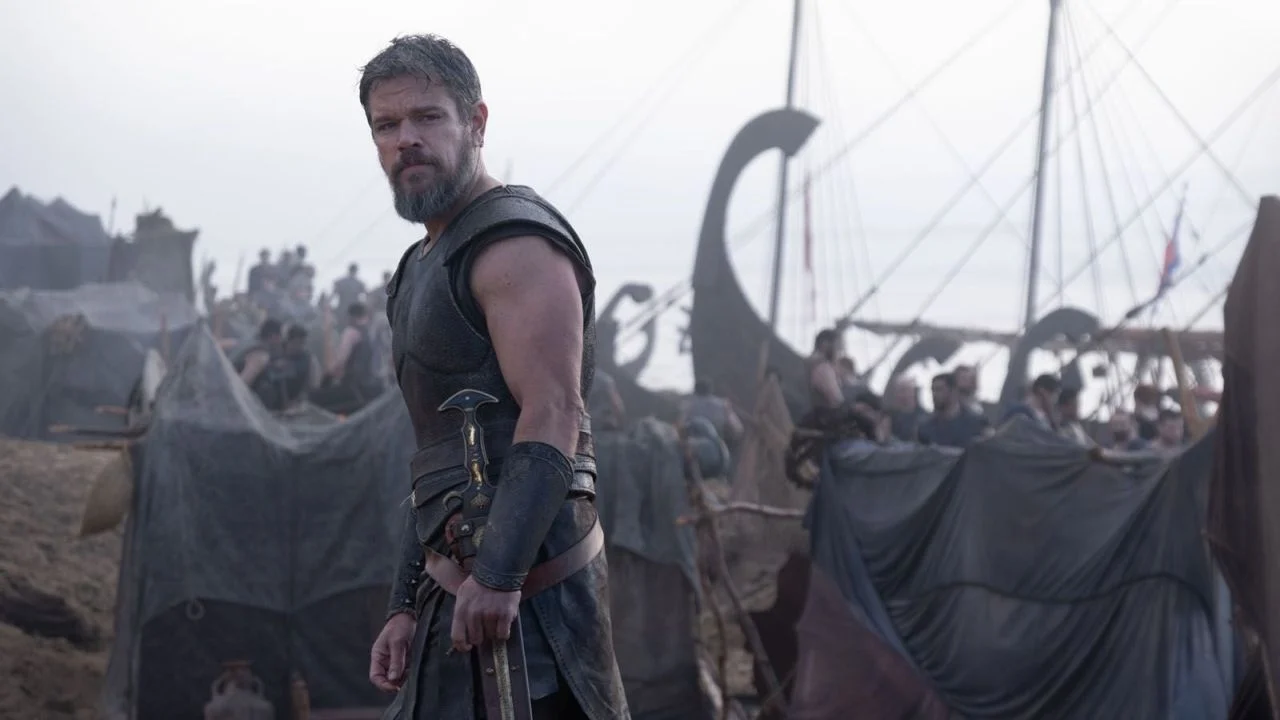
Matt Damon starved himself down to 76 kilograms for his third Christopher Nolan film after “Interstellar” and “Oppenheimer”.
Christopher Nolan bases his version of the Odyssey on the new translation by the classical philologist Emily Wilson, which was published in 2017, which is why the characters speak easy-to-understand everyday English, but at the same time remains true to the mosaic-like form of the source material. Especially at the beginning, the story of the eponymous odyssey is only put together slowly and vaguely from various stories and scraps of memory: After the ten-year siege of Troy, Odysseus (Matt Damon) came up with the idea of the horse. But on the way back to Ithaca, the king and his soldiers lost their way – and had to deal with violent storms, seductive sirens and a man-devouring cyclops. Meanwhile, his wife Penelope (Anne Hathaway) and his son Telemachus (Tom Holland) have been waiting for the missing man’s return for 20 years. In addition to Antinous (terribly greasy: Robert Pattinson), there are now dozens of other suitors at court who are just waiting for Penelope to finally realize that Odysseus is long dead and will never return…
The exact opposite of a Netflix film
While it is now common practice with streaming films to have everything important summarized every five minutes, Christopher Nolan demands a lot more from his audience than we have been used to in blockbuster cinema in this price range in recent years. What exactly happened during the siege of Troy and what does Helena (Lupita Nyong’o) actually have to do with it? What are the backgrounds of Agamemnon (Benny Safdie), Menelaus (Jon Bernthal) or Calypso (Charlize Theron)? All of this is loosely touched upon, but is actually assumed to be known. Even Zendaya, who is currently one of the most popular stars on the planet, gets less than two minutes of screen time as Athena – so it’s clearly an advantage if you can place the character in mythology beyond her film appearance.
In addition, there is a non-linear narrative style, which Christopher Nolan has used again and again throughout his career, and not just in the “Memento”, which is rolled out from the back. But it’s not just the temporal fragmentation that’s “typical Nolan”, the motif of the guilt-ridden protagonist, who longs for home and family, but first has to (literally) walk through the realm of the dead in search of transcendental knowledge, is of course immediately reminiscent of Leonardo DiCaprio’s dream descents in “Inception” or Matthew McConaughey’s black hole crossing in “Interstellar”.
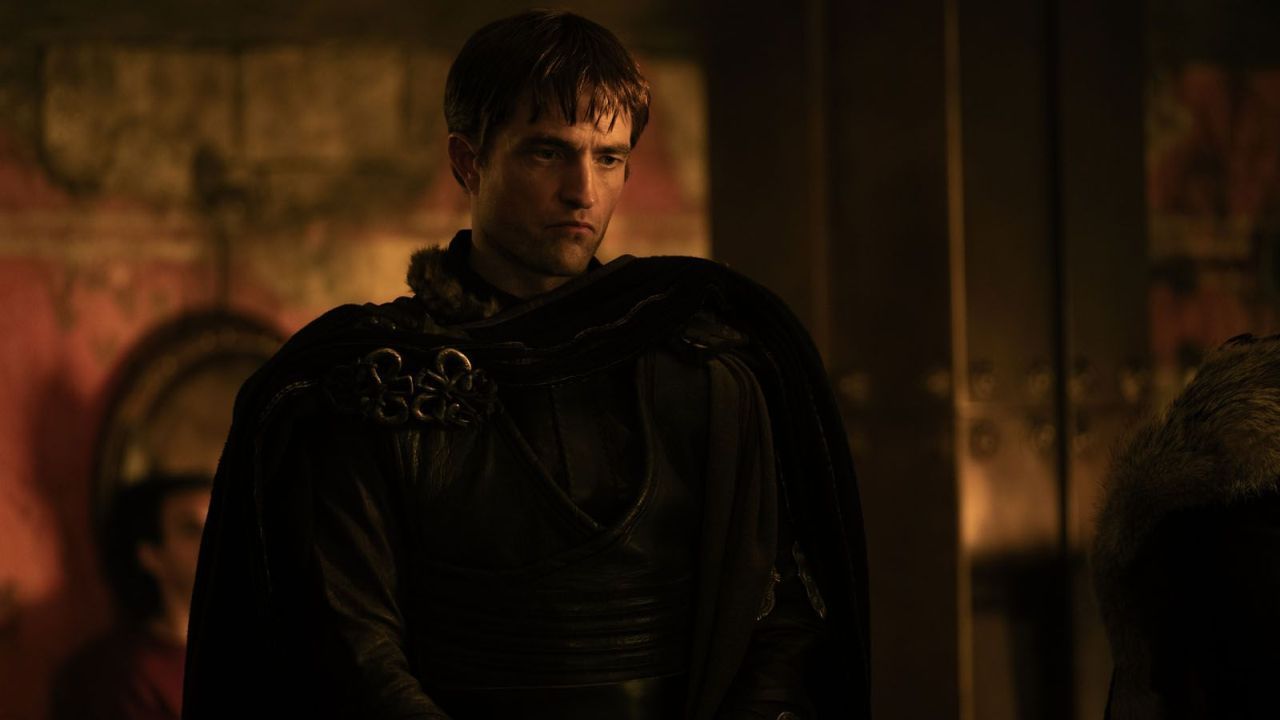
After “Tenet” for the second time for Christopher Nolan: Robert Pattinson plays a magnificent, sleazy would-be groom.
As I said, not everyone will fully get into it – at least in the first two hours. And even as a fan of the film, I have to admit that some of the stops in the odyssey are included in the breakfast. But the sheer effort alone always takes your breath away. Compared to “Oppenheimer”, where Christopher Nolan and his composer Ludwig Göransson went all out in every scene in order to make the possibly somewhat dry material as spectacular as possible, the production of “The Odyssey” almost seems “taken back”. Unlike Ridley Scott in “Gladiator II”, Christopher Nolan doesn’t slap you in the face with his acting values, instead you have to look for yourself to see how much blood and sweat is really involved: Matt Damon not only grew a full beard for a whole year and starved himself down to 76 kilos in order to be able to embody Odysseus, who was emaciated after years of wandering, but other things were also valued an almost unheard of level of authenticity.
Even the cyclops Polyphemus (Bill Irwin), for whom one would assume without hesitation that the computer helped, of course, is actually a doll in the best Ray Harryhausen style – only on the set, unlike in “Sinbad’s 7th Voyage” from 1958, it was no longer 30 centimeters high, but a massive 18 meters high! However, the scenes at sea are almost even more impressive. Yes, the waves here are certainly not as high as in many CGI blockbusters, but when the water and wind whistle around the men’s ears, it triggers a physical reaction even when watching from the warm, dry cinema. This is almost as oppressive as the moments at court where mother and son have had to pay attention to every single word and every single gesture for years so as not to reveal a point of attack to the lurking suitors. And then “The Odyssey” even takes a brief detour into the newly founded genre of mukbang body horror in Circe’s (Samantha Morton) cabin.
Of coffins and mirrors
Speaking of effort and visual power: “The Odyssey” is the first film in history to be shot ENTIRELY with 15-perf 70mm IMAX cameras. Normally, this special large format is only used in action scenes or landscape panoramas – for the simple reason that the cameras are so damn loud that the actors would hardly be able to understand each other when they speak. Christopher Nolan and his Oscar-winning cameraman Hoyte van Hoytema (“Dunkirk”) therefore had an even larger plastic coffin built as a noise barrier for the already enormous analogue cameras. However, this led directly to the next problem: Now the stars were faced with a plastic wall during their dialogues – and even if most of them have long been used to interacting with a tennis ball as a counterpart in CGI shots, such an approach would of course contradict Christopher Nolan’s striving for maximum authenticity. In addition to the sound coffins, a complex mirror system was developed to enable the performers to look at each other while playing without actually being face to face.
All of this sounds like the (unnecessary) effort of a perfectionist. But it actually pays off: later on there is a dialogue scene between Penelope and her son Telemachus about whether now might not be the time to simply take one of the suitors as her husband. Edited in a simple shot-counter-shot mode, the faces of Tom Holland and Anne Hathaway alone in this moment develop an image power that is not even possible in most other films, even a small town that has been blown up. And then something else happens that even I would no longer have believed at that point: after about two hours, Christopher Nolan suddenly drops his austere, cold demeanor and serves his audience a rousing, cathartic finale that is washed up. Even everyone who had been lost to some extent in the film was back on board – and quite a bit!
Conclusion: It has already been shown in advance sales that the audience for “The Odyssey” is primarily looking forward to the screenings in IMAX or 70mm format – and in fact: If it is worth driving 50, 100 or even 150 kilometers to see a film this year in the best possible quality, then it is definitely Christopher Nolan’s odyssey epic!