There is a nice punch line right at the beginning, especially for a German audience: The novel “The Idiot,” completed in 1869, is a scalpel-sharp reckoning with the upper class society of St. Petersburg, but as we now find out in “The Idiot(s)” – based on the non-fiction book “The Gambler Wife: A True Story of Love, Risk, and the Woman Who Saved Dostoyevsky”* by Andrew D. Kaufman – Fyodor Dostoyevsky (Johnny Flynn) was inspired by his time in Baden-Baden.
As soon as he arrives, the author, who is on the verge of bankruptcy, notes dryly that the mountain air stinks and the church bells sound flat. Meanwhile, his wife Anna Dostoevskaya (Aimee Lou Wood) is desperately trying to maintain some residual optimism – after all, the couple is planning (out of financial necessity) to write nothing less than the best novel of all time in the Baden-Württemberg spa town.
“The Favorite” with net and double bottom
Malgorzata Szumowska and Michal Englert (“Woman from Freedom”) step on the gas quite a bit, especially at the beginning. In its best moments, “The Idiot(s)” is reminiscent of the ten-time Oscar-nominated masterpiece “The Favorite” – even if the Polish directing duo always seems to act with the handbrake on compared to their Greek colleague Yorgos Lanthimos:
Out of sheer ignorance of European sanitary habits, people shit in the bathtub – and later urinate directly out the window after the bedpan that has been passed down for generations has been moved to the pawn shop. The morning after a lavish celebration, a man in a bunny costume sneaks through the knocked-out aristocratic party, who, out of sheer boredom, can only convince themselves of their own liveliness by playing Russian roulette.
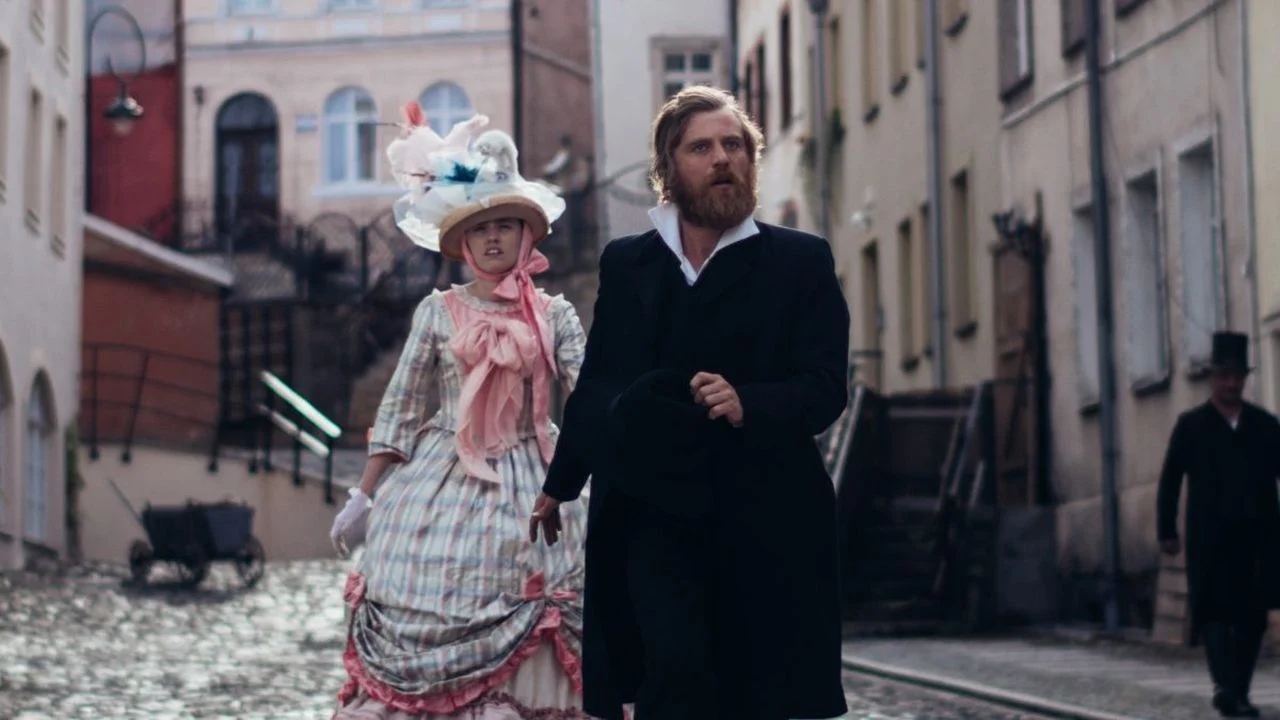
In the health resort of Baden-Baden the question arises seriously: Aren’t we all idiots in the end?
While the British folk singer Johnny Flynn (“Emma.”) remains rather pale behind his Russian beard despite a masochistic foot fetish, “The White Lotus” star Aimee Lou Wood impresses as the cheeky wife, who will later go down in Russian literary history as the first female publisher. Their often decidedly contemporary-sounding dry comments fit with a whole series of anachronistic sprinkles that run through the first half of “The Idiot(s)” in particular – from the repeated references to the pop classic “Take On Me” by the Norwegian group A-ha to Dostoyevsky’s nude drawings, whose style is more reminiscent of modern adult manga.
What exactly Szumowska and Englert are trying to achieve with this is not entirely clear – but it is precisely the more grotesque digressions that give the film in the first chapters at least a certain unpredictable, chaotic momentum. “The Zone Of Interest” star Christian Friedel also contributes to this as Dostoyevsky’s beautifully slimy opponent Ivan Turgenev, whose rivalry ultimately ends in a duel that ends up being rather embarrassing for all men involved – with the mysterious Natasha F (Vicky Krieps in a role largely wasted despite reference to “The Idiot” heroine Nastasya Filippovna) visibly disappointed by the lack of blood rushes.
Everything interesting gradually fades into the background
But with every trip to the Baden-Baden casino, the energy dwindles – and not only for Anna, who has to pull herself and her husband out of the swamp again and again, but also for the audience, for whom the repetitive-every-small-sum-is-immediately-wasted-again process eventually wears off like chewing gum. Dostoyevsky is hopelessly addicted to gambling – and even sacrifices the last thaler to his “infallible system” when his wife is giving birth to their first child at home.
In the second half, “The Idiot(s)” turns more and more into a classic addiction drama with the well-known downward spiral dramaturgy, in which, given the title, at some point you ask yourself whether Dostoyevsky, who like his novel’s hero suffers from epileptic seizures, is really the idiot here – or not Anna too, who continues to support her literary genius despite all his self-destructive ego trips.
Conclusion: “The Idiot(s)” begins as an absurdist reckoning with the decadent aristocratic society – but then sacrifices most of its more experimental approaches for an off-the-shelf addiction drama that runs out of steam long before Fyodor Dostoyevsky’s millennium novel is finished.
We saw “The Idiot(s)” at the Hamburg Film Festival 2026, where it celebrated its European premiere as the opening film.