
In his masterpiece “Dogville” (2003), all Lars von Trier needed, along with a few stage props, were chalk lines on the floor to create the eponymous village in the Rocky Mountains, complete with houses and streets, on the screen. 23 years later, Kai Stänicke pursues a similar, if not quite as radical, approach in his debut as an author and director: “The Homeless” was not filmed on a theater stage, but on the island of Norderney – but here, too, abstraction is in the foreground. Only the front sides of the village community's huts were built, while the remaining walls and roofs are missing. Just like those Potemkin villages that Prince Potemkin once had built – probably only according to legend – in order to deceive the Russian Tsarina Catherine the Great about the state of the Novorossia region.
In the first scene of the film, Hein (Paul Boche) returns to the island that he left 14 years ago as a young man to train as a teacher on the mainland. But the residents of the village don't recognize him – or at least they don't want to recognize him. His mother Mechthild (Irene Kleinschmidt) has dementia and his sister Heide (Stephanie Amarell) was still so young when he left that it wouldn't be surprising if she couldn't remember her big brother. But what about his then lover Greta (Emilia Schüle) and his best friend Friedemann (Philip Froissant)? At least they should be able to identify him? Under the direction of the village leader Gertrud (Julika Jenkins), a three-day trial is scheduled that follows strict rules, at the end of which a decision will be made as to whether the newcomer is actually Hein or whether he has to leave the island again…
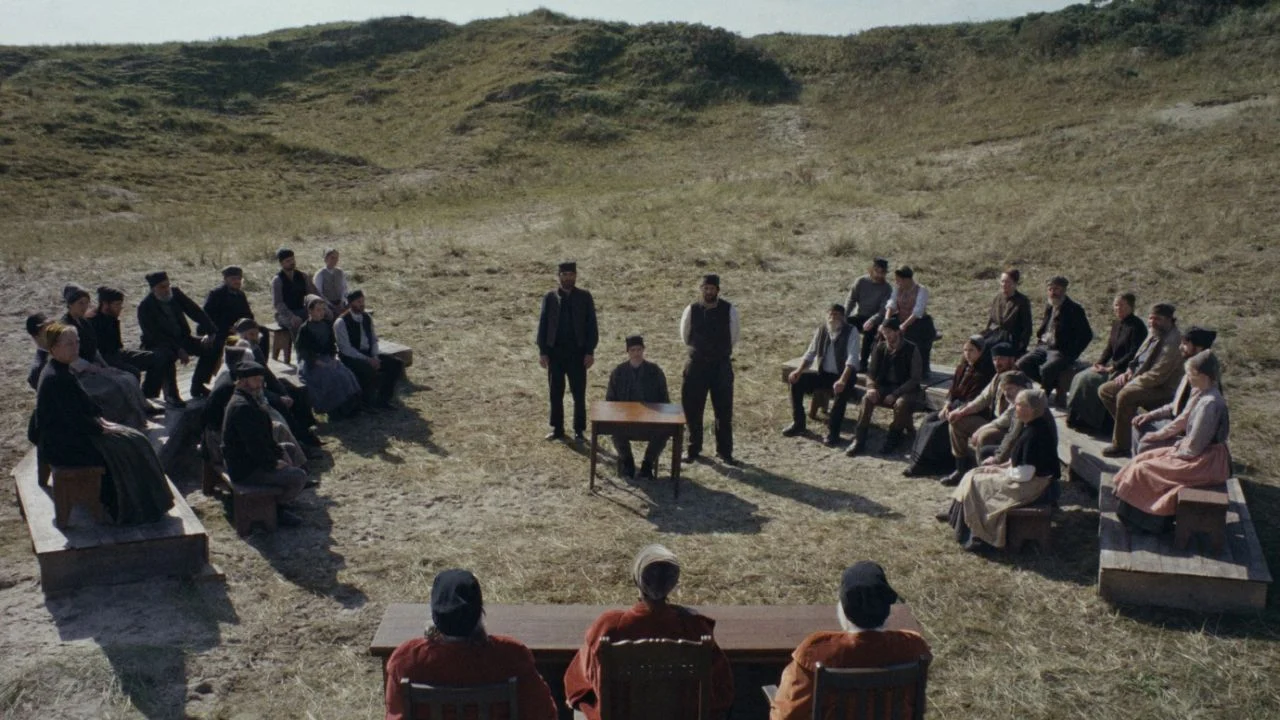
Will the village court still recognize the returnee Hein (Paul Boche)? Or does he have to leave the island straight away?
One can speculate wonderfully about what the reduced set design is supposed to mean – and many of the possible interpretations are very reminiscent of what came to our minds back then with “Dogville”. Like Lars von Trier, Kai Stänicke is also clearly in the tradition of Bertolt Brecht – and he was not only known for his clear-sighted moral experimental arrangements, but also for an emphasized artificiality that is intended to prevent oneself from getting emotionally lost in a story. Instead, the alienation effect on display literally forces you to always question what is happening rationally. At the same time, the inherent hypocrisy of village life is accused: everyone notices everything from everyone else, especially the suffering and injustices – but because one of the four walls is closed, you can at least pretend that none of this is any of your business.
The close-knit village community is only as stable as the fake facades of the huts – instead of actually standing up for each other, they have agreed to work together to keep up appearances. This is how the process works: Every day it's about remembering a drastic event from that time – and whether the residents' memories match those of Hein. But while the returnee mainly remembers the dark sides of his childhood and youth, the stories of the other witnesses are all sunshine and roses. It almost seems as if the trial wasn't about establishing identity at all – but rather about testing whether the defendant is willing to play along with the village's game of appearance instead of reality.
Great play, but a bit predictable
If it weren't so frightening at the same time, one could almost find it touching how the villagers strive to give their process a semblance of legitimacy. A waiting area is even being built specifically for the defendant and the witnesses – and when the time comes, they are waved over with red flags, although one could have simply shouted the few meters over. Paul Boche (“Wonderful One”) in particular captivates you right from the start with an incredibly concentrated and intense performance – and the rest of the cast is also excellent across the board.
But that's also necessary to a certain extent, because despite the strong images from cameraman Florian Mag (“The spoken word counts”), the course of the trial, the real reason for Hein's departure at the time and the likely end of “The Homeless” were largely understood. There were one or two more barbs with both Lars von Trier and Bertolt Brecht.
Conclusion: With his German answer to “Dogville”, Kai Stänicke makes a promising debut with a strong vision and an outstanding cast, even if the Brechtian morality play at the center becomes somewhat transparent at a certain point and is therefore largely free of surprises.
We saw “The Homeless” at the Berlinale 2026, where it celebrated its world premiere as the opening film in the “Perspectives” section.