
Theodor Storm's masterful novella “Der Schimmelreiter” from 1888 has been an integral part of the German language curriculum in this country for decades. The timelessly thrilling material, whose interpretation earned the (still very proud) author of these lines a grade A in a German exam 30 years ago, has been filmed four times since its release – most recently the story about the dike chief Hauke Haien, consumed by ambition, who wants to protect his home village from a gigantic storm surge, was directed by GDR filmmaker Klaus Gendries in 1984 and in 2023 Aegis of the Austrian Andreas Prochaska (“The Dark Valley”) made its way onto television.
Now director Francis Meletzky (“Sleeping Dogs”) and screenwriter Léonie-Claire Breinersdorfer (“Elser”) are making a new attempt at cinema and choosing a new perspective: They are translating Storm's story from the 19th century into the 2020s, in which we have to watch the effects of the climate catastrophe in the form of floods or other extreme weather events almost every day in the news or even experience them first-hand. The result is unfortunately unsuccessful: the constant balancing act between the core elements of the novella and the challenges of the present only works to a very limited extent and results in a story that is largely abstruse and is teeming with cliché-laden characters.
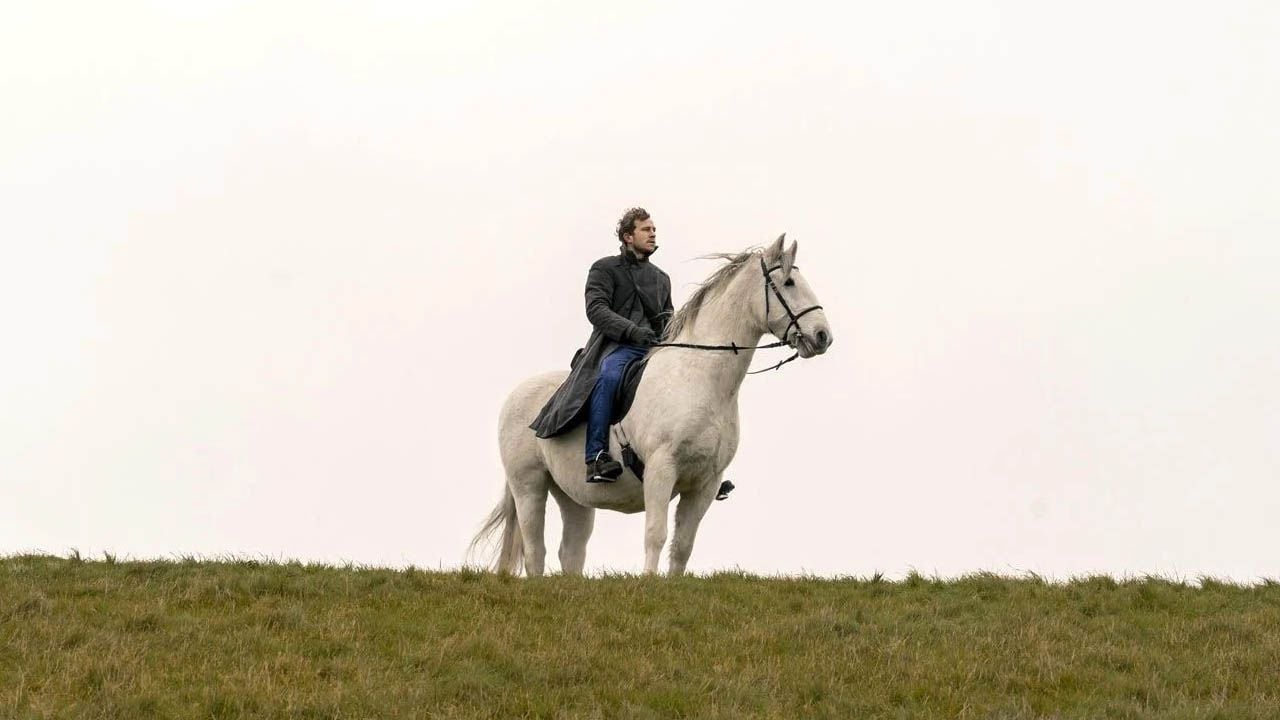
As in Theodor Storm's classic novella, Hauke Haien (Max Hubacher) also rides his white gray horse over the dike in the 2020 update.
North Frisia, in a small coastal community. After the death of his father-in-law, the ambitious outsider Hauke Haien (Max Hubacher), who lives in harmony with nature, takes on two responsible functions in one person: He inherits the deceased as dike chief and is appointed director of the coastal protection authority. As one of the few in the sleepy town, Hauke has recognized the drastic effects of the climate crisis on villages near the coast and is therefore planning to dismantle the first line of dikes. His wife Elke (Olga von Luckwald), who works at the Institute for Marine Research, supports him, as does the expert drunkard Iven (Christoph Glaubacker): she lets her connections in politics play out and appeases the opponents who dismiss Hauke's plans as climate hysteria.
But the resistance is great: Hauke's archenemy, the influential building contractor Ole Petersen (Nico Holonics), repeatedly incites the critics, while he secretly tries to get his flock out of the water by building an offshore wind turbine in the newly emerging flooded areas. What the community doesn't suspect: Hauke's plans to save the village go much further. He wants to have the entire town relocated, which would mean that almost everyone would lose their current house and farm. For the time being, Hauke only initiates Elke because no one wants to give up land that their ancestors wrested from the sea over the centuries…
An only partially useful update
Turning a 150-page novella into a 105-minute feature film naturally requires considerable cuts. Storm's framework story about a traveler who has the tragic story of Hauke Haien told to him by a local while stopping at an inn is completely missing from the new film. A very sensible measure to be able to concentrate on the core activity on the dike. In general, Léonie-Claire Breinersdorfer's script adaptation is very loose, but unlike in previous film adaptations, Haien's mute daughter Wienke (as a child: Elina Leitl, as an adult: Imke Siebert) plays a more central role: she also acts as a voice-over narrator in the prologue and epilogue and becomes the personified young generation that will have to pay for the climate-damaging behavior of their ancestors.
All of the other important characters in the novella also remain more or less intact – apart from the fact that Hauke's father Tede and the old dike count merge into a single person in the film adaptation and in the film it is only Elke who initially has to cope with the death of her beloved father. The woman at Hauke's side appears to be much more emancipated and committed than the submissive character in the novel, which would hardly work for a contemporary audience: it is usually Elke who is at odds with the narrow-minded locals in heated verbal battles. As contemporary and welcome as this female figure is, it has a significant side effect: the eponymous “Schimmelreiter” and visionary Hauke Haien does not radiate anywhere near the competence and authority in the film adaptation that characterizes him in the book. Elke often overtakes him.

Hauke's wife Elke (Olga von Luckwald) outshines the actual protagonist.
The central conflict is two-stage: While dismantling the dike and flooding the Koog to alleviate the water masses sounds plausible, the next step in Hauke's master plan becomes absurd. He fantasizes about “amphibious living” and seriously suggests moving his Frisian home village to a lake (!) – after all, that’s where it would be best protected. The alternative is to move the village several 100 (!) kilometers inland once the sea level has risen – so to speak from the North Sea coast to Saxony-Anhalt. We have already seen the resettlement of entire villages as a result of open-cast lignite mining in Germany – but despite all the inconveniences, on a reasonably humane scale and within a few kilometers. Hauke's idea, on the other hand, does not read as visionary, but rather out of touch with the world: Which person should be told that from now on they have to live in a house on stilts in a lake?
There's something unintentionally funny about it because it's actually meant seriously – and even with the constant clash between the core elements of the Storm template and modern technology, you can't help but shake your head at times. During the big storm surge finale, for example, the rescue team meets in a befitting crisis center with headsets and huge screens – at the same time, Hauke rides his white horse over the dike like in the 19th century and rescues a dog from the clutches of the construction workers, who, out of superstition, want to bury the animal alive in the fragile dike. In the Haiens' kitchen, on the other hand, there is an antiquated interior from the post-war period, while the laptop hums on the living room table and you reach for your smartphone – which doesn't fit together visually.
Visually stunning
The press release for the film promises a “visually powerful literary adaptation” – a promise that the film rarely keeps, because “Der Schimmelreiter” only delivers more visual power than a Usedom crime thriller on public television in the home straight. The filmmakers can intersperse the underwater images of a struggling white horse, no matter how penetrating, to create a mystery atmosphere at the push of a button. The screen format is largely different from the film adaptation, the aesthetics and the CGI effects (such as those in the famous Jevershallig sequence including the resurrection of a horse's skeleton) correspond to those of larger TV productions. In addition, the actors' North German dialect often seems artificial and is not consistent throughout the many dialogues.
What makes the latest “Schimmelreiter” film adaptation a big disappointment are the weak characters. The latter is particularly evident in Hauke's nasty arch-rival Ole: The greasy disgusting package of course drives a sports car, flirts with Elke and never misses an opportunity to mobilize the backward-looking villagers. A figure as flat as North Frisian cycle paths – and Annette Frier, in her role as a human interface to politics, also serves up oft-told stereotypes. When the minister finally rolls up to the inauguration, the politician is only interested in the limelight and good press, while she downplays the consequences of the climate crisis – that's how cliché it has to be. And the warning finger cannot be raised often enough: the film's final message is a cheesy voice-over that could also come from a nature documentary – the fight against climate change must now finally be followed by actions and not just words. Probably true.
Conclusion: When the gray rider meets the climate crisis, it is a theoretically exciting reinterpretation of the Theodor Storm classic – but it is still far from being a good film. Weak characters, technical defects and an absurd story ultimately make the remake a huge disappointment.
We saw “The Schimmelreiter” at the 47th Biberach Film Festival.