
The Leipzig director Thomas Stuber has established himself in recent years as one of the most sensitive observers of everyday German life. In films like “In the Ganges” or “The Silent Satellites” he often talks about people on the fringes of society – always quietly, melancholically and with a lot of empathy. “The Frog and the Water” is also a real Stuber, even if the award-winning arthouse director leaves his social realism behind a little this time and instead takes a little excursion into the dreamlike and fairytale.
The first scene sets the tone: the Japanese Kitamura (Kanji Tsuda), who is obviously grieving a serious loss, looks into a pond in his garden at home. In the next moment, his reflection in the water becomes the face of Buschi (Aladdin Detlefsen), a silent man with Down syndrome. But the simple crossfade is more than just a nice change of scenery. It shows the parallelism of the two men, who at first glance seem so different – and almost seems like an invitation to understand the following film not necessarily as a realistic story, but rather as a fairy tale.
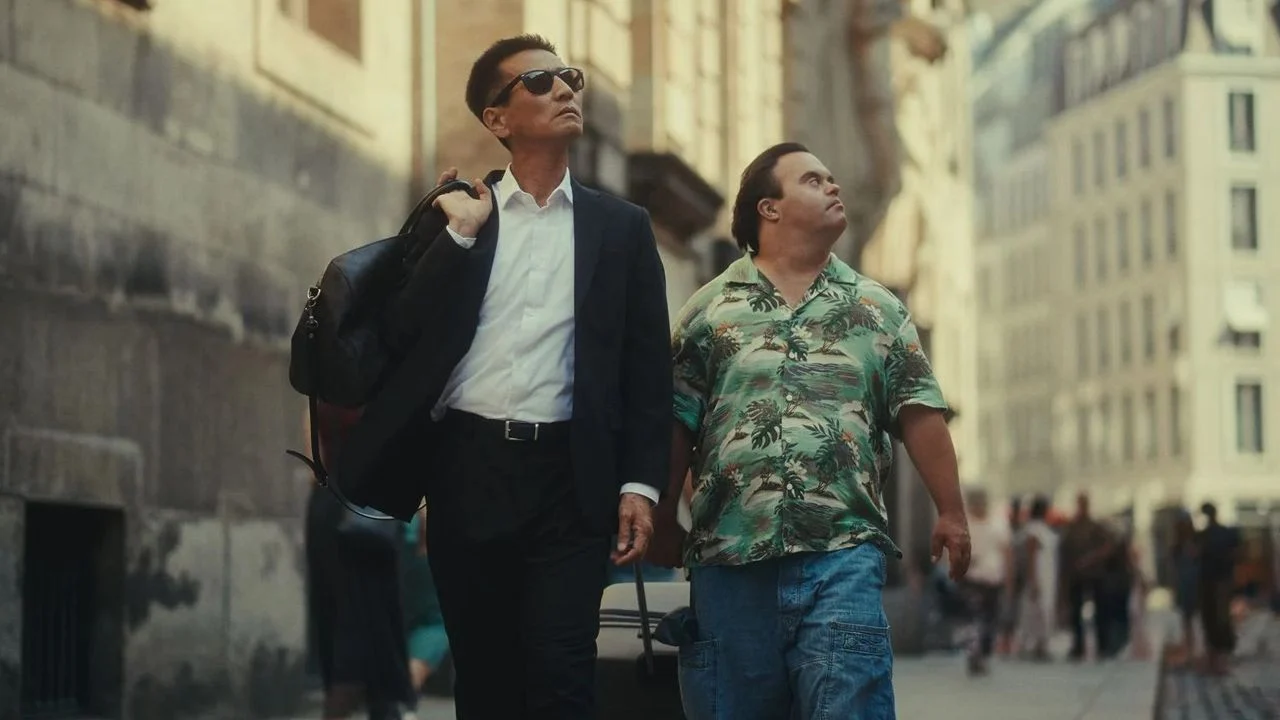
In “The Frog and the Water” an unlikely duo sets out to discover Germany together.
Stefan Busch alias Buschi lives in an assisted living group in Cologne and mostly stays away from other people. He hardly speaks at all and seems to remain in his own, silent world. Water, on the other hand, fascinates him. He could watch the babbling of a running tap for hours. He’s still not allowed into the swimming pool. When he happens to meet a Japanese tour group one day while on an excursion, he follows them without further ado. Without comment, he gets on the bus with which the tour company travels on to Weimar. And it goes without saying that the majority of tourists take this strange German right into their hearts.
Because it is the only free seat, Busch ends up on the bus next to Kitamura, who unexpectedly had to make this journey alone after a loss. With his black suit, sunglasses and constant silence, he is an outsider among the other tourists, who even speculate whether he might be a member of the Yakuza. Because Buschi’s supervisor (Bettina Stucky) has already started pursuing him, the short adventure threatens to end soon. But a friendly bus driver (Meltem Kaptan) secretly helps the unlikely duo escape. And so a journey through Germany begins for both of them, during which they cannot communicate with words, but nevertheless build an ever closer connection…
Mood instead of logic!
In The Frog and the Water you have to accept that things just happen. Buschi is warmly welcomed by the tour group, while their tour guide (Cornelius Schwalm) doesn’t notice that there’s an extra person there (but is just upset that he was charged “too much” for a meal). The motivation of the bus driver, who essentially drags the unlikely duo off to Dresden and leaves them there to their fate – is actually completely irresponsible – is also not questioned. The end of the film will also cause further discussion.
But Stuber is less interested in how plausible all of this is and is more interested in what moods can arise from it. The central appeal lies in the fact that the story tends to drift along. For a long time, the filmmaker also refrained from using the dramatic climaxes that are often used in cinema. He only uses this towards the end. His film lives from small observations, quiet moments and, above all, from the gentle warmth with which the author and director views his characters. As in his earlier works, you feel a great sympathy for these two people, who are each outsiders in their own way.

Kitamura (Kanji Tsuda) and Buschi become more and more alike on their journey.
This applies primarily to Buschi. Lead actor Aladdin Detlefsen has been active as an actor in a Bremen ensemble for people with and without disabilities for more than 20 years. In his first leading role in the cinema, he impresses as a silent protagonist with whom the audience can (re)discover the world together. That’s why he visits less of the usual sights on the trip, because he’s interested in other things – especially Japanese sword fighting. After all, his name itself sounds like “Bushi”, a term used to describe warriors or samurai in feudal Japan.
Many scenes work purely by observing small moments, such as playing together with a paper frog. However, the fact that many scenes are rather loosely strung together episodes ensures that the road movie just keeps babbling along. This calm meandering suits the atmosphere well, but it also strains your patience from time to time. Luckily, the next enchanting moment usually comes quickly enough between the strongly acted main characters, who are looking for a way to communicate without a common language.
Conclusion: With “The Frog and the Water” Thomas Stuber creates a wonderfully empathetic and visually captivating odyssey between two outsiders. Sometimes it’s enough for two faces to be reflected in the water – and a connection is created for a moment.