
False modesty? Are you kidding me? Are you serious when you say that! As is well known, Ridley Scott (“Gladiator”) is not someone who has any inhibitions about praising himself and his work in the highest tones. He relished kicking the assembled contemporary competitors in the shins when he declared that most of today’s films were rubbish anyway. That’s why he quickly started looking at his own works – with a realization that sounds very typical for him: “They’re really good! And they don’t age.” He’s not entirely wrong, at least when it comes to the quality of many of his films. The Brit, who is now rapidly approaching 90, has repeatedly made film history from “Blade Runner” to “Alien” and “Thelma & Louise” to “Black Hawk Down” and has retained an almost astonishing sovereignty when it comes to bringing visually stunning cinematic experiences to the screen.
Even with “The End of the Stars”, an adaptation of the 2012 bestseller “The End of the Stars as Big Hig knew them” (originally “The Dog Stars”) by Peter Heller, the old master showed himself to be free of self-doubt as usual in advance. In the interview, Scott confidently stated that the film was simply the best thing he had done since the acclaimed sci-fi hit “The Martian” with Matt Damon. Now we can report that Ridley Scott definitely didn’t deliver a new masterpiece with “The End of the Stars,” but the post-apocalyptic survival drama undoubtedly knows how to unleash an incredibly engaging melancholy that actually comes into its own best on the big screen.
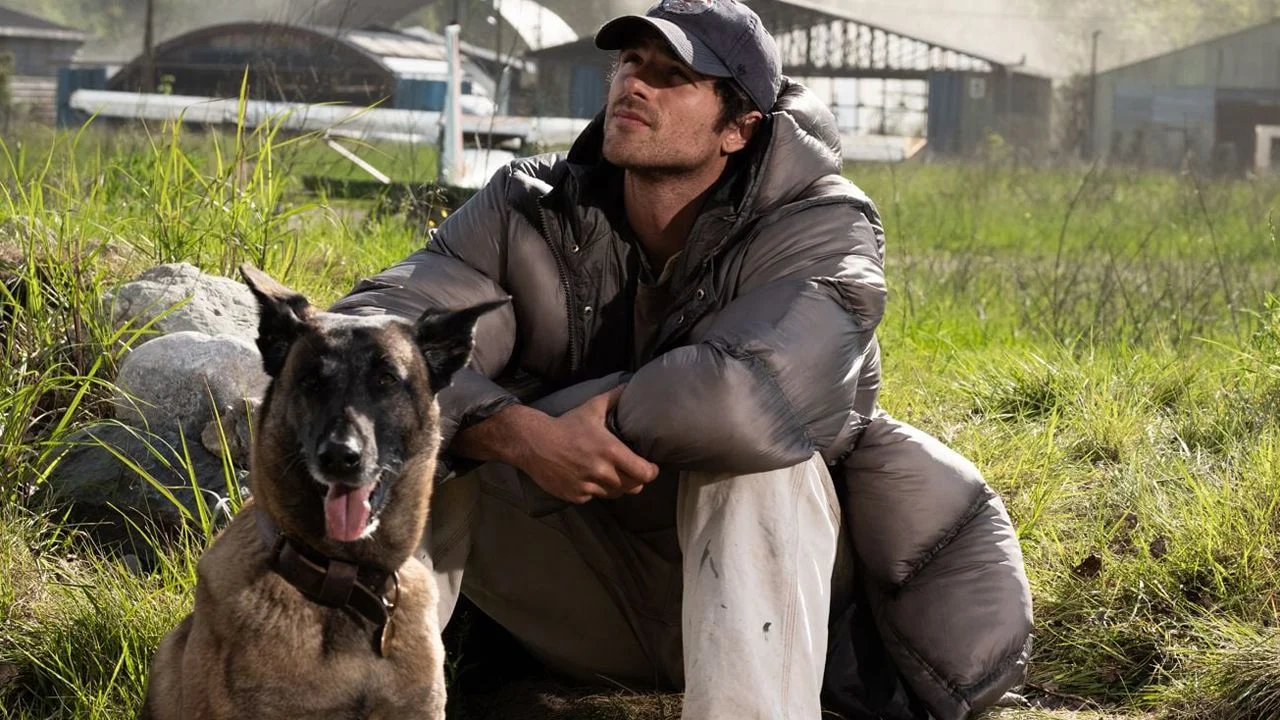
Hig (Jacob Elordi) and his dog Jasper are an inseparable team.
When a flu pandemic wipes out most of humanity, Big Hig (Jacob Elordi) is left alone with his dog Jasper. His wife died, as did his friends. Hig sets up camp at the airfield where the amateur pilot parks his small Cessna. The place can be easily defended against marauding hordes, and the misanthropic and gun crazy Marine Bangley (Josh Brolin), with whom Big Hig forms a community of convenience, is of great help.
And so the days go by until one day Hig receives a radio message that gives him new hope: Could there still be something like a civilization out there? He sets off into the unknown with his plane and meets two fellow destines, Pops (Guy Pearce) and Cima (Margaret Qualley), who join his journey…
Jacob Elordi takes on the role of Will Smith
We all remember the iconic images of Will Smith combing the deserted streets of New York City with his loyal German Shepherd in “I Am Legend,” always looking for possible signs of life and new supplies. “The End of the Stars” inevitably evokes associations with the 2007 hit film when Hig and his four-legged companion Jasper go hunting in a town in Colorado. There are no zombies here, but there is a danger from looters. However, Ridley Scott makes it clear from the start that his main focus is by no means on moments of tension and superficial spectacle. Rather, he is interested in the new, strangely distant reality in which people are stranded after a devastating pandemic.
What is impressive is the view of the urban world, which nature is reclaiming with an almost unstoppable naturalness: the concrete of the skyscrapers gradually disappears under dense vegetation, while the once flawless asphalt is broken up by wild growth. The city, once a symbol of human control and civilization, becomes an overgrown ruin and thus a silent testimony to what once was. These pictures in particular develop an unusual atmosphere. Also because Ridley Scott charges almost every shot with an elegiac melancholy.
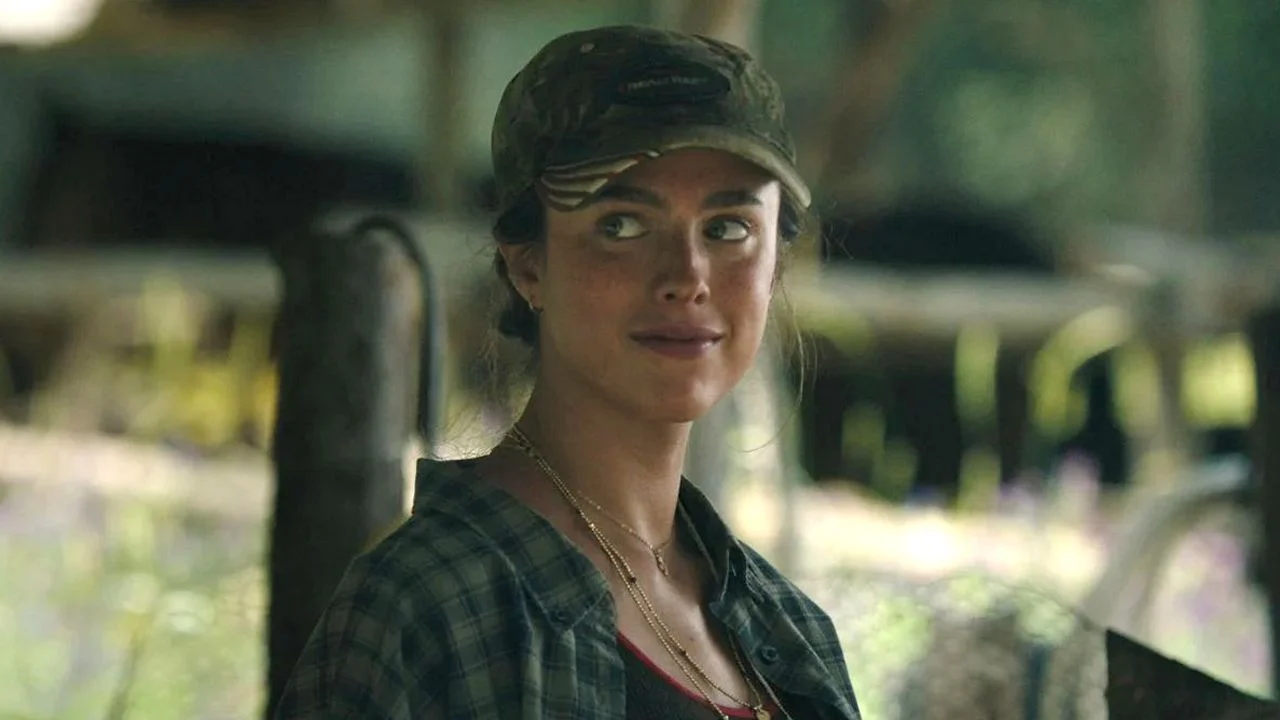
Is Hig possibly running into a woman for (survival) in Cima (Margaret Qualley)?
Ridley Scott returns again and again to the sublime landscape panoramas of Colorado throughout the course of the story. There he celebrates the gigantic, misty mountain ranges around which flocks of birds circle, while deer graze at their feet and people seem to disappear completely. Scott discovers something deeply comforting in the majestically photographed nature: it makes visible that beauty endures, even after the greatest possible catastrophe. At the same time, he finds in her an expression of loneliness that can cause grieving people to have terrible thoughts. We repeatedly see Hig driving his plane towards a rock face and finally turning off the engine. However, he won’t crash into it; a dream of better times still lives in him.
In fact, in view of these exquisite images, sensitively accompanied by gentle guitar sounds, one could even discover hints of a glorified dropout romanticism: Hig is no longer dependent on anyone, is surrounded by the most beautiful panoramas, has his loyal dog Jasper at his side and can otherwise devote himself entirely to his self-sufficient life. However, the fact that this supposed idyll is deceptive is not only made clear by the bulletproof vest that Hig has to wear as soon as he ventures into the city. The memories of his – of course pregnant – wife also keep coming back to haunt him. There is no longer freedom without pain.
Only the attractive survive
While Jacob Elordi’s dachshund look naturally speaks of longing vulnerability and, as a former mechanic, he can’t help but emulate the hope of being able to repair things again, Josh Brolin forms the jaded veteran antithesis at his side. His motto is: First shoot, then speak. Even for children, no exceptions are made to this iron law. As was to be expected, delicate nuances continue to break through the hard shell as the film progresses, even though Bangley is one of those people who have spent their entire lives preparing to be on their own. Brolin not only finds bitterness in the hardship, but also portrays a person who has been in survival mode since birth.
Pops, played by Guy Pearce, is similarly structured, whose distrust and always fully loaded shotgun are primarily due to the fact that his daughter Cima is trying to protect what is most important to him. And because, especially alongside Elordi and Brolin, we want to get an even stronger feeling that the end times are apparently reserved primarily for the attractive, Ridley Scott and his cameraman Erik Messerschmidt hardly miss an opportunity to show Margaret Qualley’s face in close-up: When her Cima listens to music again for the first time in years, the actress manages to create one of the most touching moments in the film.
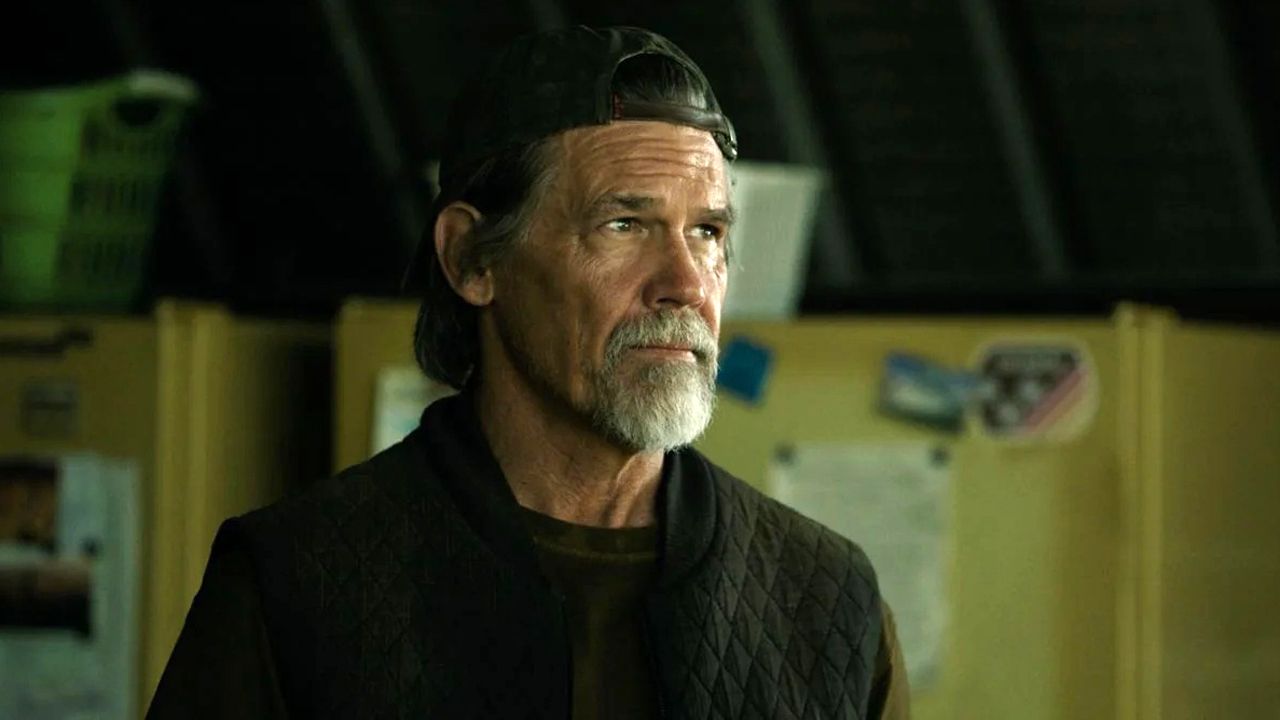
Hard shell, soft core: Bangley (Josh Brolin) shows no mercy towards intruders, but he still has a measure of remaining humanity left.
However, “The End of the Stars” is not just a gentle survival drama, because with a film costing more than 100 million dollars, there must of course be a few cracking set pieces: A herd of bison thunders through the hinterland – and in a rather splendidly staged sequence, partly bathed in night vision green, Bangley is attacked by a flock of reapers. Not only does the scene have a lot of intensity, video game fans will also inevitably be reminded of the zombie hit “Days Gone”, in which the fanatics with tattoos up to the top of their heads and shaved heads are not called Reapers, but Ripper. The parallels are nevertheless very clear, even if Scott really shows no deeper interest in the mythology behind the disinhibited sectarians.
No matter how well these moments are staged in themselves, you always notice how much Ridley Scott is drawn back to the careful, sensitive tones. The spectacular interludes seem like foreign bodies that interrupt rather than enrich the actual narrative flow. Of course, Scott doesn’t want to completely miss out on the drastic scenes: skulls are bloodily torn from their necks by rotor blades, headshots splatter, throats are brutally cut. However, things get really irritating when Hig finally reaches the supposed haven of hope, which of course won’t be spoiled in detail at this point. The script deviates drastically from the original and suddenly you find yourself in a scenario that can almost be compared to the last 30 minutes of “28 Days Later” due to its tonal break.
A new ending for the film
Ridley Scott certainly wanted to add a disturbing element of surprise here, which shows that communities in this post-apocalyptic world do not necessarily come together to achieve something good. However, the bright horror show that the film presents here would not have been necessary. Mainly because Scott doesn’t have much interest in really diving into this world or exploring it in more detail. Rather, it seems as if he mainly had a few impressive images in his head without then paying enough attention to whether this excursion fits organically into the story. At this point the original shifts down two or three gears and therefore finds the more appropriate tone.
Conclusion: With “The End of the Stars”, Ridley Scott delivers a wonderfully melancholic survival drama in its best moments, whose real strength lies in the careful and atmospheric observation of its protagonists’ everyday life. The action sequences are staged with convincing craftsmanship, but they never really fit organically into the film. The spectacular outliers repeatedly noticeably unbalance the otherwise engaging narrative flow.