
The title of the 2026 Cannes opening film, “The Electric Kiss,” may sound like a metaphor for a particularly charged passion, but surprisingly it is entirely literal: In Paris in 1928, Suzanne (Anaïs Demoustier), who was sold to a fairground by her parents as a teenager, earns her meager money as an attraction called “Venus Electrificata.” On an isolated stage, she allows herself to be charged by two electrodes so that the men who pay 30 centimes receive a blow from her when they kiss her – and thus an irrefutable proof of love.
The fair experiment actually existed, was in Paris Années folles but actually already cold coffee. The physicist and astrologer Georg Matthias Bose had already designed it in the 18th century. Of course, the spark still looks good on the big screen, especially if, like director Pierre Salvadori (“Better Antoine than no trouble at all”), you like to brag about the elaborate historical setting in his comedy. He doesn’t ignore the dark side either, when Suzanne not only feels like she’s been sold to the shock-loving male clientele, but also has to wear mittens all the time because of the burn marks on her palms.
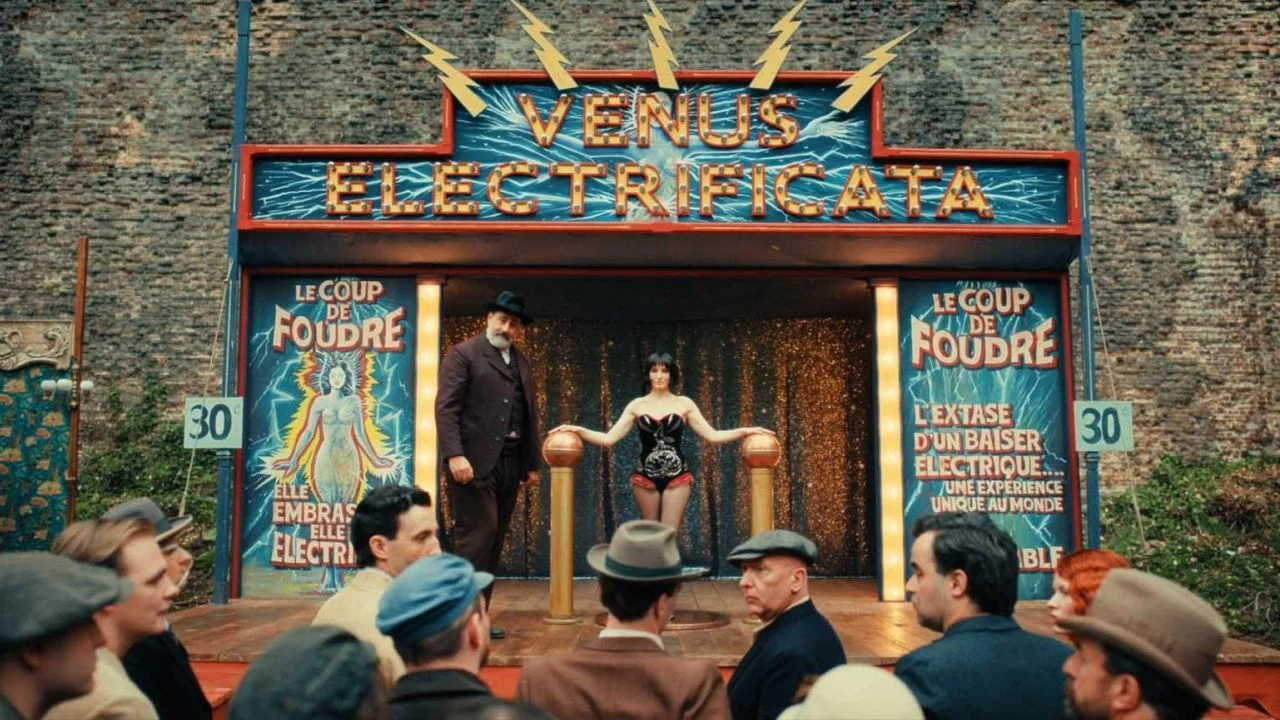
Suzanne (Anaïs Demoustier) makes men’s hearts beat faster as “Venus Electrificata” at the Paris fair.
Nevertheless, the titular attraction actually only plays a role again in the finale, when Salvadori prepares for what is probably the most tragic ending in literary history and shakes up Shakespeare’s most famous couple with a lot of excitement. Until then, we have to deal with what is actually a very typical comedy of mistakes: Suzanne is mistaken by the painter Antoine (Pio Marmaï) for the fortune teller of the hype. With her help, the desperate and drunken widower wants to get in touch with his wife Irène (Vimala Pons), who died years ago and for whose death he still blames himself.
Suzanne agrees in exchange for some quick money. But then things get out of hand: Antoine’s gallery owner Armand (Gilles Lellouche) immediately sees through the mummery, but is above all thrilled that his good friend not only regains his courage to live, but also finally starts painting again. That’s why the art dealer Suzanne proposes a deal: She continues to play the medium for Antoine and lets him communicate with his dead wife – and in return she receives a handsome share in all the pictures that the painter completes in his suddenly improved state of mind…
Wanted too much
Actually the perfect material for a nice, at best even a little biting, tabloid comedy. Especially since the historical fair provides an extra dose of show value and the top-class cast around Pio Marmaï (“The Event”), Anaïs Demoustier (“The Count of Monte Cristo”) and Gilles Lellouche (“Zone 3”) provide the necessary charm. However, the original idea for “The Electric Kiss” came from Rebecca Zlotowski (“An Easy Girl”) and Robin Campillo (“120 BPM”), two extremely ambitious auteur filmmakers – and “The Electric Kiss” is also more than two hours long. Suddenly that no longer sounds like a simple feel-good cinema for in between – and actually:
When Suzanne discovers the deceased wife’s diaries in a secret desk compartment, she also uses the information from Antoine’s past to make him continue to believe in her abilities as a spirit medium. At the same time, the film itself opens up a new level and tells the story in a parallel story of how Antoine and Irène – both still poor at the time – met in 1920. It is the story of an unsuccessful genius and his muse, who is the only one who believes in him and ultimately leads him to the success he deserves.
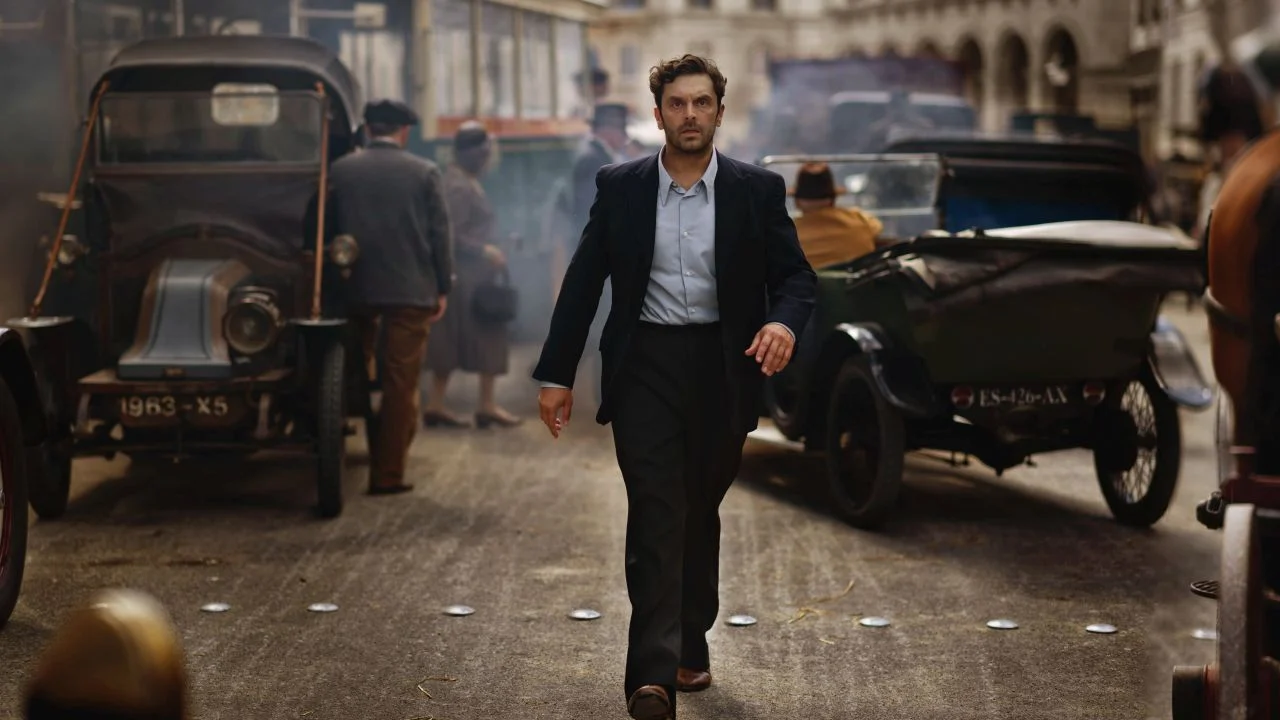
In this scene with Pio Marmaï you can see above all that the historical setting of his film was particularly important to Pierre Salvadori.
The only problem is: instead of complementing each other, the two strands keep slowing each other down. Tragedy and comedy suddenly stand next to each other and stare at each other in amazement. In addition, falling in love all the time loses all credibility at some point, especially in the second half, when it happens again out of the blue. The way the feelings of guilt towards the dead wife are eliminated with another head-over-heels-in-love twist seems more like a telenovela twist and not like the melodramatic climax that was actually hoped for.
Conclusion: At this point you can imagine a pun of your choice that has something to do with electricity and sparks and makes it clear that although “The Electric Kiss” has top-class stars and lavish equipment to offer, it clearly leaves a lot to be desired in terms of bite and humor.
We saw The Electric Kiss at the 2026 Cannes Film Festival, where it had its world premiere as the opening film.