
For me, the Italian Bernardo Bertolucci (1941-2018) is the best director of all time! Known to the wider public for the scandal classic “The Last Tango in Paris” and the historical epic “The Last Emperor”, “The Great Mistake” was my top choice for a long time until I saw my current personal favorite film “Shandurai and the Piano Player”. Of course, I was pretty hyped when two Bertolucci projects – absolutely spectacular in their own way – were announced for this year’s Venice Film Festival: Firstly, there’s a documentary that comes from none other than “Challengers” director Luca Guadagnino and lasts 435 minutes.
And if 7 hours and 15 minutes are too much for you to sit on, the title is even longer: “Joie De Vivre. Notes, Thoughts, Words, Reflections, Faces, And Visions Concerning Bernardo Bertolucci And The Cinephilia Of The 20th Century That No Longer Exists”.
Spectacular announcement – completely unspectacular film
I see the documentary – split over two days – at the end of the festival. A few days earlier, however, the addiction drama “The Echo Chamber” celebrated its world premiere in the official competition. The special thing about it: The idea for the project came from Bernardo Bertolucci, who worked on the material together with Ilaria Bernardini until his death.
The author then continued the work alone – and finally found a new director in the Italian Andrea Pallaoro (“Hannah”). But after the two hours of “The Echo Chamber” that dragged on, hardly offered anything new and were even unintentionally funny towards the end, we unfortunately have to say: You can also turn down an inheritance – and in this case that would probably have been the better decision.
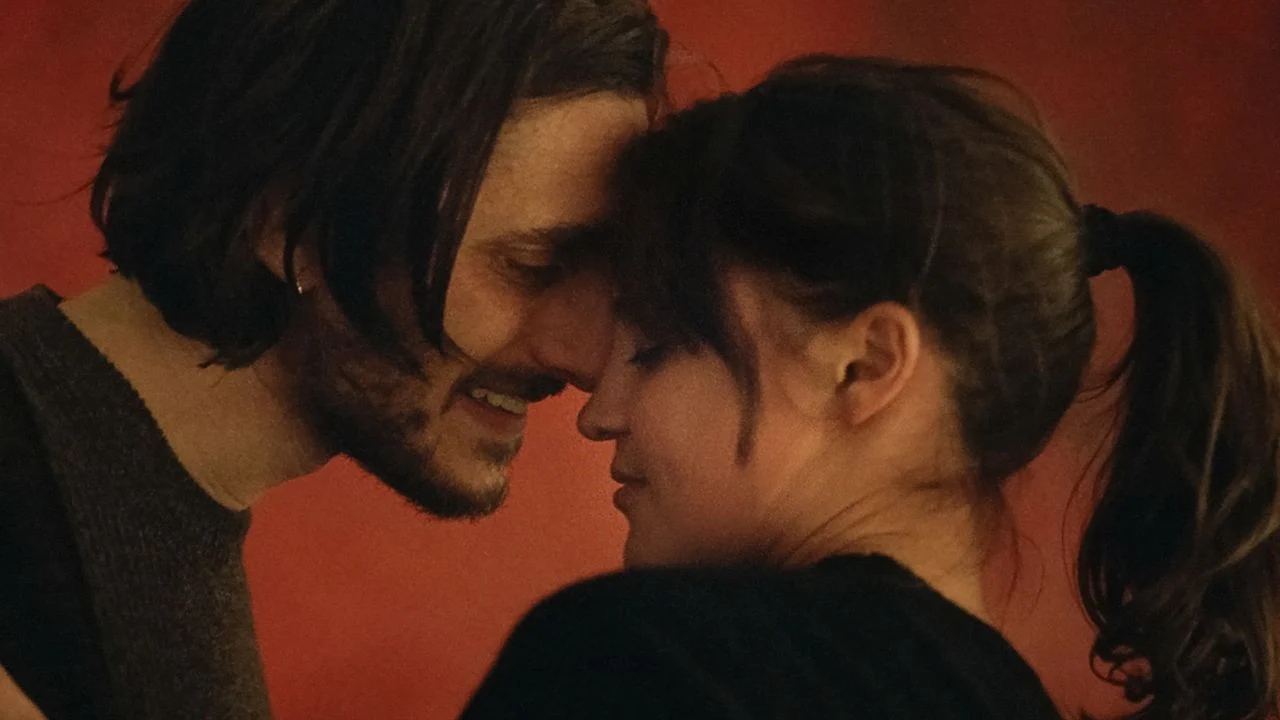
With Anne (Alicia Vikander), addiction also enters the life of Leo (Luca Marinelli).
“The Echo Chamber” is – as the title suggests – a chamber play in which we never leave the protagonist’s apartment: the music producer Leo (Luca Marinelli) loses consciousness in the first scene after an opioid overdose, only the intervention of his girlfriend Anne (Alicia Vikander) saves his life. The film then follows two tracks. On the one hand, we learn in flashbacks how the couple met: Anne was Leo’s doctor who treated him for his almost unbearable spinal pain – and it was she who gave him the first strong painkillers out of pity and thus laid the foundation for his addiction.
On the other hand, we accompany Leo as he struggles through everyday life after 87 days without pills. It was he who convinced the long-retired singer Ava (Susan Sarandon) to record another album. But can he really do it without being able to artificially suppress his pain? At the same time, Anne secretly sneaks into his apartment during the day when Leo is out and about. Her feelings of guilt are obviously too great to meet him in person, but she can’t let him go either. So the two only perceive each other as the titular echo of each other…
You know everything – and then it’s not even convincing
There is at least one really good scene. When Leo tells Anne that he missed her, she not only kisses him in response, she also reaches into her pocket to get the pills for him. It is clear to her that he also means “her” as a human being, but at the same time he also means “her” as a redeemer from the constant pain. Now it may not be easy to believe that “Ex Machina” star Alicia Vikander of all people has to “buy” her way into a love affair with illegal painkillers, but it is precisely this complete naturalness of automatically reaching for the pills that is really frightening.
Unfortunately, there are far too few of such moments. Despite the wonderfully smoky voice of Susan Sarandon (“Rocky Horror Picture Show”), the musical work on the new album is as banal as it is dull. In addition, neither the addiction-dominated romantic skirmishes nor the later resistance to the temptation to fall back into old patterns seem fresh or even believable. The same applies to the infatuation, which on paper appears to be tragically manic, but which then simmers on the back burner the whole time.
Ghosts also have an echo
Alicia Vikander’s role in particular remains a single blank space until the end – but this fits at least with some of the production ideas: Diego García, who has already worked with such master directors as Yorgos Lanthimos (“Nimic”) and Apichatpong Weerasethakul (“Cemetery Of Splendor”), gives the apartment a claustrophobic narrowness with his analogue 4:3 images. And sometimes two shots are even superimposed so that Alicia Vikander creeps through the rooms like a half-faded ghost.
And then a quarter of an hour before the end there is a completely undeserved twist that comes out of nowhere, which sets “The Echo Chamber” on a completely new track for the remaining minutes. It was supposed to be a big, tragic turn, which Andrea Pallaoro then appropriately ushers in with a long sequence of shots out the window – one of the very few moments in which we look out of the apartment, even if we never leave it. But at least at my press presentation in Venice, many people just laughed surprisingly loudly at that moment.
Conclusion: Of course it sounds spectacular when a screenplay by cinema legend Bernardo Bertolucci is suddenly made into a film eight years after his death. But this fact only makes it even more painful that the result is really hardly worth mentioning.
We saw “The Echo Chamber” at the Berlin Film Festival, where it had its world premiere as part of the official competition.