
Naoko Yamada is one of the most sensitive voices of the Japanese animated film. Her works usually revolve around introverted young people, whose emotional worlds are only hesitant. In “A Silent Voice” she addressed bullying, guilt and social exclusion in an intensive manner. In “Liz and the Blue Bird”, in turn, she said almost meditatively about the longing ambivalent friendship between two girls. “The Colors Within”, her first film production with the Studio Science Saru (“Inu-OH”), is now a quiet coming-of-age film about three young people who found a band together and become friends.
The director again worked with the screenwriter Reiko Yoshida. For the first time, the story is not based on an existing manga or novel, but on an original idea. Despite this new creative freedom, “The Colors Within“Familiarized: topics such as loneliness, self -doubt, unspoken feelings and the retreat to music as a shelter also determine this film. But while the director's earlier works were released with emotional reprint painful conflicts,“ The Colors Within ”has been committed to ease. The problems of the characters are rather indicated instead of formulated. Sometimes not only the autumnal pastel tones appear softly.

When Totsuko discovers her former classmate Kimi with a guitar, the idea arises to found a band together.
Tototuko visits a Christian boarding school and has an unusual ability: it sees other people's aura than colors, comparable to synesthesia. But out of fear of rejection, she keeps this talent to herself. When she meets the classmate Kimi, she is directly fascinated by her radiant color. But shortly afterwards Kimi leaves school and seems to disappear without a trace-until Tototuko discovers her in a hidden second-hand bookshop with a guitar in her hand. In their embarrassment, Tototuko pretends to be interested in a piano notebook-a misunderstanding that the reserved Rui observes. The trio gets into conversation and directly makes the decision to found a band. A friendship slowly arises between the outsiders …
Naoko Yamada remains formally and thematically loyal in “The Colors Within”, but the film does not reach the strength of its predecessors. As so often with the director, young people are at the center of the action who struggle with the expectations of their surroundings and their own uncertainties. Tototuko hides their gift of color perception. After leaving the girls' school, Kimi struggles to reveal this to her caring grandmother – and Rui fights with the pressure to have to take a medical career to continue the island practice of his family. All three are looking for a place where you can simply be yourself and live out your joy in music.
Shy gestures
It is striking that Yamada chose a more communicative protagonist this time: Tototuko is more lively and open than the often self -contained heroines of her previous works. Nevertheless, speechlessness remains a central motive, for example when it comes to the relationship between Totsuko and Kimi. The fact that this may be the first romantic feelings is only indicated and deliberately not formulated. It stays with the near and small gestures. The queer coding is noticeable, but as is so often subtle with Yamada, almost shy.
Visually, “The Colors Within” is a consistent continuation of Yamada's style. The film relies on delicate pastel tones, in which figures and backgrounds are about to come. That fits well with an animated film of the quiet tones, in which the young people take careful first steps into a self -determined life. A watercolor-like look dominates especially in those scenes in which Totsuko sees the colors of other people. This visual implementation of synesthesia gives the film a poetic quality, even if the ability increasingly takes a back seat even in the course of history. The color symbolism is rather aesthetic expression than narrative drive.
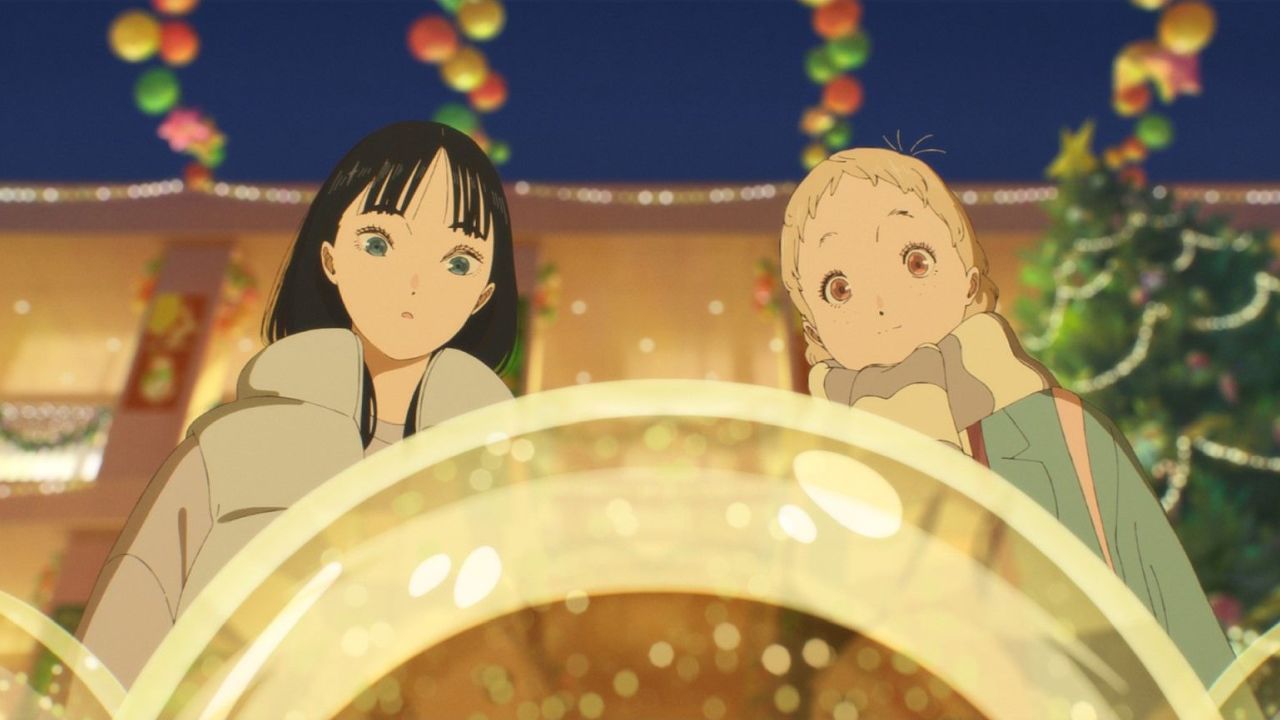
Tototuko can see other people's auras than colors. No wonder that “The Colors Within” also visually lives up to his title.
The music also remains surprisingly reserved in its effect. How the three young people approach in secret rehearsals and overcome their shyness is captivated sensitively, but the creative process of composing and making music together is more indicated than deepened. The electric pop band acts less as a narrative center, but rather as a symbolic expression of cohesion and youthful self-discovery. The fact that the director herself indicates that she wanted to live out her dream of founding her own band with the film explains the loving and sometimes idealized representation of the music group. By only indenting deeper conflicts and longings of the young people, the narrative keeps a soothing lightness, but also remains reserved in their emotional depth.
Even if the precise observing of gestures, postures, silence also comes into play in “The Colors Within”, the interpersonal dynamics often look too smooth. The conflicts are not lived through, but rather orbit. Rui in particular remains a edge figure – its problems are only striped. Precisely because the film stays almost completely from dramatic exaggerations, it seems emotionally steamed. The pain of “A Silent Voice”, the obsessive binding of “Liz and the Blue Bird” is missing. Instead, there is a visually pastel -colored animation work, which tells full of warmth and lightness of three young people without allowing darker colors.
Conclusion: “The Colors Within” is visually enchanting, but remains surprisingly soft. Yamada does without dramatic developments and around the emotional problem areas, which makes the film look light -footed, but also somewhat irrelevant.