
For a brief moment in the late 1990s and early 2000s, the entire cinema world seemed to belong to Alejandro Amenábar. With the snuff thriller “Tesis,” the Chilean-Spanish director scored his first notable success in 1996, which was artistically and commercially convincing. The sequel “Virtual Nightmare – Open Your Eyes” (1997) was a worldwide phenomenon: It launched Penélope Cruz’s global career, Tom Cruise bought the rights and had the script remade as “Vanilla Sky” by Cameron Crowe, also with Cruz on board. This was followed by “The Others” (2001) with Nicole Kidman – the extremely successful Hollywood entry – and then “The Sea in Me”, for which Amenábar was honored with the foreign Oscar. It's not easy to find a director whose rise has been similarly meteoric.
The hangover after the party was even more sobering. The elaborate drama “Agora” (2009) with Rachel Weisz flopped, the thriller comeback “Regression” (2015) failed, and his last film to date “Mientras Dure la Guerra” (2019) took place more or less in camera. Of course, the quality of the films mentioned can be debated. But the fact is that neither the audience nor the critics were particularly favorable to Amenábar. However, at least in Spain, his name still seems to be driving ticket sales. This is the only way to explain why a relatively generous budget was given to a rather intimate historical drama like “The Captive”. To achieve this, Amenábar goes all out in terms of content and production technology, as befits a project about Miguel de Cervantes, the inventor of the novel genre and saint of world literature.
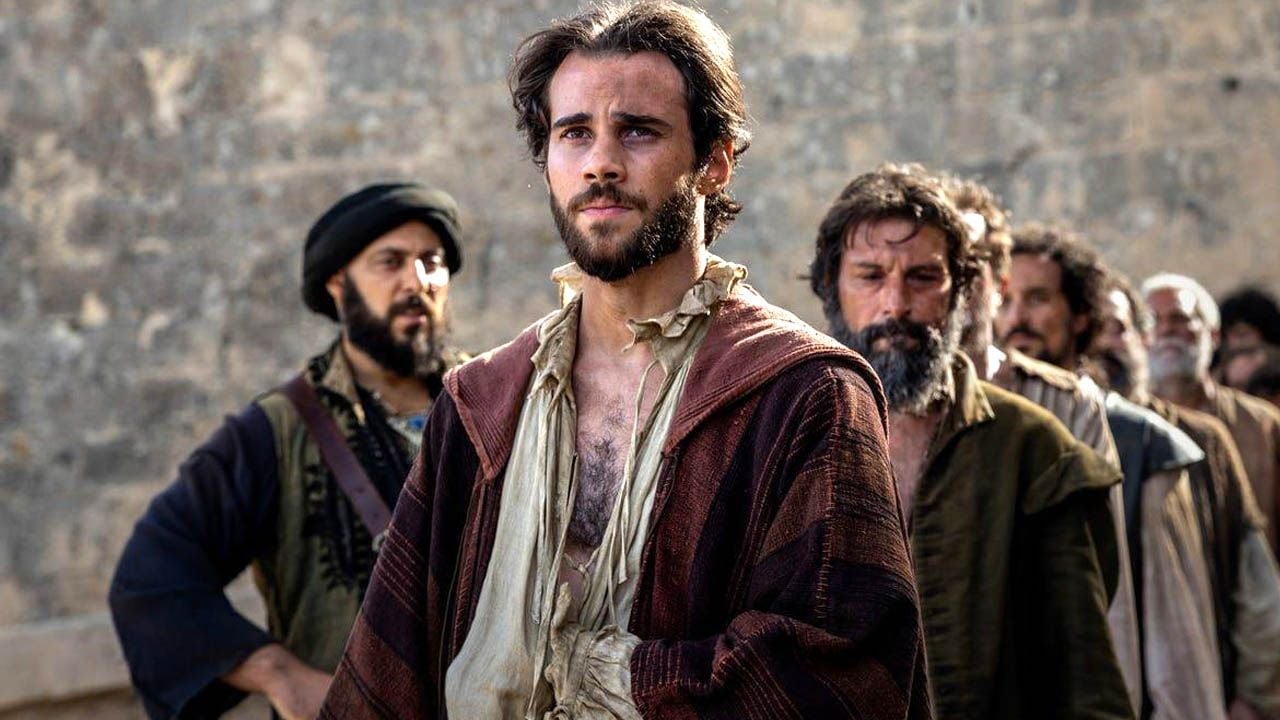
Miguel de Cervantes (Julio Peña) has to spend five years in an Algerian prison – and soon inspires not only his fellow prisoners with his storytelling skills.
Amenábar's film begins during Cervantes's captivity in Algeria between 1575 and 1580, which is documented by sources, but otherwise cares little about facts. Miguel de Cervantes (Julio Peña) is kidnapped, enslaved and remains with other Christian prisoners under the despotic rule of the Sultan of Algeria, Hasán Bajá (Alessandro Borghi). The chances that he will be released by paying a ransom are slim. To pass the time and keep the prisoners' morale up, Cervantes begins telling stories.
His reputation as a master storyteller in the prison camp soon precedes him, and the Sultan himself takes notice of him. He likes to be enchanted by Cervantes' art and grants him privileges for particularly beautiful stories: delicious food, hamam baths, outdoor activities. Inspired by this, Cervantes begins to make escape plans with his fellow prisoners. But he soon finds himself torn between his longing for freedom and unexpectedly emerging feelings for the Sultan…
Not a boring biopic
I first saw posters for “The Captive” during my summer vacation in Spain and at first thought it was a Don Quixote film adaptation. The main actor Julio Peña smiled provocatively and invitingly from the posters, but my interest was limited because I had originally expected a well-behaved, boring costume film. So I'm happy to report that I was wrong about that. As you might notice from the summary, Amenábar is less interested in a dull biographical retelling. Rather, in the film he creates a wildly fabled discourse about the power and power of storytelling.
To do this, he relies on a complex, ambiguous script that often cleverly blurs the line between reality and reality as the plot progresses. Even spectators who pay close attention are repeatedly led on the wrong track. Just like his hero, who first wins over his fellow prisoners and then increasingly his tormentors with his storytelling talent, Amenábar succeeds in getting the audience more and more excited about his film as the story progresses. The approaches of the main character and the director reflect each other in a beautiful way.

Sultan Hasán Bajá (Alessandro Borghi) soon becomes aware of Cervantes' talent.
The film's attitude towards religious issues proves to be interesting, pleasantly relaxed and deeply humanistic. The conflict between Islam and Catholicism forms the background, but Amenábar does not use this to settle ideological scores. It is not the religion of the actors that is crucial, but rather their individual conscience and free spirit, which always enable them to create freedom within the narrow limits set for them.
Beautiful locations, a no less great set design and an agile widescreen camera prevent the material from becoming a tiring constant fire of dialogue. A touch of Orientalism creeps in as Cervantes travels through Algeria, with sexually charged images that become increasingly important in the second half of the film. The erotic tension between Cervantes and the Sultan is released very explicitly at some point, with Alessandro Borghi and Julio Peña making an extremely attractive couple that you sympathize with and root for. This helped the film get a lot of press in Spain and a good box office result, even if discussions about Cervantes' sexuality miss the point of the story. But gossip is always popular, as it is part of the oral tradition – and thus also contributes to the theme of the film.
Conclusion: After a long break, Alejandro Amenábar returns refreshed with an idiosyncratic and narratively ambitious mixture of adventure film, historical drama and boyslove comic that doesn't shy away from the literary ivory tower as well as the disrespectful joy alley. Sophisticated yet light-hearted, sardonically entertaining yet intellectually stimulating, the film is an unmitigated, baroque delight.