
Ridley Scott and Matt Damon were also on the bill beforehand. But when their space survival drama “The Martian” hit like a bomb in 2015, Hollywood became aware of one man in particular: The original author Andy Weir, with his self-published debut, had ultimately provided the basis for the equally exciting and entertaining Mars adventure, which grossed six times its budget of 108 million dollars at the worldwide box office. So it’s no wonder that the dream factory secured the film rights to his next two science fiction novels before (!) they were published.
After mixed reactions to the book, in which a petty criminal gets caught up in a conspiracy on a moon colony, the film adaptation of “Artemis” came to nothing. However, the “Spider-Verse” duo Phil Lord and Christopher Miller, who were slated to direct, did not let this discourage them. Three years later, they simply picked up Weir’s next, more favorably received novel – and turned it into a visually breathtaking world-saving trip with “The Astronaut – Project Hail Mary”, which also features perhaps the most heartbreaking on-screen friendship of the year.
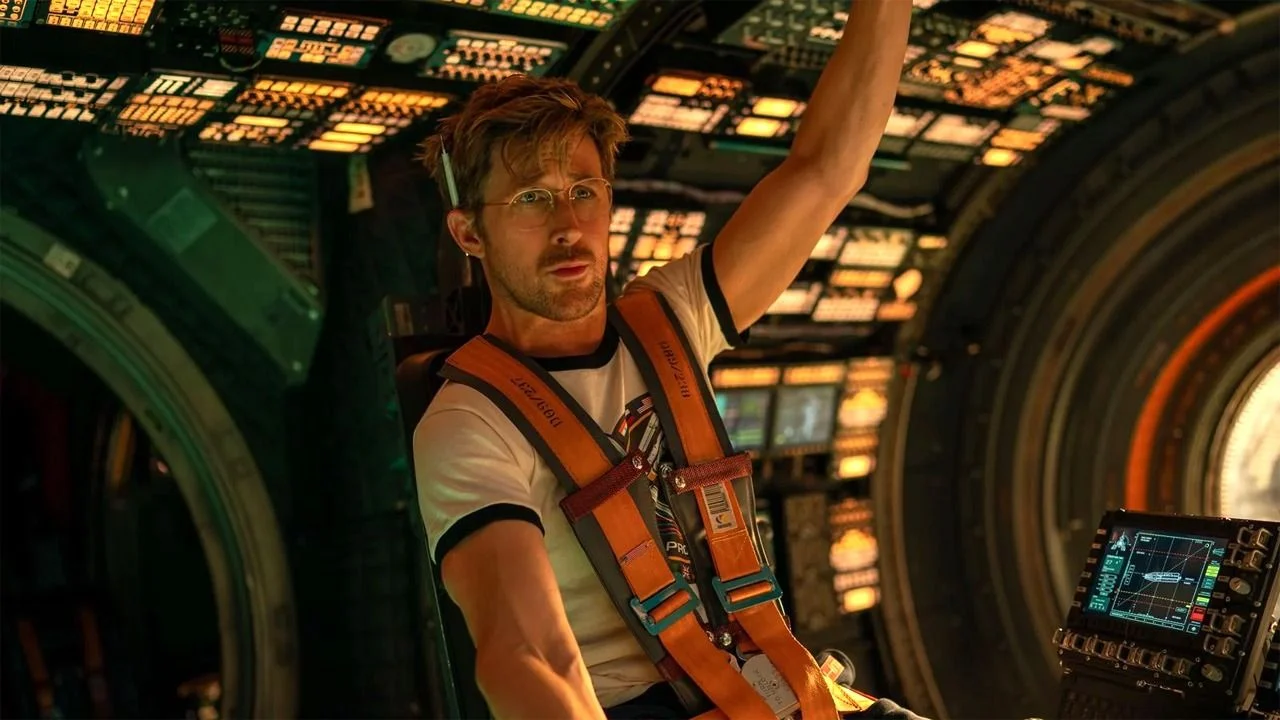
In space, Ryland Grace (Ryan Gosling) is completely on his own – or is he?
Dr. Ryland Grace (Ryan Gosling) wakes up alone on board a spaceship hurtling through an alien solar system far from Earth. After initial lapses in memory, he soon realizes the true nature of his extraordinary mission: he has been sent to save his home planet! The earth is heading towards a new ice age since the sun is rapidly losing energy.
However, the phenomenon not only affects our sun, but also seems to be spreading throughout the universe. Only one star is apparently unaffected – and that’s exactly where Grace is now heading to look for a solution to the cosmic problem. Left to his own devices, the biologist increasingly doubts the feasibility of this human task – until he realizes that he may not be as alone in the vastness of space as he initially believed…
Hopeful science fiction
The scenario presented to us here by Andy Weir and screenwriter Drew Goddard, who was already responsible for the “Martian” adaptation, would be the starting point for a dystopian-melancholic farewell to humanity in many films. “The Astronaut” also makes no secret of how serious the situation is. Nevertheless, in many ways the story takes exactly the opposite path to similar visions of the future. Including loss of memory and disorientation, consistently told from the perspective of the main character, a hopeful sci-fi adventure unfolds about the power of solidarity in difficult times.
This already shines through during the repeatedly interspersed flashbacks, in which it is revealed how Grace, under the guidance of the resolute project manager Eva Stratt (Sandra Hülser), became part of the Hail Mary project – for which all the nations of the world pulled together. But the message is conveyed even more powerfully through a very special relationship that forms the wonderful heart of the film, allowing it to really gain momentum after a rather leisurely beginning and making it stand out from the mass of sci-fi stories.

To save the world, teacher Ryland Grace (Ryan Gosling) unexpectedly becomes an astronaut.
At this point we need to briefly address a key development in the plot of The Astronaut. This is also highlighted in the trailers. However, if you haven’t seen a preview yet and want to go into the film completely unbiased, you should skip the following three paragraphs.
As already indicated, Ryland Grace, contrary to expectations, does not remain alone on his suicide mission (hence the original English title “Project Hail Mary”). Instead, he meets a crab-like stone creature that he affectionately names Rocky and that has set off into space for the same reason as him. Rocky is also looking for a way to save his planet from extinction in the face of star extinction. And so, after overcoming the initial language barrier, the two unlikely astronauts team up to increase their chances of success.
The two quickly develop a deep mutual understanding, which turns the initial community of convenience into an increasingly intimate friendship. This is especially a feat because the rocky Rocky has no face at all and therefore no facial expressions! The unusual astronauts initially approach each other using gestures, sounds and even puppet shows, until a translation program is finally used.
More feelings, less science
With an elegant mix of cross-species situational comedy and great emotions, Phil Lord and Christopher Miller create a heartwarming bond on the screen – not only between Rocky and his counterpart, but also with the audience. A small downer for fans of the original: With this clear focus, the scientific underpinnings that run through the entire novel (and were also more pronounced in “The Martian”) tend to fade into the background in “The Astronaut”.
The Oscar-nominated directing duo always leaves mouths open on other levels, not least when it comes to what happens outside the spaceships. Since 2014’s “22 Jump Street,” Lord and Miller have not brought a film to theaters as directors (they were fired on the “Star Wars” spin-off “Solo” due to creative differences, and they “only” accompanied the “Spider-Verse” films as writers and producers). Apparently a lot of visual energy has built up there, which now literally explodes into a perfect rush of colors and lights in “The Astronaut”. Space probably hasn’t looked this beautiful since Christopher Nolan’s sci-fi epic “Interstellar” in the cinema.
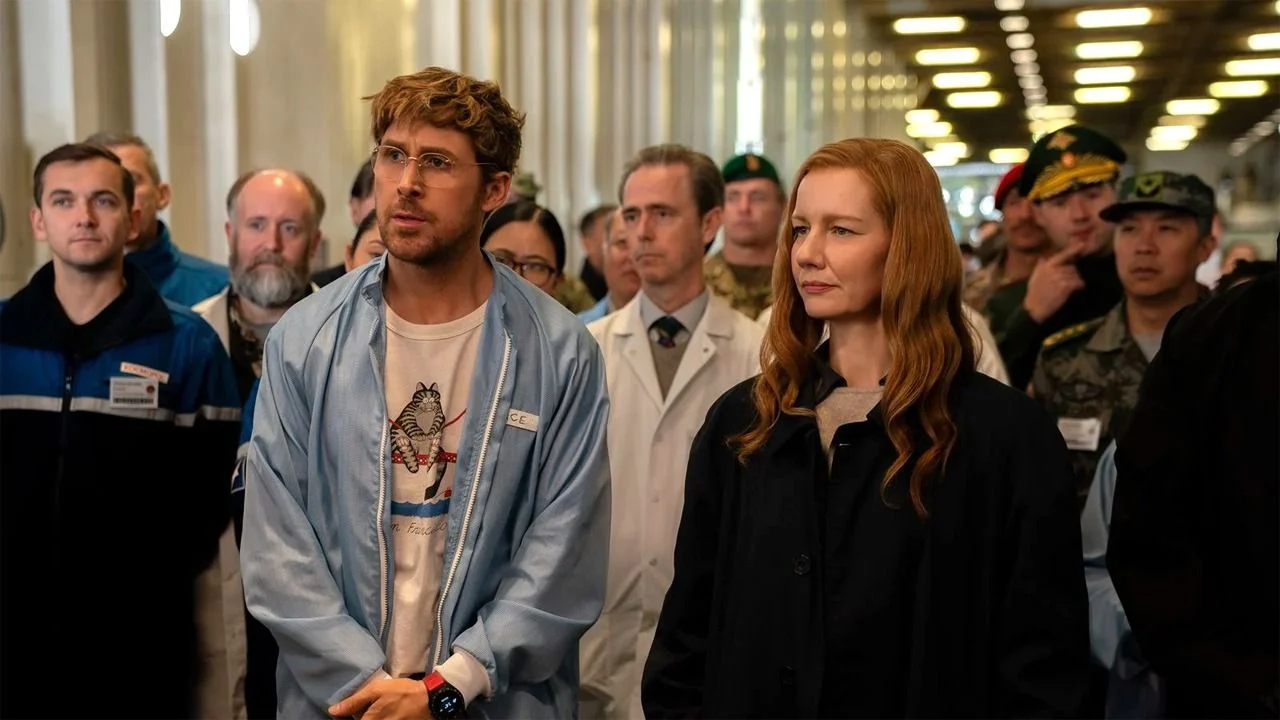
Ryland Grace (Ryan Gosling) ultimately takes on a more important role in Eva Stratt’s (Sandra Hülser) project Hail Mary than he would like.
But all of this would probably only be half as powerful without the adept use of music, which enriches “The Astronaut” in a variety of ways. On the one hand, there is the playful score by “Spider-Verse” composer Daniel Pemberton, which is diverse and catchy at the same time, from spherical, meditative sounds to pieces full of a lively spirit of optimism and the accompaniment of a kind of spaceship ballet (!). But it goes even further when music becomes an essential means of communication within the plot – and not only when communicating with otherworldly sounds, but also in one of the most beautiful scenes, when the project manager Eva Stratt, who has been so aloof for a long time, finally comes out of her shell.
During a moving karaoke interlude, she suddenly performs Harry Styles’ “Sign Of The Times”, giving a small glimpse behind the composed facade. Ten years after her unforgettable “The Greatest Love Of All” solo in “Toni Erdmann,” Sandra Hülser (“Rose”) once again contrasts an apparently cool film character with an unexpected singing performance. A sudden flash of truthfulness that makes it clear why the whole of Hollywood now wants to work not only with Andy Weir, but also with the German Hollywood export (she will soon be seen alongside Tom Cruise in “Digger”).
Conclusion: A touching buddy comedy in space! Despite its fatalistic doomsday scenario, “The Astronaut” turns out to be an infectiously optimistic story about solidarity and a sense of community. After the almost overwhelming space panoramas, you almost feel like taking a trip to the stars. Or to put it in the words of one of the main characters: “Amazement, amazement, amazement!”