
As we all know, the best feel-good comedies with a social cause come from the UK. Bittersweet, heartwarming films in which a bunch of cranky characters grow beyond themselves and grow together. Unforgettable: The 90s classic “All or Not at All” (about stripping unemployed steel workers), the Irish insider tip “Brassed Off” (about a miners’ brass band) from the year before and the surprise hit “Fisherman’s Friends” about a shanty choir from Cornwall. Just like in “Brassed Off” and “Fisherman’s Friends” – as the title suggests – everything in “So Sounds Life” revolves around music. The Spanish tragicomedy focuses on a genre that is deeply rooted in the country’s folklore and is particularly popular in Galicia: the rondallas.
These are instrumental bands that – accompanied by flag bearers – usually perform traditional songs and dances to the rhythm of percussion and plucked instruments. In some areas of Galicia, the rondallas are so popular that there are even competitions in which regional groups compete against each other in the largest halls in front of thousands of spectators. A group from near Vigo that is in top form is now preparing for such a championship in “This is how life sounds”. This marching ensemble show was staged by Daniel Sánchez Arévalo. The Goya Prize winner (for “dark blue, almost black”) takes few dramaturgical risks, but he skillfully maintains the balance between melancholy and lightness.

Extraordinary instruments also have their place in a Rondalla group.
Two years after a tragic shipwreck, the residents of the Galician fishing village of A Guarda are trying to find their way back to life. But that is difficult, after all, many of them have lost family members or close friends as a result of the accident. To escape the lethargy, Luis (strong: the two-time Goya winner Javier Gutiérrez) and Carmen (María Vázquez) decide to reactivate the old musical ensemble. What was initially slow progress turned out to be a great success after a few weeks. Because through rehearsals together, the traumatized village community gradually comes together again…
Dry humor and odd characters
Daniel Sánchez Arévalo looks at the simple lives of the people in A Guarda with a lot of feeling and empathy. Most of them make a living from fishing, including Luis, who holds the film together narratively. The director groups a large number of lovable, stubborn protagonists around him, all of whom have their own burden to bear in their own way. Including Yayo (Carlos Blanco), who lost a leg in the accident. The always tipsy, bearded fisherman, who travels with a lowered electric wheelchair, faces the adversities of life with dry, laconic humor and hearty sayings.
Or Xoel (Tamar Novas), who has the (elementary) role of standard bearer in the competition. The sensitive man has been lacking motivation since a breakup. Thanks to Yayo, who teaches him the art of flag-carrying, he finally finds new self-confidence. The duo’s “practice sessions” at the local basketball court are among the funniest scenes in the film.
An excess of storylines
Speaking of humor: Arévalo skillfully generates it from the peculiarities of the locals without making fun of them. What is also striking is the authentic impression that arises when watching. On the one hand, this is due to the wonderfully well-rehearsed ensemble, which credibly embodies the lifelike characters. On the other hand, this lightness comes from the carefully composed cut. This is based entirely on “natural” human behavior (movements, gestures, facial expressions) and the rhythm of the music.
However, when it comes to plot dramaturgy, the film plays it safe. Unfortunately, “That’s What Life Sounds Like” cannot break away from the mechanisms and (unwritten) rules of classic feel-good comedies. This means that the course of the plot and the ending are fairly predictable and are suggested early on. In addition, some subplots and characters lack depth – a typical problem with many ensemble and episodic films.
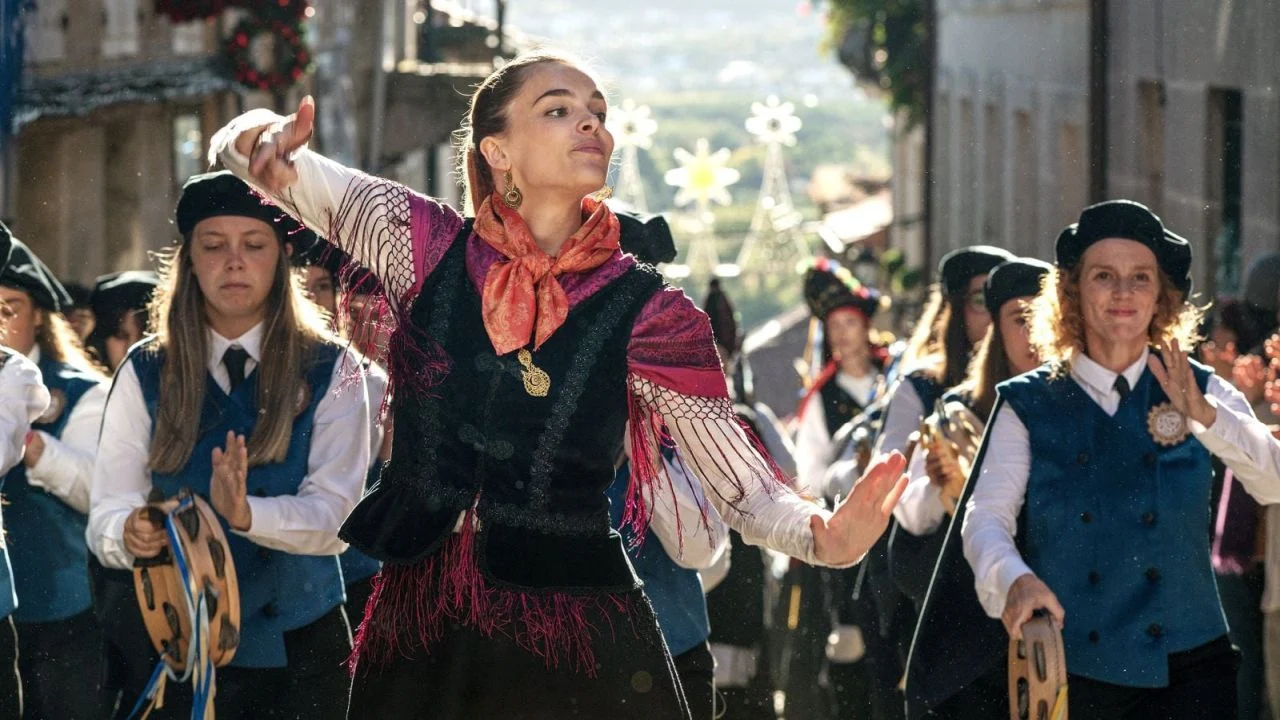
At the Rondalla, music and dance simply belong together!
This is particularly true of “That’s What Life Sounds Like,” as Arévalo stuffs his almost two-hour film with subplots, characters, storylines and themes (coping with grief, money worries, depression, environmental destruction, generational conflict). Much of it remains only hinted at and appears sketchy. And then there is also a crime subplot that reveals unexpected details about the true causes of the ship accident. Due to this wealth of topics, the film seems quite overloaded and downright bloated.
In return, Arévalo presents all the energy, power and diversity that lies behind the Rondalla performances with their complex choreographies during rehearsals and in the grand finale of the music competition. These scenes are masterfully edited and arranged. However, Arévalo does not use the music and the performances to evoke emotions in the viewer in a striking way. Rather, he uses these energetic moments in which the residents grow together and form a unit in a targeted manner and with a sense of atmosphere.
Conclusion: “This is how life sounds” celebrates the resurrection of a traditional Rondallas ensemble with powerful live impressions and downright intoxicating music scenes. The film, told in a relaxed manner, impresses with a well-rehearsed ensemble and proves to be an enjoyable, feel-good movie with depth. However, the mosaic-like narrative and the extreme density of themes are not good for the Spanish tragicomedy.