
Coming-of-age stories from “Lady Bird” to “Unorthodox”, which take place in a religious environment, often follow a familiar pattern: the young protagonists begin to question the (religious) rules, want to try things out and at some point are faced with the decision whether they should dare to break out. The award-winning “Sundays,” however, takes exactly the opposite approach. Because this is not about breaking away, but rather about consciously turning to a strictly religious life. The 17-year-old protagonist confronts her family with the desire to join a convent and become a nun.
This comes as a complete surprise to their relatives and raises questions. Is she actually driven by a religious vocation, or is it perhaps the (overreaching) influence of her Christian school? Director Alauda Ruiz de Azúa, who after her debut “Lullaby” and the series “Querer – Behind Closed Doors” once again focuses on family tensions, is little interested in clear answers. Instead, it’s about the dynamics that the unexpected decision triggers. Her production deliberately remains reserved and focuses precisely on the reactions within the family.
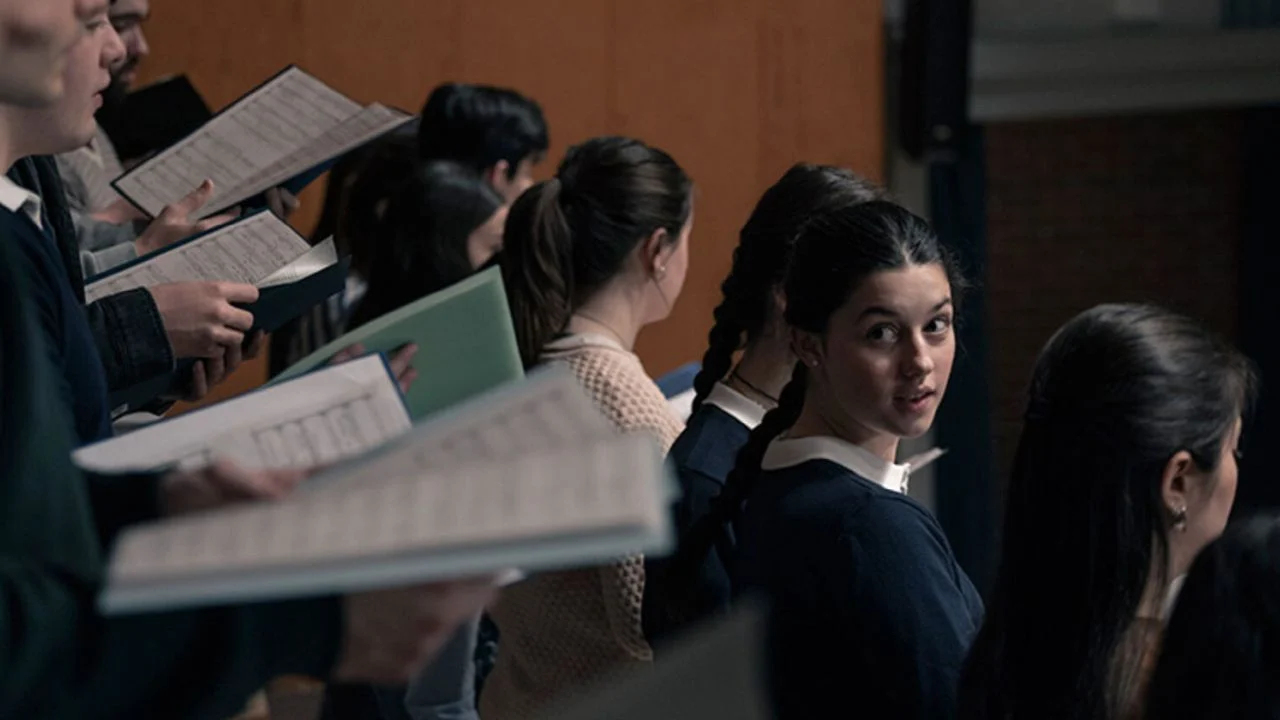
Did Ainara (Blanca Soroa) really freely make the decision to pursue a religious life as a nun?
After a trip to a monastery with her school choir, 17-year-old Ainara (Blanca Soroa) decides to become a nun herself. Her single father Iñaki (Miguel Garcés) initially expresses concerns, but soon accepts her wish to live in the convent as an expression of her free will. Her aunt Maite (Patricia López Arnaiz), in particular, reacts with growing incomprehension.
For her, Ainara is still far too young to make such a far-reaching decision. She suspects strong influence from the Catholic school and from the young guidance counselor and priest Txema (Víctor Sainz). That’s why she tries to dissuade Ainara from her plan. Within the family, different ideas about life paths and beliefs are increasingly clashing…
Won tons of prizes
Alauda Ruiz de Azúa’s staging is reserved and declares her protagonist to be neither a fanatic nor a seduced person. Rather, Ainara becomes a projection surface for the family’s doubts. Without dramatic exaggerations or melodramatic exaggerations, “Sundays” instead relies on calm settings and concentrated character management – and was immediately awarded the Golden Shell, the main prize at the renowned San Sebastián International Film Festival. Later, five Spanish film awards were added, including the Goya for the best Spanish film of the year. The 17-year-old’s drastic life decision does not seem to be based on a slow process, but rather on a strong inspiration.
Newcomer Blanca Soroa plays Ainara as a quiet, reserved girl who develops an astonishing clarity about her life’s path. She’s not your typical rebellious teenager; rather, she seems to find something in her faith that she was missing before. Especially in the conversations about her newly discovered spirituality, she seems more alive, almost liberated at times. Whether Ainara’s decision is an expression of self-determination, spiritual inspiration or indoctrination remains to be seen. Although the Catholic school and the young priest form a context that allows for doubt, Ruiz de Azúa refrains from making a clear accusation or a clear explanation.

The members of her family react completely differently to Ainara’s desire to become a nun.
The character of Aunt Maite in particular gives the film an emotional sharpness. She acts as a counterpoint to Ainara’s desire to leave the family and enter the monastery without ever becoming a mere antagonist. Their resistance is not ideological but deeply personal; it feeds on genuine concern. Patricia López Arnaiz (“20,000 Kinds of Bees”) plays Maite with great precision and a presence that makes the character tangible.
Her character oscillates between rational doubt and emotional overwhelm, especially since her own life with her husband is currently in a difficult phase. Her vehement reactions show how much she struggles for her niece’s well-being and at the same time struggles with her own, unresolved conflicts. This is particularly impressive in her encounter with the Mother Superior of the convent: despite polite words, the mutual incomprehension becomes clear. This is where the central area of tension between two life plans that can hardly be reconciled with each other becomes more intense.
Exciting contrasts in the use of music too
The use of the song “Quédate (BZRP Music Sessions, Vol. 52)” at the very beginning of the film forms a conscious contrast to the otherwise reduced sound design, which is largely limited to the choir songs of the students and the nuns. In a particularly impressive sequence, the singing of a previously captured choir rehearsal continues while the young people are seen dancing exuberantly at a party in the flickering light. For a moment, Christian music intertwines with the everyday world of young people. The lightheartedness of youth that Ainara is ready to leave behind shines through.
Life in the convent is not romanticized, but rather shown as a strict, clearly structured everyday life: prayer, work, community, but also an isolated life and conscious renunciation. The fact that Ainara consciously chooses all of this makes her decision all the more radical. Ultimately, the director is not just concerned with religion, but also with (family) relationships and their resilience. How do you deal with a decision that you deeply disagree with but should (possibly) still respect? And how do you hold on to a relationship when you can no longer understand the other person’s path?
Conclusion: “Sundays” is a quiet, precisely staged family drama with an unusual coming-of-age theme. Alauda Ruiz de Azúa is particularly interested in the emotional conflicts that the 17-year-old protagonist’s radical life decision triggers both within herself and those around her. Patricia López Arnaiz is particularly convincing as the worried aunt with an immense presence in the overall strong ensemble. The ambivalent description and the fine, reserved observations create a certain distance, but at the same time they also make the Goya winner 2026 so special.