
Director Ed Herzog’s Eberhofer cinema franchise now includes ten parts – even though “Dampfnudelblues” was actually shot for television at the time and was only released on the big screen at the instigation of a Bavarian cinema owner. With such a long-running film series, two things can hardly be avoided: firstly, a lot of supporting characters accumulate over the years – and secondly, it becomes increasingly difficult to fundamentally reinvent the wheel every time. The anniversary case of the “Steckerlfisch fiasco” is a good example of this, because this time there are no real surprises, while the now incredibly extensive arsenal of figures turns out to be ballast – no matter how bizarre and lovable the individual residents of Niederkaltenkirchen may be.
Nevertheless, the ever-growing crowd of fans (Part 9 set another record with 1.5 million visitors) gets their money’s worth again this time – and is entertainingly entertained for the majority of the 99 minutes. Or with the words from our review of “Rehragout-Rendezvous” from 2023: “A new Eberhofer crime novel is like eating at grandma’s. You know exactly what you’re getting!”
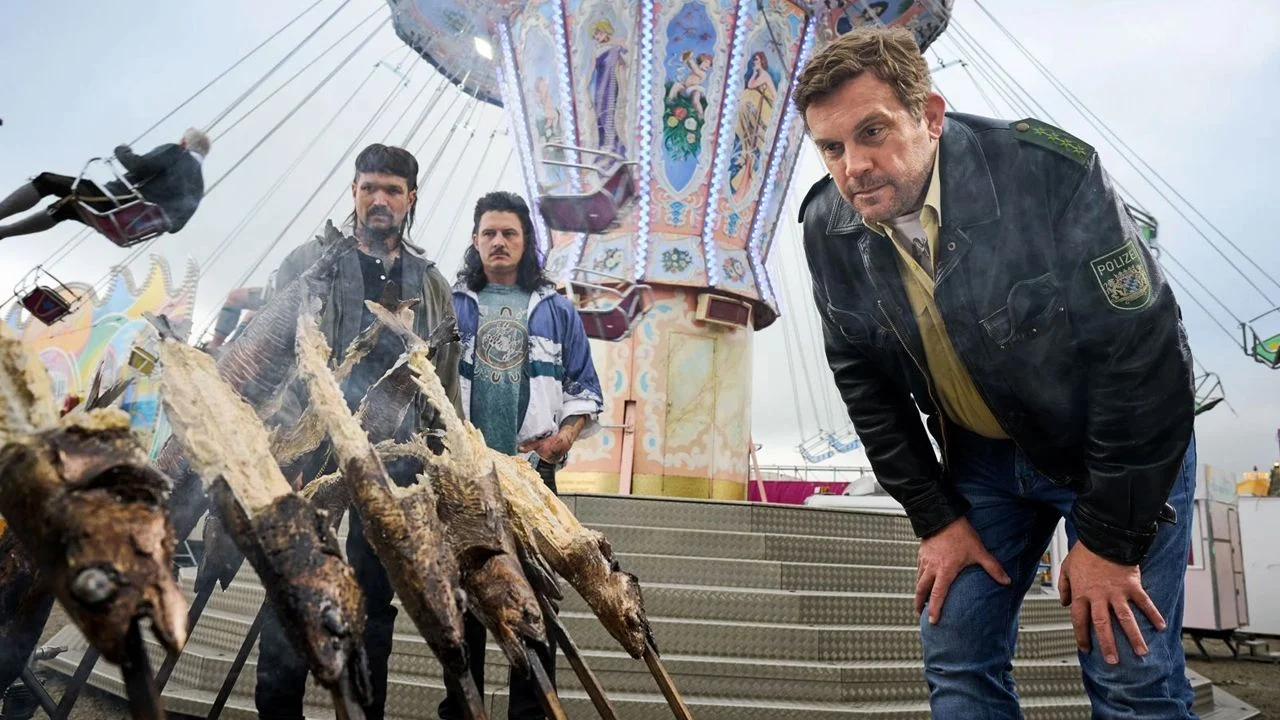
This time, the village sheriff Franz Eberhofer (Sebastian Bezzel) is investigating at a fairground.
Franz Eberhofer (Sebastian Bezzel) is slowly having enough: He has been called to the fairground in Niederkaltenkirchen several times to settle disputes between the local male fish king Paulus (we are not revealing the spectacular cast at this point at the request of the distributor) and the extended Dottinger family. Added to this is the trouble at home, where Franz is not allowed to take his dog Hinkelotta into the house due to the renovation of the semi-detached house at home – and Susi (Lisa Maria Potthoff) only thinks about her candidacy for mayor.
A new murder case comes at just the right time for Eberhofer: the plug fish king in question was found dead in the newly built golf club in Niederkaltenkirchen. During the investigation that follows, it doesn’t take long before he and his old friend Rudi Birkenberger (Simon Schwarz) become involved in a full-blown family feud between two folk festival clans. But is the case actually as simple as it first seems?
Romeo and Juliet at the fairground?
The case mentioned in the previous paragraph is just right for Eberhofer in “Steckerlfischfiasko”, but the crime plot still doesn’t take up a lot of time – even though a promising foundation is actually laid with the fairground setting and the family feud. So no one should expect “Romeo and Juliet at a Lower Bavarian fairground” here, even though that’s exactly how it’s pronounced in the film. Rather, the focus of the film is on two (other) relationships: the once again troubled romance between Franz and Susi and the bromance between Franz and Rudi. Both teams bicker in an extremely amusing way in “Steckerlfischfiasko”.
In addition, not only are the investigations, which are rather dutifully carried out here, clearly pushed into the background, but some of the obligatory guest appearances don’t really work either. Enzi Fuchs remains the heart of the film series as Grandma Eberhofer despite the few short scenes, but other appearances almost feel a little forced – especially those of Eberhofer’s buddies Flötzinger (Daniel Christensen), Simmerl (Stephan Zinner) and Wolfi (Max Schmidt).
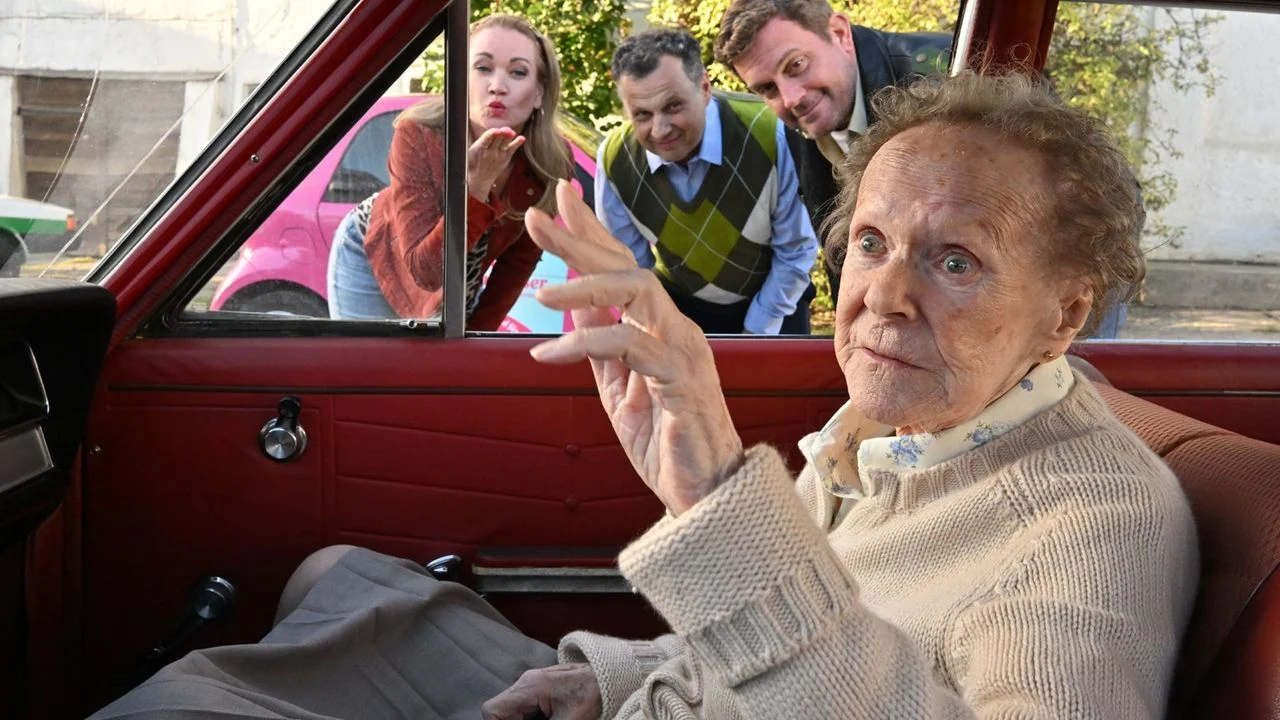
Grandma Eberhofer (Enzi Fuchs) is and remains the heart of the film series.
The integration of the entire Niederkaltenkirchen ensemble is not as successful this time as it was last time in “Rehragout-Rendezvous”. But it’s still incredibly entertaining. Because the tenth Eberhofer film is also firing on all cylinders when it comes to humor. Not only are extremely funny one-liners constantly being dropped (“Anyone who speaks standard German is not automatically right!”), “Steckerlfischfiasko” also always hits the mark when it comes to character drawing and situational comedy. This time Rudi is in a phase of self-discovery and lives in his car, which is why not only – a very successful running gag – do characters constantly complain about his body odor, but there is also a fly buzzing around him in every scene.
And when Franz’s patience breaks at some point in the mayoral election campaign between his Susi and the current incumbent (Thomas Kügel) and he ends a dispute over incorrectly pasted election posters by towing the affected advertising pillar with his police car and tipping it off a bridge, this has never been seen in the previous nine films.
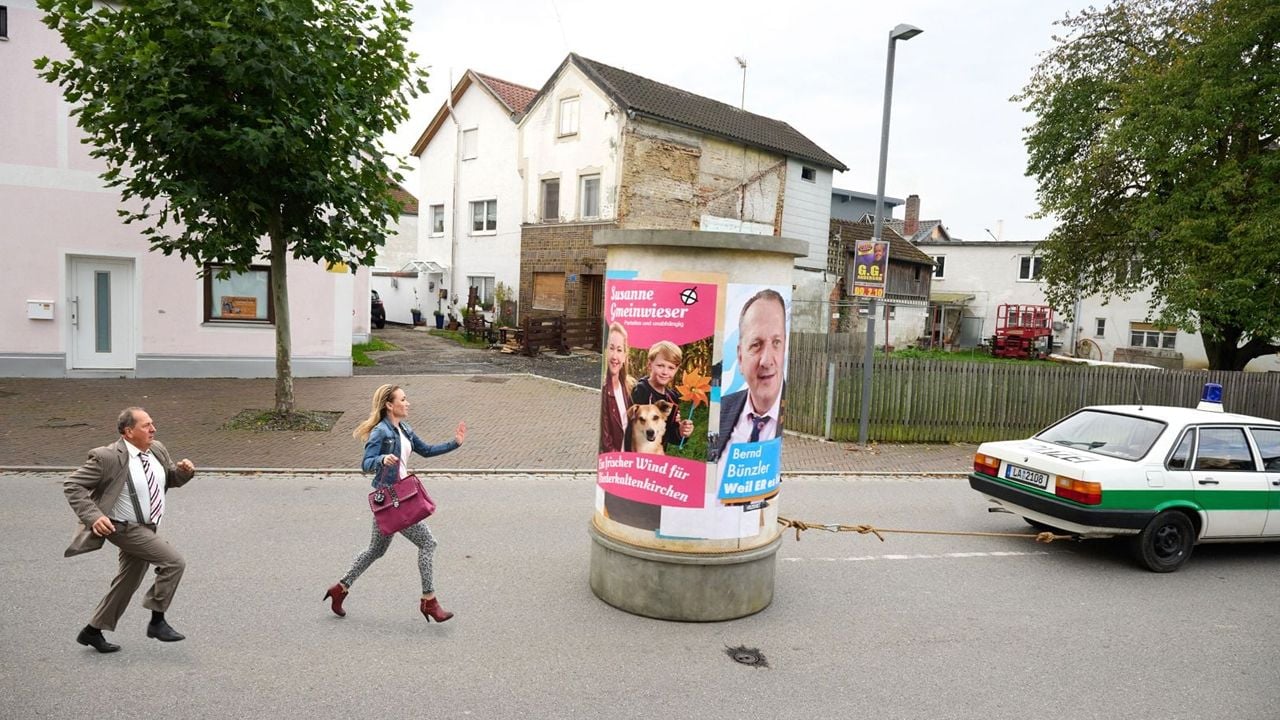
The advertising column scene is one of the highlights of “Steckerlfischfiasko”.
Even the storyline about Franz and Susi’s son Paul (Pelle Küffner), who has recently started dancing ballet, is used for humor. However, not to make fun of this fact (which no one should find funny anymore), but because numerous characters expose themselves with their reaction to it – including Eberhofer himself.
Director Ed Herzog, who is responsible for all ten films, and his well-rehearsed team demonstrate a pretty good hand here, even if the whole thing dissolves a little too easily at the end of the 99-minute running time. This also applies to the other central conflicts of the film – and even the resolution of the criminal case (which has since been pushed into the background) feels more like a compulsory exercise, which is why “Steckerlfischfiasko” noticeably loses its entertainment factor, especially in the last few minutes.
Conclusion: The tenth Eberhofer case is definitely more comedy than crime thriller – because most of the humor works excellently, fans probably won’t mind at all!