
The screen remains black for now. On the soundtrack, however, there is a storm raging. Although the rain is never visible, the consequences of the floods that were triggered on September 1, 2024 in all 23 provinces of Chad by the heaviest rainfall in more than 40 years are certainly visible. The flood damage can also be seen in the mud huts in the desert village of 17-year-old student Kellou (Maïmouna Miawama), who is regularly haunted by nightmarish visions. Even more serious, however, is the fact that five babies have recently died of unknown causes. For the village leader the matter is therefore clear:
The blame must lie with the herbalist Aja (Achouackh Abakar Souleymane), who has returned after a years-long absence. She should therefore kindly disappear again; The youth of the village are already throwing stones at their house. Only the young protagonist supports the woman, who was already working as a midwife when Kellou's mother died during childbirth. Mahamat-Saleh Haroun, who left Chad for France in 1982 because of the civil war, but still sets the majority of his films in his old homeland, relies on a decidedly simple plot and equally reduced characters in “Soumsoum, The Night Of The Stars”.
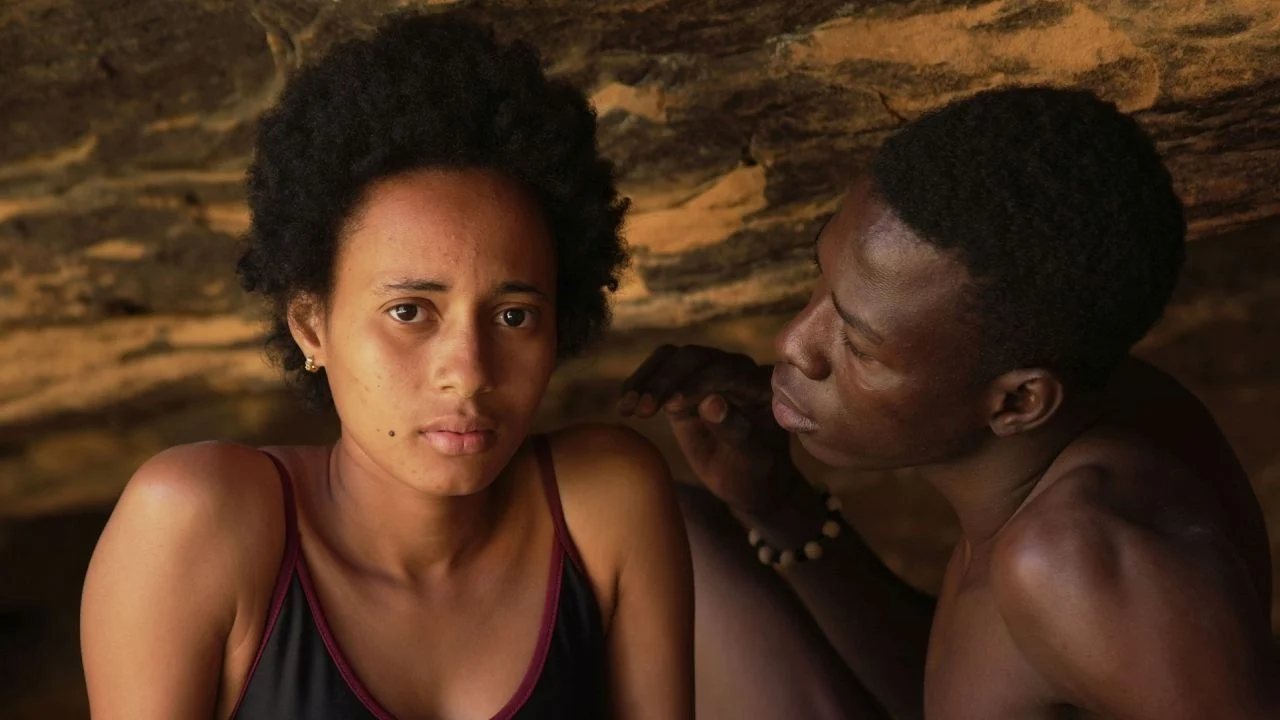
Kellou (Maïmouna Miawama) suffers from her visions – and does not yet understand that they are an important part of her identity.
Instead, he stages his protagonist's coming-of-age as a sun-drenched, spiritual desert trip, which, despite the spectacular locations, drags on for a while at times before suddenly coming up with a few surprises in the last 15 minutes – zombies included. While a particularly bold use of CGI (keyword: raven head) actually comes out of nowhere, the undead announce themselves early on in one of the first of Kellou's visions: a handful of men in white clothes stagger towards them with twisted limbs.
The blurring effect in this scene is one of the few striking staging devices that Mahamat-Saleh Haroun uses in the first hour and a half of his film. Otherwise, the director, who has long been one of the usual suspects in the international festival circuit since works such as “Bye Bye Africa” (Prize for the best debut in Venice), “Daratt” (Special Jury Prize in Venice) and “A Man Who Screams” (Jury Prize in Cannes), is taking a particularly cautious approach this time. The plot in particular seems extremely sparse, a lot remains vague, and the emotions are largely on the back burner – despite the existential situation of those involved.
The only thing that is really new is the ending
The only problem is: By the time Kellou ends up alone in the desert, where the surreal elements increase significantly under the eponymous starry sky, you've actually seen all of this too often to be bothered by the dumbed-down, less specific version of it. Here is the young outsider who, since the death of her mother, has been insulted as being “blood-born,” and whose visions metaphorically depict the feminine and nature-bound. In contrast to this is the destructive superstition of the men in the village, who exclude and incite people with their demon drivel. These are all well-known themes and tropes of (festival) cinema.
“Soumsoum, The Night Of The Stars” simply takes too long to finally become something entirely of its own…
Conclusion: A somnambulistic film between village drama and desert fairy tales, superstitious patriarchy and female solidarity, the visible and the invisible world. Set in a spectacularly sunny setting, “Soumsoum, The Night Of The Stars” is always incredibly beautiful to watch, but the reduced, parable-like plot develops noticeably long stretches before the final quarter of an hour has something unexpected in store.
We saw “Soumsoum, The Night Of The Stars” at the Berlinale 2026, where the film celebrated its world premiere in the official competition.