
When medical student Hana (Midori Francis), protagonist of Natalie Erika James' weight-loss horror “Saccharine”, scrolls through her social media feed, she is literally bombarded with videos that make various offers to her about her own body. The school of body positivity encourages her not only to come to terms with her appearance, but to embrace it. The apologists of self-optimization, on the other hand, lure people with diet plans, fitness courses and weight loss pills. At this point, Hana has already decided on a path: as she will later say, she wants to change for the better.
“It’s my body,” she shouts to her worried friend and fellow student Josie (Danielle Macdonald), and of course she’s undoubtedly right. The other question is to what extent her desire to weigh a few kilos less comes solely from herself, or whether it is more a product of internalized ideals. Her body may belong to her, but others now have the authority to interpret it. A billion-dollar industry has long benefited from the resulting uncertainties.
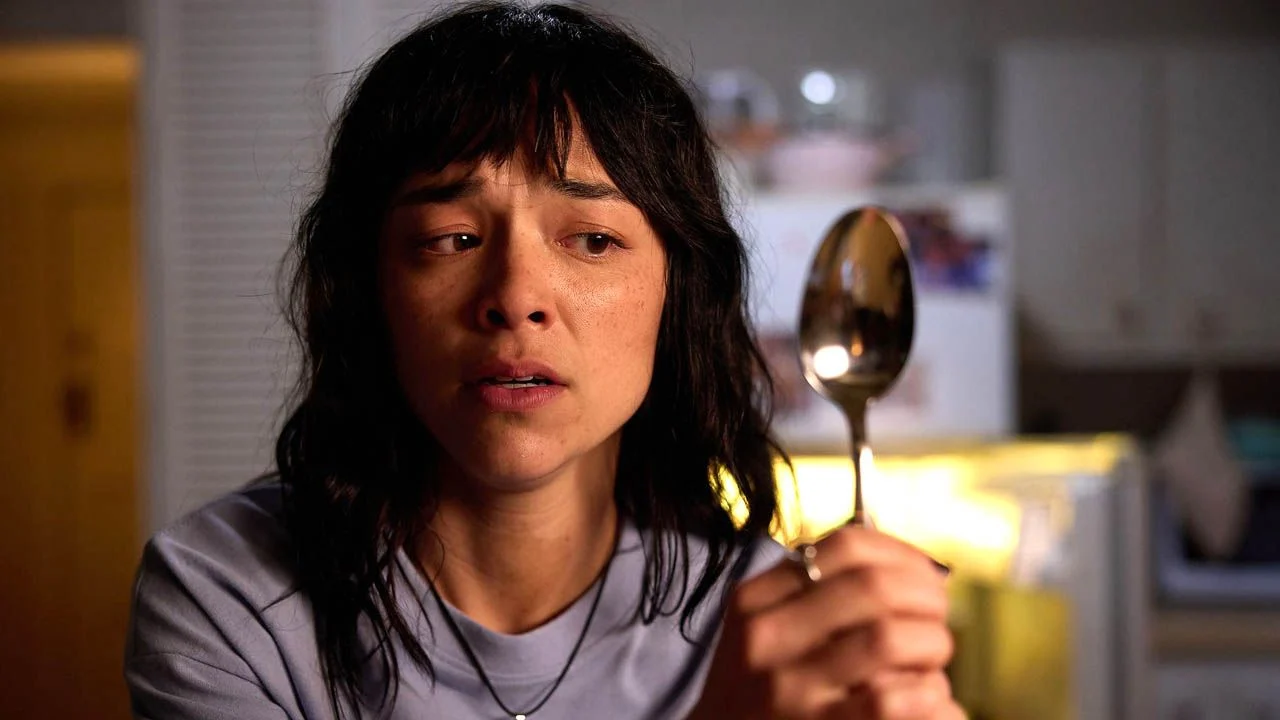
Hana (Midori Francis) has ingested parts of a corpse – which is now looking for her, among other things. in the form of reflections.
In order to finally lose weight – and possibly also to get closer to the fitness trainer Alanya (Madeleine Madden), who she secretly adores – Hana signs up as a guinea pig in a new twelve-week training program. At the same time, she meets her former classmate Melissa (Annie Shapiro) in a bar, who was bullied for being overweight at the time, but is now slim and normally attractive. Her former self is dead, explains Melissa – thanks to a miracle drug called “the gray”, of which she gives Hana a few tablets to take home with her. Your claim that thanks to these pills you can lose significant weight without having to pay attention to your diet quickly seems to be coming true.
Curious as to how this is possible, Hana analyzes the composition of the preparation in the university laboratory – and makes a horrifying discovery: “The Gray” consists partly of human ashes. So Hana makes a radical decision: she secretly steals individual bones from the corpse of an obese woman, untastefully named “Big Bertha” by the students, who made her remains available as a body donation – and from then on she creates her own version of the “horror” at home. In fact, she soon fell below her goal weight of 60 kilograms. But that's not the only effect of the questionable treatment: Hana is haunted by uncontrolled binge eating while she's asleep and by eerie visions when she's awake.
Hints instead of exaggeration
In itself, it wouldn't be a problem if director and screenwriter Natalie Erika James (“Relic”) failed to make Hana's decision plausible from the outset. Unlike “The Substance,” which is often cited as a comparison, “Saccharine” does not recognize the potential for absurdity and dissolution of boundaries that lies dormant in its premise. James tells her story about a young woman who spontaneously becomes a kind of cannibal to combat dissatisfaction with her body, with sometimes paralyzing seriousness. Apparently the film is their attempt to tap into the rampant elevated horror trend, while at the same time the dull look and lack of directorial profile expose it as a direct-to-streaming production.
The stylistic devices seem all too familiar – from alienating detailed shots to ominous slow motion to the ominous score, which is partly made up of loops of human panting and breathing noises. But “Saccharine” hardly develops beyond the mode of pure tease. James delays almost every opportunity to escalate their scenario and allows most of the scares to end on the same note. At the same time, the film is clearly designed around its theme, but still struggles to find a focus.
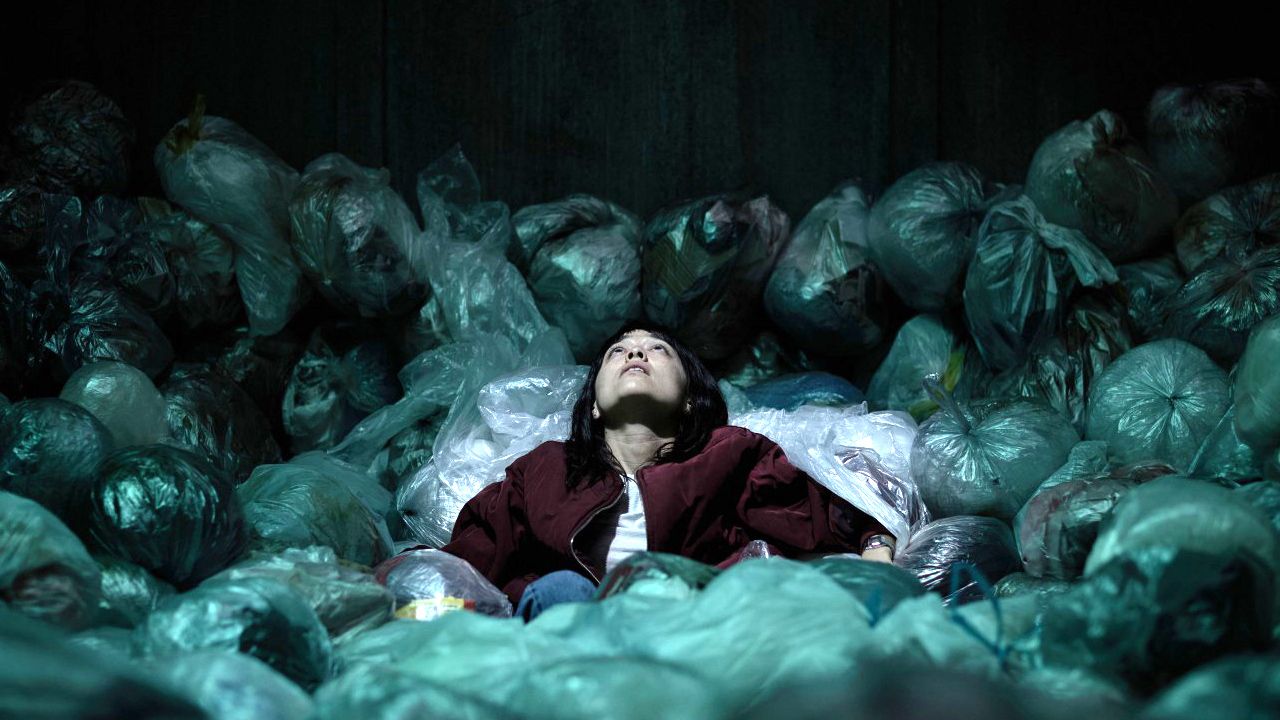
Hana resorts to radical measures to get rid of “Bertha”.
Again and again, the script opens up new sideshows that expand the plot, which are supposed to shed light on Hana's psychological constitution. For example, “Saccharine” works awkwardly towards a revelation about Hana's relationship with her absent father, which briefly lands it in the territory of Darren Aronofsky's chamber play “The Whale” – but it still lacks any added value. Even after two thirds, he is still busy explaining his shaky set of rules instead of pushing the basic idea to some interesting point.
How “Saccharine” derives much of its shock value from the fact that “Bertha's” obesity is displayed in ever more monstrous ways is only partially coherent in the context of its fundamentally body-positive message – even if it is of course tempting to read her appearance as a caricature of Hana's body dysmorphia. And yet, at least in theory, the quality of this body horror lies in the massive presence of the dead, which Hana only perceives in reflections and whose shape, deformed by decay, is grotesquely deformed into the curve of the back of a spoon. One would have wished for a better film for her.
Conclusion: Despite highly topical parallels to Ozempic & Co., it's a body horror film that's not very compellingly staged and that, even after two hours that are far too long, doesn't really know what it actually wants to tell.
We saw “Saccharine” at the Berlinale 2026, where it celebrated its European premiere in the Berlinale Special section.