
In my review of “Resident Evil: Welcome To Raccoon City” I asked whether this was the film that fans of the brand always wanted. After all, the six cracking “Resident Evil” action spectacles with Milla Jovovich were previously extremely successful, but they had about as much to do with the legendary survival horror video game template as an outbreak of the T-virus has to do with a relaxing summer vacation.
Five years after “Welcome To Raccoon City” this question is asked again. After the disappointing performance of “Primate” director Johannes Roberts’ version at the box office, the series is already daring to make its next big screen debut. There is a reason why the answer this time is completely different than in 2021: Zach Cregger! While the first reboot made a massive mistake in adapting the first two games, the new “Resident Evil” under the leadership of the “Barbarian” and “Weapons” mastermind now turns out to be a breathless horror spectacle that rushes across the screen at full speed for a crisp 90 minutes. However, the film loses some of its horror punch due to an overdose of humor.
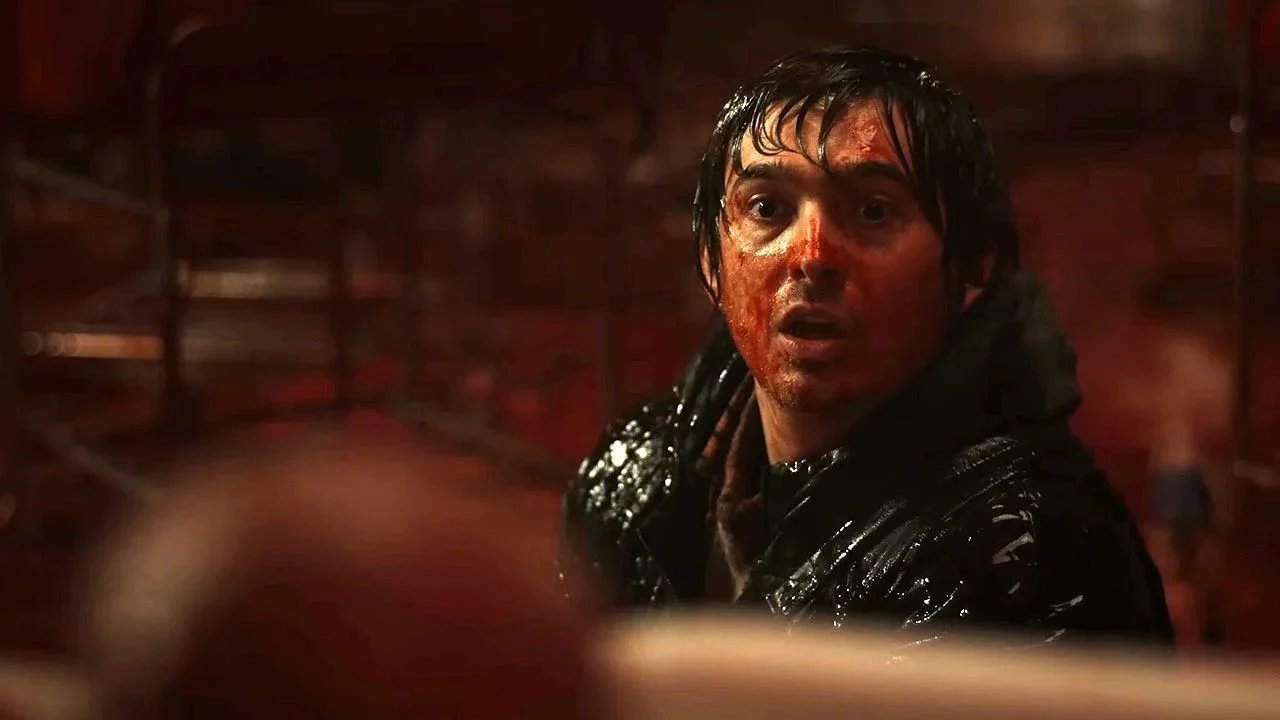
Courier driver Bryan (Austin Abrams) ends up in a nightmare.
Courier driver Bryan (Austin Abrams) delivered a package to the hospital late in the evening and actually wants to return to his girlfriend. She finally just told him on the phone that she was pregnant. But because Bryan doesn’t really know how to deal with it, it’s actually quite right for him that another errand unexpectedly arises. This not only postpones the necessary discussions, but also promises good money.
Bryan is supposed to deliver a medical package to the hospital in nearby Raccoon City. But on the way there an incident occurs when a woman suddenly runs in front of his car on the snowy street. And that is just the beginning of a hellish odyssey in which the young man soon fights for survival against cruel mutated creatures…
Right in the middle instead of just in front of it: camera work like in a video game
Like “Welcome To Raccoon City” creator Johannes Roberts before him, Zach Cregger is now a declared fan of the “Resident Evil” series, which, as one of the most successful video game franchises of all time, has been teaching fear to gamers worldwide for 30 years now. Unlike Roberts, Cregger, who has established himself as one of the current hopes of horror cinema with his acclaimed horror highlights “Barbarian” and “Weapons”, has not picked out a specific part of the long-running series for his adaptation. Instead, he came up with his own story, which is basically set on the sidelines of the games “Resident Evil 2” and “Resident Evil 3”, in which a zombie plague overruns Raccoon City.
And yet his “Resident Evil” breathes the spirit of the original in a way that none of the other films before it did. Cregger has clearly internalized the series, including its mechanisms and peculiarities. With Bryan as a fixed point and quasi-avatar, he often lets the camera dynamically explore the locations from the shoulder and first-person perspective – as if they were actually areas in a video game. This means that the film comes as close to the visual language of the original as it can without becoming a game itself.
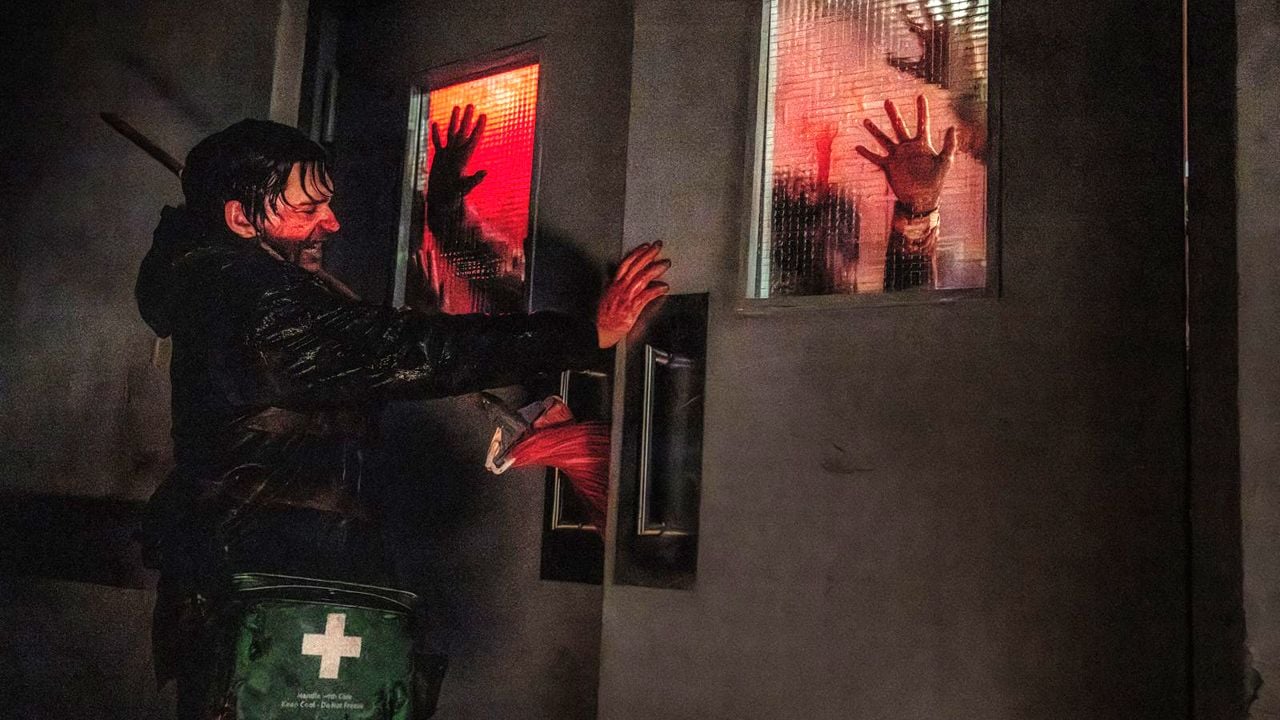
Bryan (Austin Abrams) doesn’t want to open this door, but rather close it.
Many Resi gamers should also recognize themselves in Bryan’s demeanor. If, in the face of a new danger, he would rather turn back (only to face it anyway, of course), constantly waste the scarce ammunition or curse the umpteenth padlock that blocks his further path, it is not difficult to take this somewhat clumsy but always so approachable normal guy to his heart and to support him in his nightmare.
But it’s not just Bryan and the camera work that create an immersive feeling. Zach Cregger’s feeling for spaces and their lighting also ensures a pleasant feeling of horror. Especially at the beginning, the filmmaker plays with light and shadow in an incredibly atmospheric way against the backdrop of a secluded snowy landscape. These appear so impenetrable and black that they could actually harbor all sorts of horrors and even raise doubts as to whether anything exists beyond them.
Real terror meets MCU humor
Things become particularly uncomfortable when Cregger rethinks suspense moments when building up the tension by letting not only the audience but also his main character notice the approaching horror at an early stage. Bryan observes from a distance how an infected person quickly approaches the house in which he has holed up. While Cregger consistently stays with the frightened protagonist, he lets the threat get closer and closer – only to finally, despite all foreboding, pull the rug from under your feet and let the discomfort turn into sheer terror. This is pure goosebumps material and far more effective than some of the clumsy jump scares scattered throughout the film.
What is particularly surprising is how much humor there is in “Resident Evil” – and even more surprising is how well it works, at least initially. In fact, Zach Cregger couldn’t hide his comedy roots in “Barbarian” and “Weapons” and mostly mastered the ability to combine bizarre humor and horror. In “Resident Evil,” the laughs at the beginning develop quite organically from Bryan’s awkward (and all too understandable) behavior in the extreme situation he is confronted with.
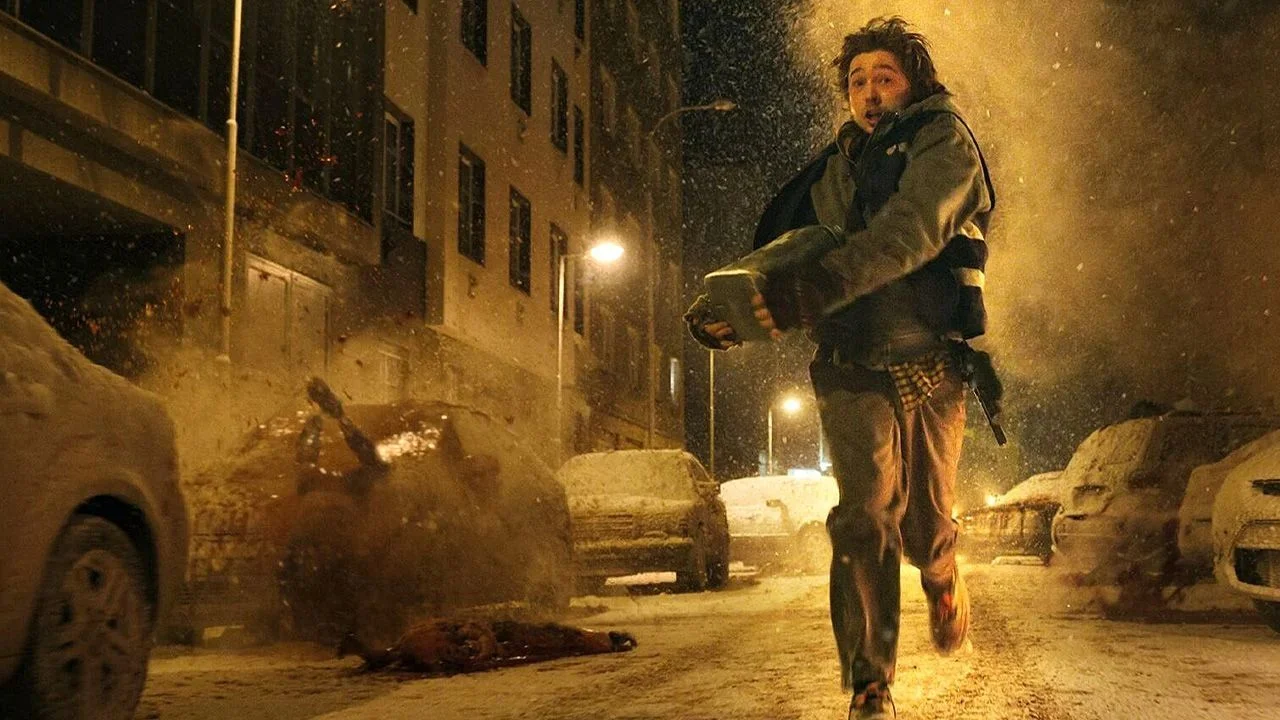
Bryan (Austin Abrams) fights his way through Raccoon City.
As the running time progresses, however, Cregger sometimes oversteps the mark. Especially when not only the overwhelmed Bryan, but also other characters suddenly become unmotivated quips, it reduces the enjoyment. After all, especially in the weaker second half, this noticeably damages the chilling atmosphere that was so carefully built up at the beginning. In this context, a scene in which Bryan is given an emotional moment as he threatens to surrender to his fate is even an unpleasant reminder of the worst sides of the MCU. There, too, one or two touching character moments were ultimately destroyed by a funny throwaway gag. One can be glad that after test screenings, Zach Cregger decided to even remove a few gags from his film. Because the bottom line is that the remaining ones are a bit too much of a good thing, as they not only detract from such scenes, but ultimately also the feeling of threat. Despite a lot of the original feeling, the new “Resident Evil” is only really scary in parts.
But this is made up for to some extent by all sorts of disgusting inserts and monster designs that do the games credit, regardless of new ideas, and don’t skimp on bloody violence (despite the FSK rating for ages 16 and up). And there isn’t much time to criticize anyway. The story pushes Bryan forward consistently, with almost no pause for him and the audience. Fueled by a driving score that sometimes even rivals the stress-inducing soundscape of Christopher Nolan’s “Dunkirk” in terms of urgency, “Resident Evil” unleashes an incredible kinetic energy that, despite some inadequacies, is simply captivating.
Conclusion: Zach Cregger’s “Resident Evil” is undoubtedly the best adaptation of the groundbreaking games. Strongly staged and garnished with some eerily beautiful disgusting interludes, the “Weapons” mastermind skillfully transfers the aesthetics and survival aspect of the original to the screen. This is also great fun for fans, although the horror is never able to reach its full potential due to too much comedy.