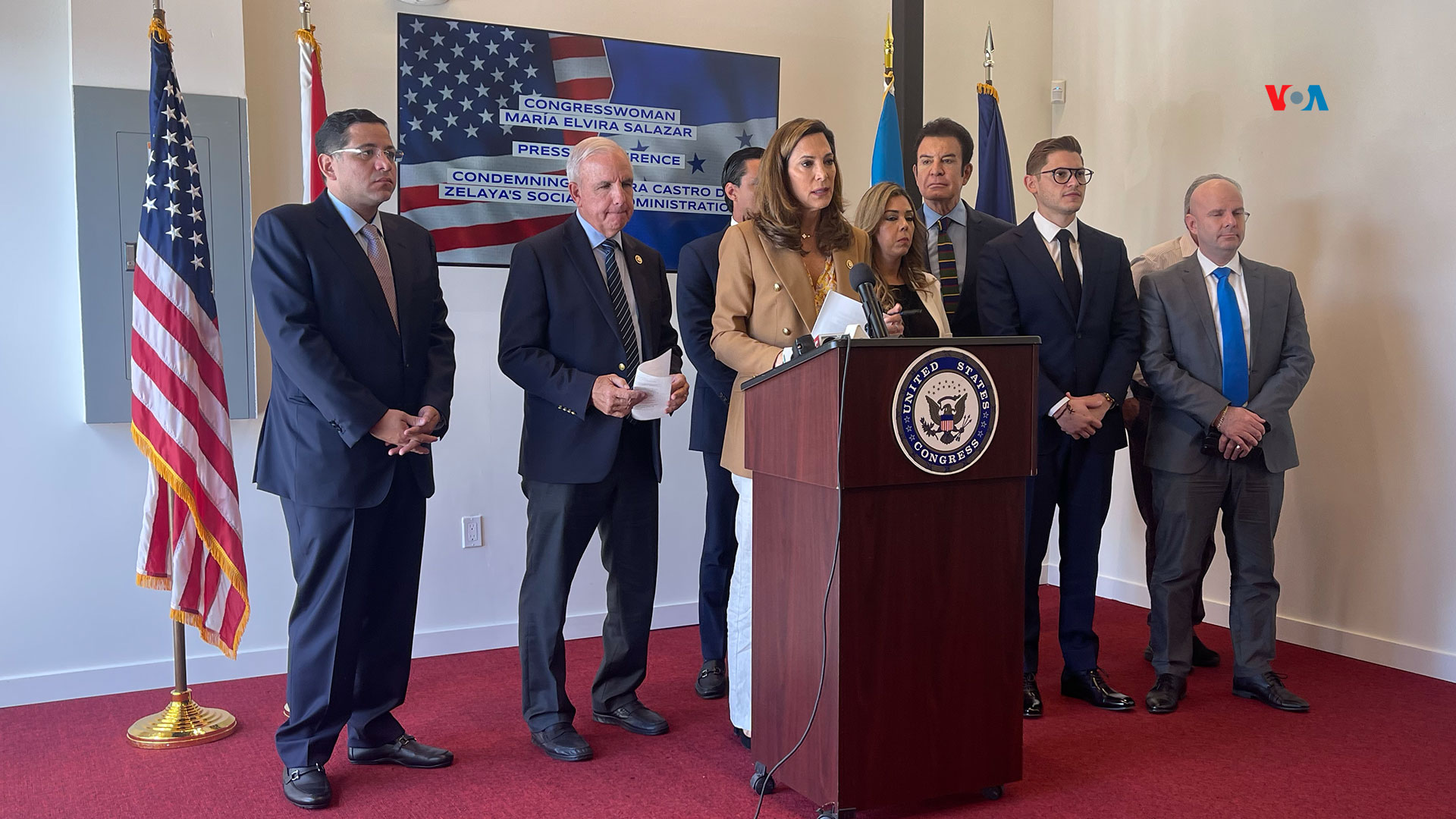
US congressmen María Elvira Salazar and Carlos Giménez have warned of the risk of Honduras following in the footsteps of Cuba, Venezuela and Nicaragua, and called on the opposition to present a united front in a possible next presidential election in 2025.
South Florida Republican legislators in the United States House of Representatives, María Elvira Salazar and Carlos Giménez, urged the Honduran opposition to put aside their differences and run jointly in the Central American country's presidential elections, scheduled for end of next year.
“The great challenge is that they can unite as an opposition to confront the clutches of communism,” declared the Cuban-American congresswoman during a press conference in Miami, Florida.
For his part, Carlos Giménez considers “regrettable” the drift that the government led by Xiomara Castro has taken in recent months and, like his colleague in the US Congress, he also asked that the opposition present itself as a single candidate.
“I am here to support the opposition, to unite in one candidate because the worst that can happen is that there is a divided opposition,” he stressed.
According to him, this strategy should serve so that the candidate has greater support at the polls and the vote against the current president is not fragmented. “It is so that the candidate comes out with a larger vote, so I demand that our friends unite behind one person. That or it means that they agree one hundred percent with that person, otherwise they will go through the same step as Cuba, Venezuela and Nicaragua,” he reiterated.
Concern for Honduras
Salazar also expressed his “concern” warning of the serious consequences that this could entail. “There is a president who has violated the democratic system by becoming friends with the governments of Cuba and Venezuela or who has decided to abandon Taiwan for communist China,” he said.
Along these lines, he assured that the objective of this call is “to see a solid democracy in Honduras” with a free and transparent “democratic system” so that the candidates who decide to run do so with all the guarantees “and that the people decide.”
“We are supporting the democratic system so that, through the ballot box, we can get rid of the scum that is socialism. Xiomara Castro has said that she wants to join Cuba, Venezuela and Nicaragua, and that is not the way,” he noted in this regard.
Furthermore, Carlos Giménez advocated that the US continue to play an important role in the “preservation of democracy and freedom throughout the (Western) hemisphere.”
“Let the people of Honduras know that they have friends here in the United States and we are going to fight both in Honduras and in the rest of the hemisphere. Cuba, Venezuela and Nicaragua are not democratic and there are others who are taking that step,” he said, convinced that freedom and democracy must be “restored” in those countries in the region.
Xiomara Castro's position
This movement against the Honduran government has worsened in recent weeks. In September, Xiomara Castro warned that she will not allow “a coup d'état” to be organized in the country, in addition to guaranteeing “clean and transparent” elections in 2025.
All this occurred in a context in which the president denounced an attempted coup d'état after the NGO Insight Crime released a video in which his brother-in-law, Carlos Zelaya, was observed in a meeting with members of drug trafficking, something that the brother of former president Manuel Zelaya recognized and for which he resigned his position as deputy and secretary of the Honduran Parliament.
Castro has also distanced himself from the White House. The last measure taken by the Presidential House was the breaking of the extradition treaty with the United States, an agreement that had allowed the extradition of dozens of Hondurans, mostly on charges linked to drug trafficking, to be tried in that country.
This decision was made in response to statements by the United States ambassador, who questioned the recent visit of Honduran officials to Venezuela, where they held a meeting with the Venezuelan Minister of Defense, accused of drug trafficking on US soil. The Honduran government described the diplomat's observations as “interference” and a few hours later reported on the termination of the treaty.
With the end of this agreement, Honduras would stop sending its citizens required by US justice.
“The Executive Branch, in use of its constitutional powers, informs the honorable embassy of the decision of the government of the Republic of Honduras to terminate the extradition treaty,” reads the official document sent by the Honduran Foreign Ministry to the US diplomatic headquarters in Tegucigalpa.
The document also highlights that said agreement was signed on January 15, 1912. Since 2014, a total of 64 Hondurans have been extradited to the United States to face judicial proceedings for various crimes.