
From battlefield epics like “Saving Private Ryan” and “The Longest Day” to the espionage thriller “The Needle” and the romantic biopic “In Full Bloom” to the horror shocker “Overlord”: There are already very different films about D-Day, i.e. the June 1944 invasion of Nazi Germany-occupied France by Allied troops across the English Channel. Nevertheless, “Hotel Mumbai” director Anthony Maras manages to tell us a story based on actual events with his chamber play-like war thriller “Pressure”, which offers a very unique view of this fateful day in world history.
“Pressure” is based on the play of the same name by actor David Haig (“Downton Abbey”). The story about the Allied weather experts, modified and fictionalized in some details, is absolutely fascinating. After all, it’s hard to imagine the incredible pressure (the one that gives the title). Pressure) the main character embodied by “All Of Us Strangers” star Andrew Scott must have stood during the real events. Unfortunately, at the end the film breaks with its previously coherent and concentrated concept in order to serve up a few action moments enriched with extremely mediocre CGI effects.
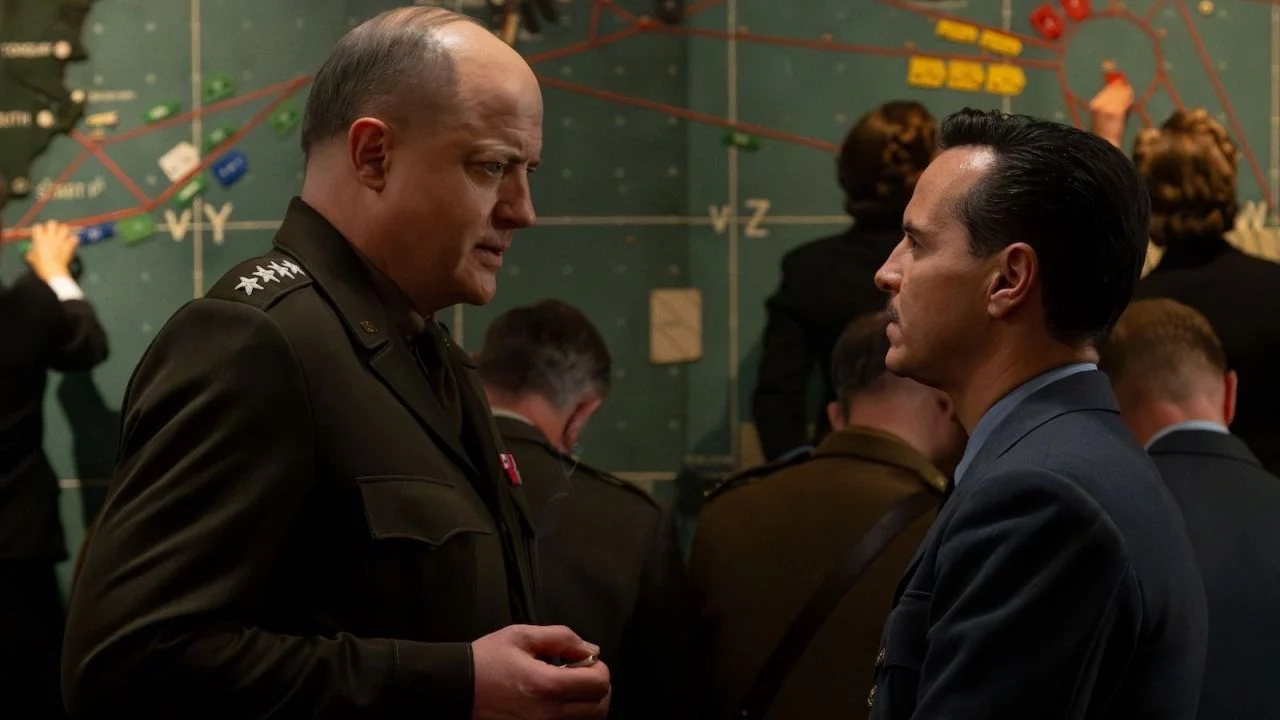
No shoulders bear as much pressure as those of Dwight D. Eisenhower (Brendan Fraser) and chief meteorologist James Stagg (Andrew Scott).
June 2, 1944: Operation Overlord is scheduled to begin in 72 hours! The Allies want to bring a total of 160,000 soldiers across the English Channel on 5,000 ships in order to push back the German army occupying France – and in the next step to completely defeat it. Everything was meticulously prepared in absolute secrecy by the staff of US General Dwight D. Eisenhower (Brendan Fraser). Nevertheless, there is a legitimate fear that the enemy could at any moment become aware of the operation and divert its own troops to the planned British and American landing sites. So the whole thing has to happen as quickly as possible. But there is still one unexplained variable: the weather.
Britain’s chief meteorologist James Stagg (Andrew Scott) is supposed to make the forecast on which millions of lives could depend in the coming days and weeks. A storm would make the greatest naval invasion of all time impossible. So Eisenhower needs good weather to give the final order. Stagg’s American colleague Colonel Krick (Chris Messina) is convinced that on so-called “D-Day” the sun will shine and the sea will be calm – exactly what the commander in chief needs. Stagg, however, makes a contrary prediction – and in doing so takes responsibility for nothing less than the outcome of the Second World War…
Waiting for the weather
We all know how the liberation of France occupied by the Wehrmacht by the Allied troops ended. Nevertheless, Anthony Maras manages to tell his story of D-Day in an intense and gripping manner, even damn exciting for long stretches. “Pressure” is a chamber play – admittedly set in quite large and opulently furnished settings. The main setting of this unusual war film is not a battlefield, but Southwick House in southern England, the improvised headquarters of the Allied commanders around General Eisenhower. Dozens of high-ranking officers lived and worked in the three-story building. Meanwhile, on the sprawling site, several battalions of soldiers camped in tents and improvised barracks, protecting the complex as they awaited deployment to the front.
Those of you who have seen the spy film “Enigma – The Secret” with Kate Winslet, which was also set during the Second World War, are familiar with such a scenario. The most important rooms in the mansion are the room of the meteorologist crew around Stagg and Krick, Eisenhower’s office, where he only makes his decisions in the presence of his aide Summersby (Kerry Condon, “F1 – The Movie”), and the huge command center with maps of Europe that take up entire walls. In these locations the decisive confrontations take place between Stagg and Krick, Stagg and Eisenhower as well as Eisenhower and the assembled commanders of the American and British Navy, Army and Air Force. Everyone demands that the weatherman finally give them the green light to launch the attack.
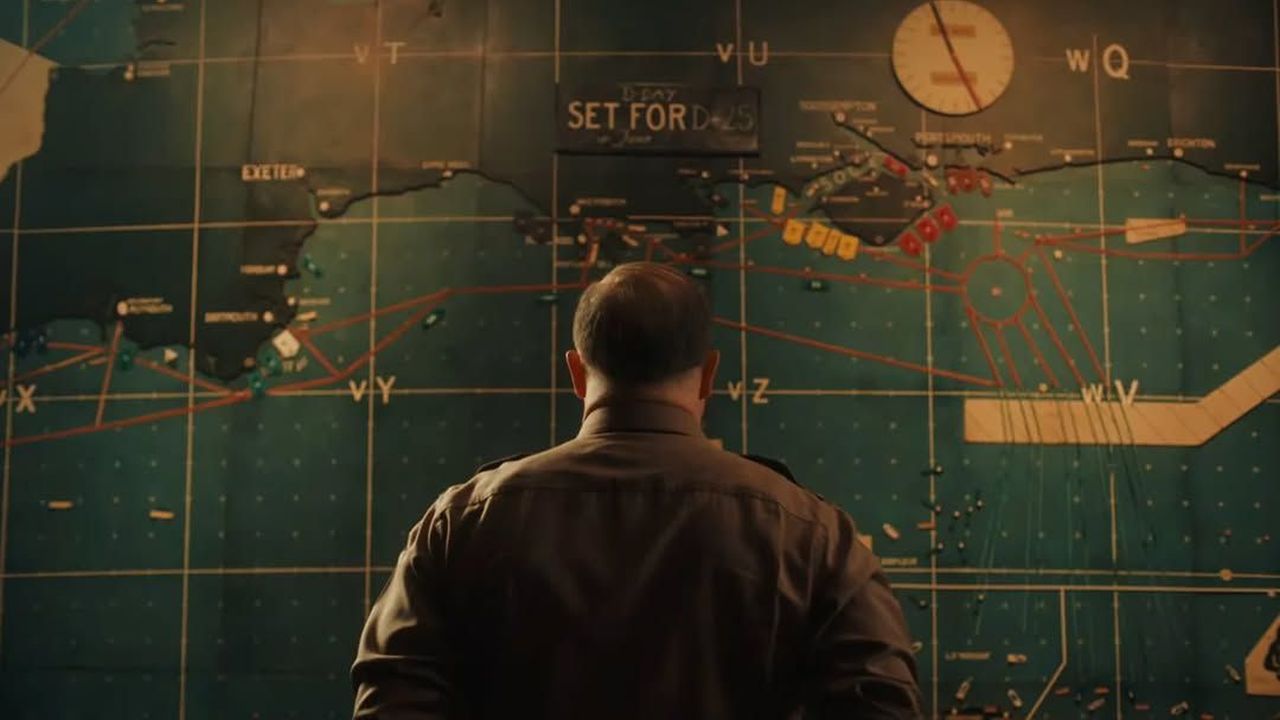
Potentially millions of lives depend on the decision about the right time for D-Day!
But Stagg is not a trigger-happy cowboy like Army General Montgomery, interpreted almost like a caricature by “Band Of Brothers” veteran Damian Lewis. He’s also not a carefree party stud and yes-man like Krick, who only ever tells Eisenhower and the others what they want to hear. After all, during his previous missions in North Africa and southern Italy, the sun always shone when he predicted it would. Stagg, on the other hand, is an introvert, but also a man of absolute integrity – a humorless advocate of science. He is an outsider who quickly loses his reputation as a troublemaker in Southwick House. Ultimately, he threatens to disrupt the orderly course of events and especially the plans for the attack on the Nazis. While Stagg has to deal with this situation, he is also hit by personal terrible news: parts of the hospital in which his heavily pregnant wife (Tamsin Topolski) wants to give birth to their child have just been reduced to rubble by German bombers.
That can be a bit much drama for one person compressed into just 100 minutes. Andrew Scott’s reserved performance, based on nuances in the play of eyes and posture, often stands in direct contrast to that of Brendan Fraser (“The Whale”). The latter casts Eisenhower as a larger-than-life authority figure. Only later do we learn that the future US President not only wants to convey self-confidence to his subordinates with this appearance, but also has to encourage himself. The dress rehearsal for D-Day, which he initiated and supervised just six weeks earlier, went disastrously wrong and cost the lives of many of his men. Oscar winner Fraser is always at his most effective when he plays alongside Condon and his character is allowed to show doubts about his own abilities and decisions.
Superfluous addition
For the final part of the film, “Pressure” leaves the rather intimate setting in southern England. Maras gives his audience a little action by taking us to the battlefield in Normandy for a collage of scenes – which, however, is completely unnecessary. After all, the story about the clear focus of the film, Captain Stagg, has long since been told. The images of the landing of the Allied soldiers on the French coast and the subsequent battles are adequate, but one should not expect that these could in any way compete with “Saving Private Ryan”. We would therefore recommend for future video evenings: Simply switch over from the “Pressure” finale to the “James Ryan” opening ten minutes before the end.
Conclusion: A controlled, withdrawn Andrew Scott and a powerfully exuberant Brendan Fraser are the highlights of the prequel to the all-decisive day of the Second World War, staged as a dialogue-heavy but still gripping chamber play.