
Plan A failed, Plan B could not be reconciled with reality and the tax office intervened in Plan C, explains a (would-be) content creator who had recently moved to the country in a sparsely attended Kreuzberg pub. However, the woman next to him can only smile wearily at this, after all, Franka (Bärbel Schwarz) has long since arrived at the titular “Plan F”, which, depending on her mood, stands for either “Fame” or her first name. At the end of his 40s, little remains of his former dreams; The drummer has been thrown out of her punk band and the condominium of her ex-girlfriend, who is now in a psychiatric hospital, has been seized. So now citizen’s money, couch surfing and as much alcohol as the beer mat will give you.
But the almost manically good-tempered Franka doesn’t let that get her down. Instead, she stands in red cowboy boots and a fake fur coat in a snow leopard pattern in front of her little sister Maya (Ursula Renneke), who is still asleep at lunchtime. In a constant state of depression, she still lives with her parents on a farm in the Berlin area, even in her mid-40s. In director Ina Balon’s feature film debut, which was awarded half a gold bar worth 17,500 euros at its world premiere at the Hof International Film Festival, the unlikely sisters go on a 24-hour trip, especially around the Kottbusser Tor – and discuss there in the clearest theater German, even after the umpteenth beer and MDMA drops.

At first, May (Ursula Renneke) doesn’t like her sister Franka (Bärbel Schwarz) being dragged out of her bed and with her to Kreuzberg.
Bärbel Schwarz (“Last Exit Schinkenstraße”) and Ursula Renneke (“I was at home, but…”) really enjoy their roles. At the beginning you even briefly wonder whether the sisters weren’t cast with amateur actresses – that’s how believable Franka’s bluster into her family seems. In Hollywood, when you think of such a forceful punk proletarian, you might first think of the shameful superstar Melissa McCarthy, but the “Bride Alarm” scene-stealer would of course only provide the over-the-top cliché version. Bärbel Schwarz, on the other hand, achieves an astonishing authenticity when she clumsily hangs upside down on the pole in the S-Bahn or immediately draws all her energy into herself when she enters a room…
… and precisely because she so recognizably embodies a self-centered drunk who has long since driven everyone around her away with her constant lies, the character is actually quite annoying at times. Especially because the lethargic Maya first has to learn to counteract her overwhelmingly self-absorbed sister over the course of the film. On the other hand, there is always a lot of tension in the trip through the unpredictable Kreuzberg night – with a running length of a crisp 85 minutes, “Plan F” remains pleasantly entertaining, even if it takes some time until you still fall in love with the protagonists, who are not necessarily likeable at first.
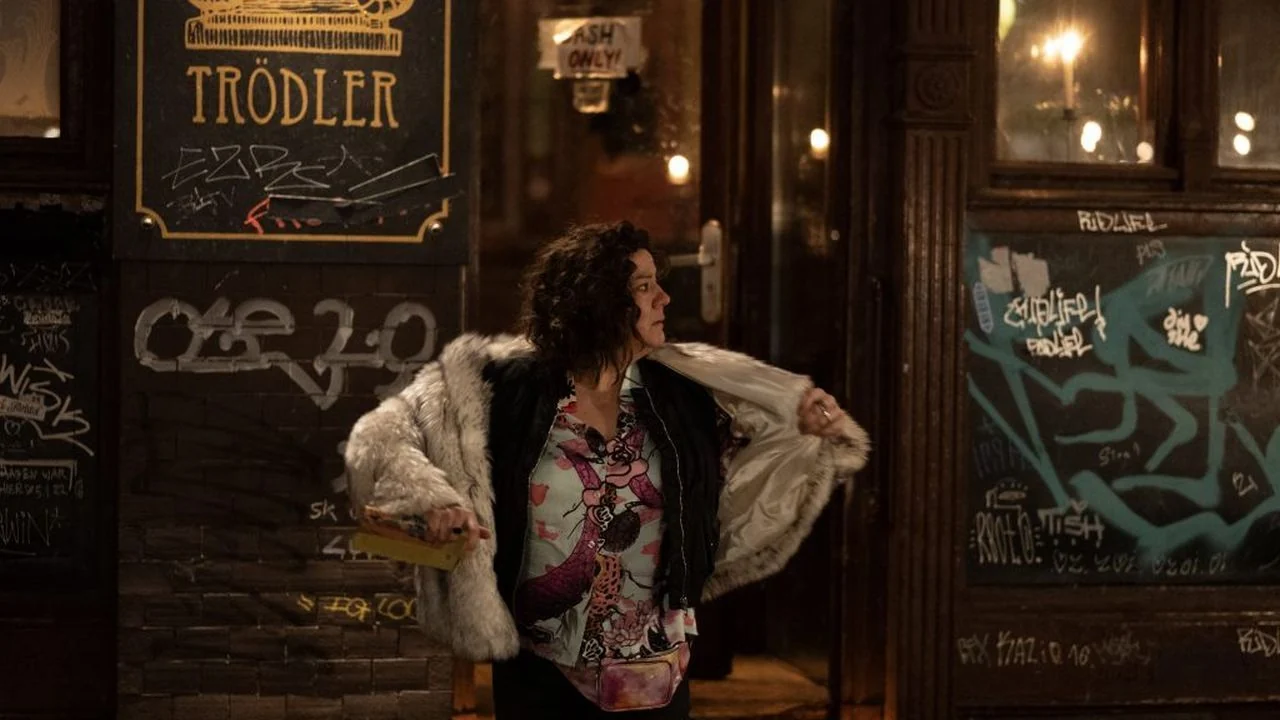
Franka has long been as well-known as a colorful dog in all Kreuzberg pubs.
Unfortunately, Ina Balon and her co-author Claudius Beutler don’t allow themselves to be as unreserved in the script as their leading actresses. A lot of it seems too statically constructed – and sometimes scratches the basics of problematic films. At one point, Maya even writes out her sister’s complete character analysis on the voicemail so that no one in the cinema misses it. And speaking of missing out: the mumbling king Christopher Nolan could really learn a lesson from Franka and Maya – even when they’re completely drunk and otherwise stoned, they don’t swallow a syllable of the neatly written dialogue. To be honest, I’m used to something different from my personal Kreuzberg nights…
Conclusion: Franka and Maya definitely have what it takes to be really annoying. But it’s also about time that it’s not always just guys who drink themselves out of their minds in films and then grow to love them after spending time together at the bar. Bärbel Schwarz and Ursula Renneke really throw themselves into their roles with full physical effort – but the dialogues, which sound very written and are recited as if they were on a theater stage, don’t exactly live up to the claim to authenticity.