
Around 1900, a very special gang was up to mischief in the British industrial city of Birmingham. The members of the Peaky Blinders stood out not only because of their unrestrained brutality, but above all because of their unmistakable style: no crime without low-slung peaked caps, long coats and tailor-made suits! More than 100 years later, screenwriter Steven Knight took up the legend – and used it to develop the series “Peaky Blinders”, which followed the Shelby crime family in their (mis)deeds over six seasons and 36 episodes from its premiere in 2013.
The clan is led by Oscar winner Cillian Murphy (“Oppenheimer”), who became the most defining character in the series as gang boss Tommy Shelby. The series finally ended with the sixth season in 2022 – much to the regret of many fans who desperately wanted a sequel. And actually: Now there is a return to the dark Birmingham cosmos, although not in the form of a whole seventh season, but in the 112-minute feature film finale “Peaky Blinders – The Immortal Man”. Director Tom Harper, who has already directed three episodes of seasons four to six, doesn’t even try to make Krampf appear bigger than the previous series episodes – and that’s precisely why long-time fans in particular should be very happy with the result.
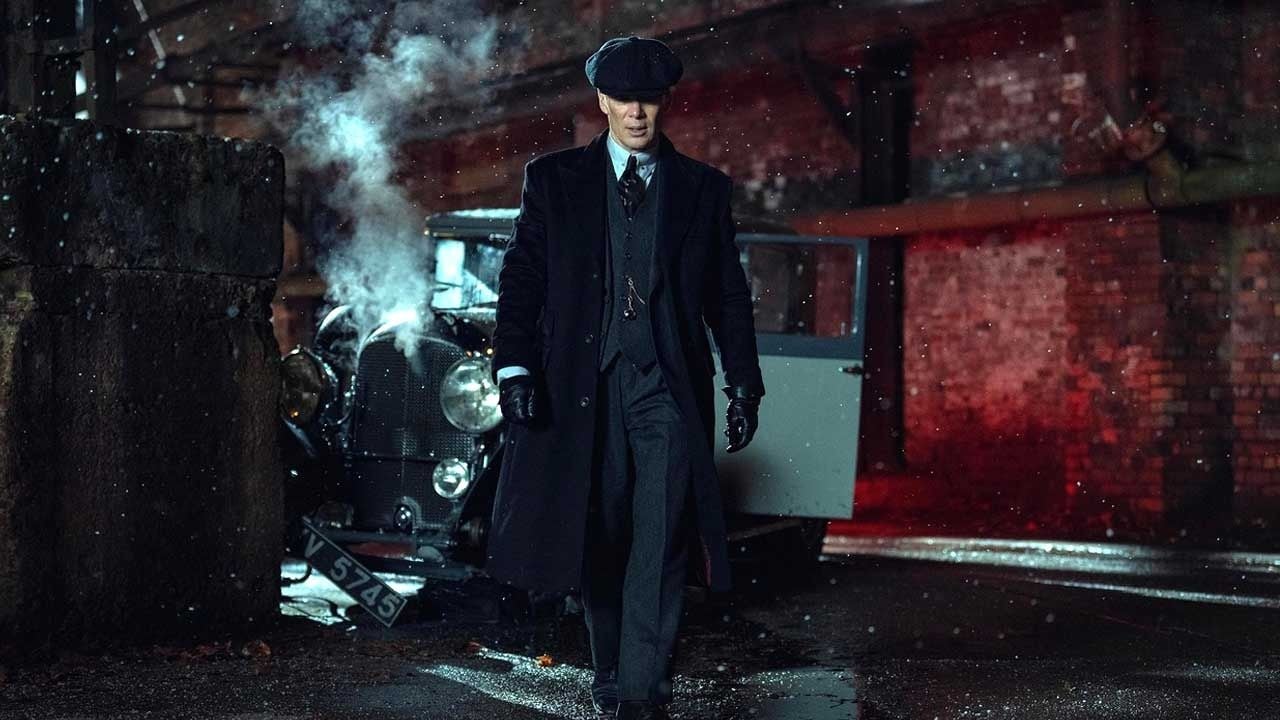
Cillian Murphy as Tommy Shelby is and remains the heart of “Peaky Blinders”!
The action begins about six years after the finale of the sixth and final season: the year has now begun in 1940 and the war has also found its way into Birmingham. Tensions are rising across the country. Tommy Shelby (Cillian Murphy), on the other hand, has withdrawn from his former life and is trying to finally put an end to his criminal career. But the ghosts of his past are catching up with him – and he can hardly avoid facing them this time too.
Meanwhile, his eldest son Duke (Barry Keoghan) has officially taken over the leadership of the Peaky Blinders. The fascist John Beckett (Tim Roth) therefore turns to him to persuade him and his gang to betray their own fatherland and fight for the German enemy. When not only his family but also his homeland are threatened, Tommy Shelby ultimately has no choice but to return from his self-imposed exile and sort out his affairs once and for all…
You immediately feel like “at home”
“The Immortal Man” unfolds its story with the same calm narrative style that characterized the series: instead of hectic action, detailed, dialogue-rich scenes continue to dominate – and since the series creator Steven Knight himself returns as screenwriter, the narrative DNA of “Peaky Blinders” remains intact in the film format. After all, hardly anyone knows how to pack power games, loyalty and subliminal violence into such precise, pointed sentences like Knight.
With the foggy fields, the smoke-filled streets, the dimly lit interiors and the dim light of the industrial buildings, “The Immortal Man” remains absolutely true to the series in terms of aesthetics. A cold color palette, diffuse light and deliberately weak contrasts characterize the imagery. The world appears rough, gray and permeated by a permanent heaviness – a dark, dirty atmosphere that has long since become one of the central trademarks of the franchise and that Harper confidently maintains in his feature film sequels.
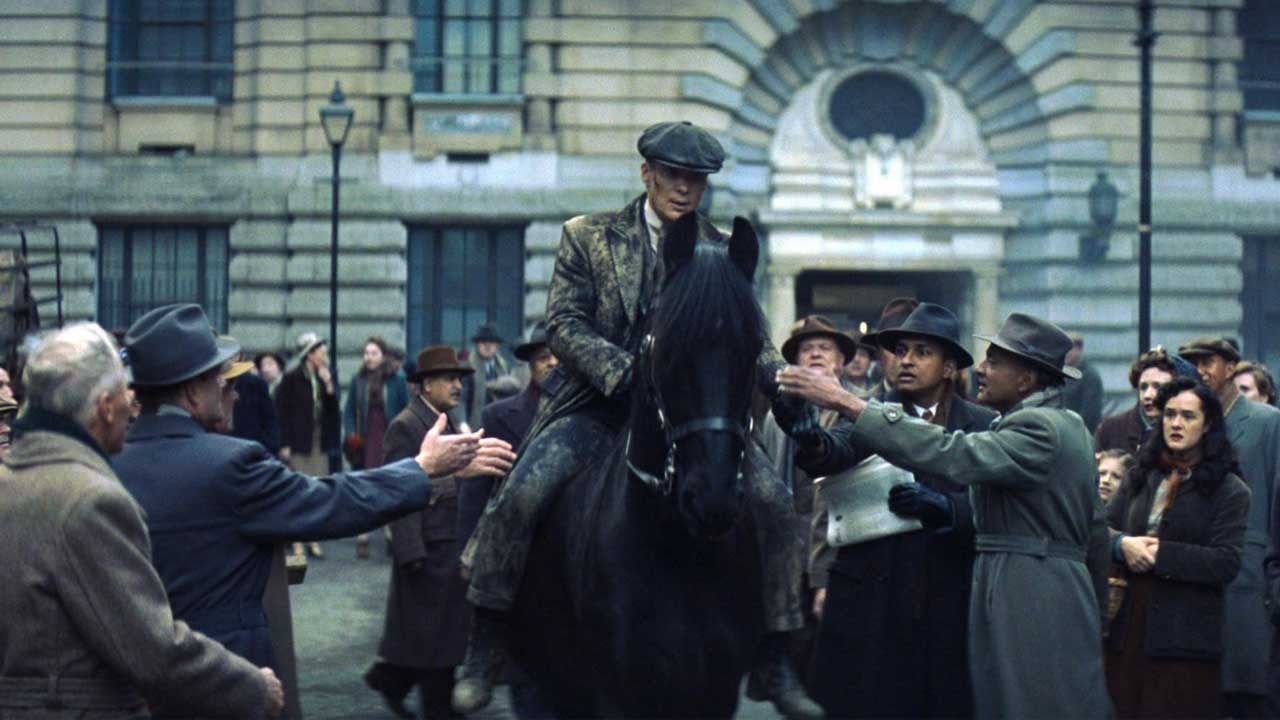
Things come full circle with the return of Tommy Shelby.
While the film as a whole refrains from being overly dramatic, at least Tommy Shelby’s comeback is celebrated appropriately. You can almost hear Peaky Blinders fans screaming with excitement as the character slips back into his iconic outfit. The absolute highlight of fan service is the moment when Tommy rides a black horse through the streets of Small Heath while the series’ unmistakable theme song, “Red Right Hand” by Nick Cave And The Bad Seeds, plays – a deliberate allusion to the very first scene of the series, which means that the finale draws an elegant bow all the way back to the beginning.
Although a few years have passed not only in the series but also in reality (including an Oscar win), Cillian Murphy immediately gets completely absorbed in his role. The best example of why no one else could play this role is certainly the scene in the legendary Garrison pub: a cheeky soldier actually dares to ask who the hell this Tommy Shelby actually is. Murphy plays the subsequent reaction with a casual matter-of-factness that immediately makes it clear who is really in charge here. When the soldier mockingly asks him to dance, Tommy remains completely unimpressed: he takes a hand grenade, pulls out the pin and sticks it into the man’s shirt, saying that they could do a quickstep. At this moment at the latest, the question of who Tommy Shelby is has been fully answered.
Returnees, losses and new faces
Cillian Murphy’s performance forms the emotional core of the film. He embodies Tommy with a mixture of fatigue, inner conflict and dangerous determination. Every gesture seems controlled, every word has weight – a spectacle that ensures that the character never loses his profound fascination even after more than a decade. Fans still have to cope with a small downer: In addition to Murphy, some well-known series faces are returning – including Sophie Rundle as Ada Thorne, Stephen Graham as Hayden Stagg, Packy Lee as Johnny Dogs, Ned Dennehy as Charlie Strong and Ian Peck as Curly. But other important characters are completely missing this time.
The fate of Tommy’s older brother Arthur is integrated into the plot, but there is no trace of his actor Paul Anderson. The younger brother Finn (played by Harry Kirton in the series) is hit even more drastically – he is not even mentioned in the film. The same fate befalls Tommy’s last wife, Lizzie (Natasha O’Keeffe). At least their daughter Ruby (played by Bonnie Stott in the film) makes a brief appearance in the form of a ghostly apparition. The list of missing characters could go on, but “Peaky Blinders – The Immortal Man” can at least partially make up for the losses with convincing new additions.
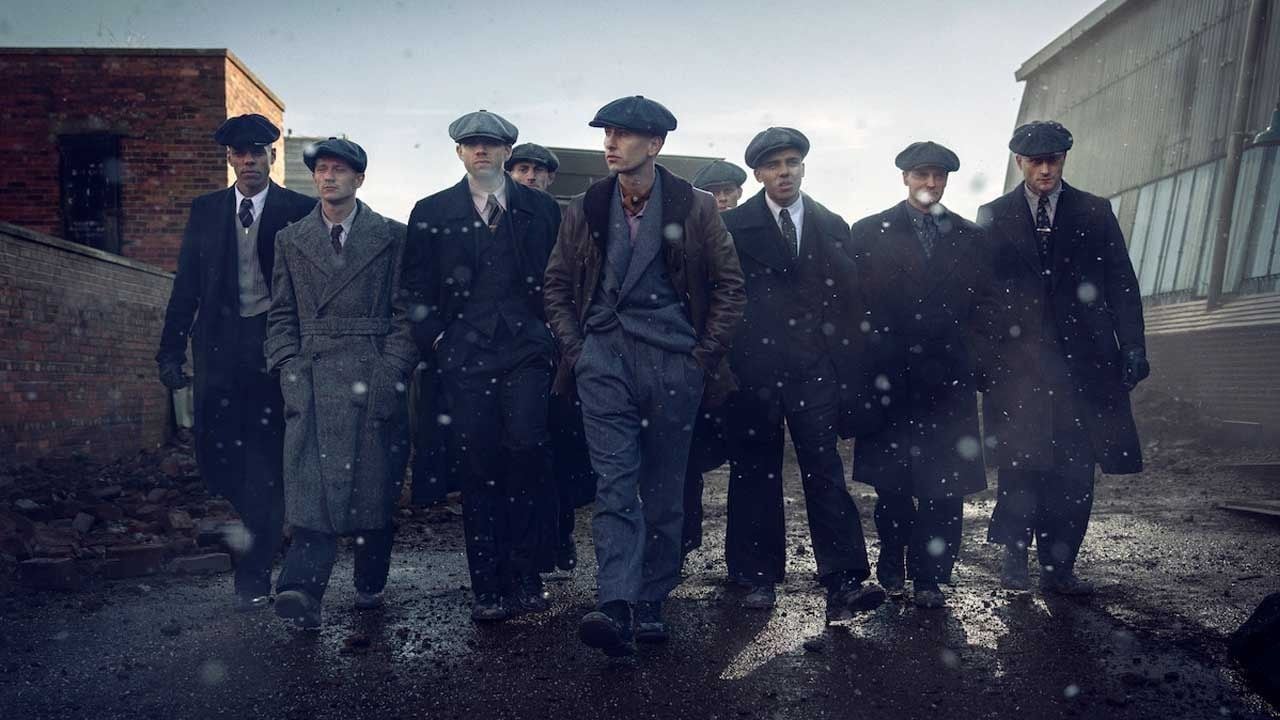
Duke (Barry Keoghan) is the new leader of the Peaky Blinders.
Barry Keoghan (“Saltburn”) is a good choice for the role of Tommy’s son, not only because of his obvious physical resemblance to Cillian Murphy. In terms of acting, he also manages to convincingly portray Duke’s indifference and cool calculation. An interesting dynamic emerges between father and son, particularly in the scenes together with Murphy: experience, cynicism and youthful unscrupulousness collide here. Rebecca Ferguson (“Mercy”) also impresses as Duke’s Aunt Kaulo.
As a representative of Roma culture, the “Mission: Impossible” star brings both dignity and an underlying toughness to the role – qualities that fit well into the morally gray universe. A new antagonist, Tim Roth, is also introduced. The “Pulp Fiction” star gives John Beckett his usual rough charisma, but as an antagonist the character still falls short of expectations. It lacks the haunting menace that has always characterized previous antagonists in the series.
Conclusion: As a finale in the style of an epilogue, the film works excellently! “Peaky Blinders – The Immortal Man” is not a particularly bombastic conclusion, but instead consistently relies on the strengths of the series: atmosphere, dialogue and psychology!