
Even though James Gray (“Ad Astra”) had already incorporated autobiographical elements into his films before, he made the most personal film of his career when he was in his early 50s: For “Times of Upheaval,” he processed his own childhood experiences into a family drama in order to explore (for himself and the audience) how New York society in 1980 shaped him and other young people. With his new work “Paper Tiger” he now follows on directly from this; Once again, his own youth served as the foundation for the script. Originally, Anne Hathaway and Jeremy Strong were supposed to play the alter egos of Gray’s parents again. However, after delays, they had to leave the project and were replaced by Scarlett Johansson and Miles Teller.
But it’s not just the change in cast that sets “Paper Tiger” apart from “Zeiten des Umbruchs”. James Gray returns here to the thriller genre, which made him famous through outstanding films such as “Little Odessa”, “The Yards” and “Heroes of the Night”. This time too, he manages to create incredible tension, primarily through words and atmosphere – rather than through intense action. “Paper Tiger” is an old-fashioned film in the best sense of the word in the tradition of New Hollywood cinema. The action is captivating not only with its detailed equipment and the slow, controlled camera movements, but also thanks to a magnificent Adam Driver in a charismatically engaging performance.
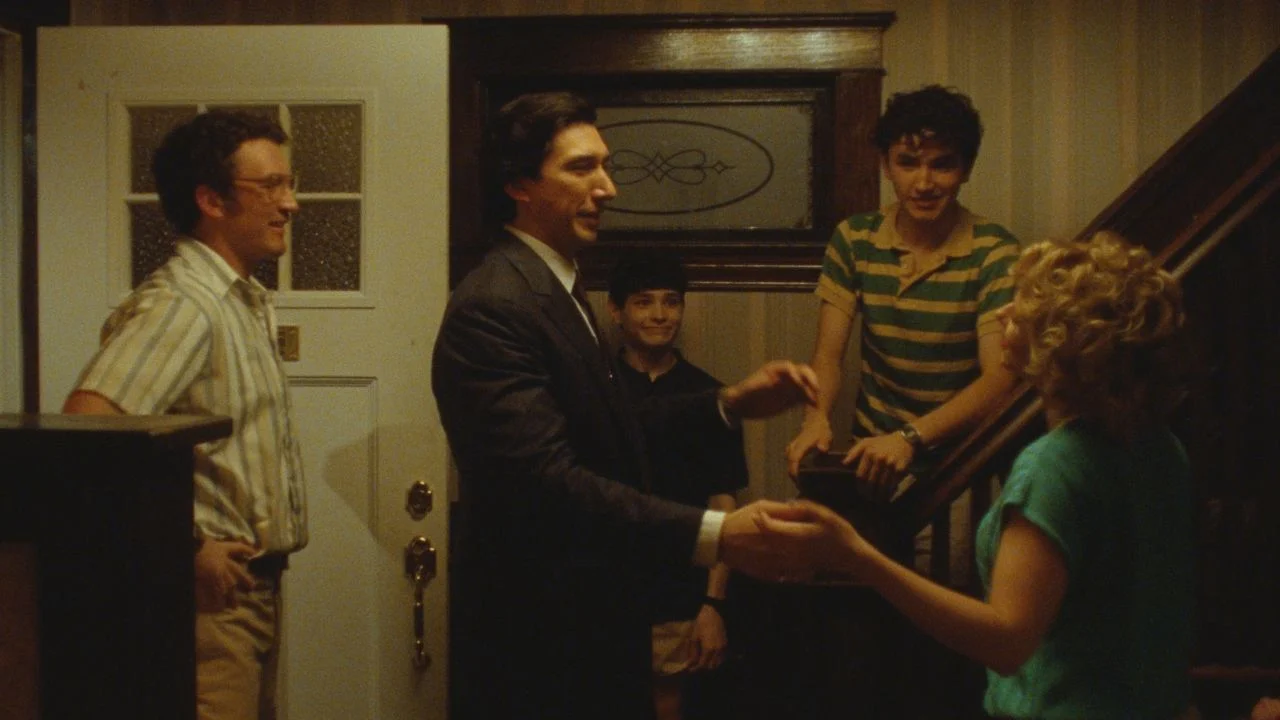
When ex-cop Gary (Adam Driver) visits his brother’s family, he immediately becomes the center of attention.
In Queens in 1986, the engineer Irwin Pearl (Miles Teller) and his wife Hester (Scarlett Johansson) and their two sons are making ends meet – even if they secretly hope for more and are jealous of Irwin’s brother Gary (Adam Driver) look. The ex-cop now works as a security consultant, drives a Mercedes and always seems to have plenty of money. But then a joint business suddenly presents the chance to make a big splash, which would also allow Irwin and his family to make the financial leaps they had hoped for: Russian crooks have gradually taken over the old mafia areas on the contaminated Gowanus Canal in Brooklyn…
… and now need someone to take care of the bureaucratic hurdles. With Gary’s connections and Irwin’s technical background, the plan was to make some quick money. But because the father of the family wants to do his job particularly conscientiously, he even takes his boys on an excursion to the canal that night – and is directly threatened there by gangsters who dispose of toxic waste. The criminals are anything but happy about the uninvited snoop, which puts the entire Pearl family in mortal danger…
Tension from silence
In two outstanding scenes from “Paper Tiger,” the already intense tension escalates even further: On the one hand, the final confrontation in a cornfield, with which Gray seems to bow to Martin Scorsese and Alfred Hitchcock alike, is absolutely brilliant. For reasons of spoilers, we won’t go into this more than worthy conclusion any further here, but to underline Gray’s class, just look at an earlier scene. “We now know where he lives,” is the warning with which the Russians let Irwin go after his visit to the canal. They emphasize this threat forcefully: The flash of a Polaroid camera slowly awakens Irwin from his sleep and he realizes that someone is in his house.
He carefully sneaks out of the bedroom and grabs a small air rifle. He can’t do much with it, but at least the shadow gives the illusion of a real weapon. Gray turns this into a game of patience. Irwin stands on the top steps with his weapon at the ready. Quiet voices can be heard from below. Neither party dares to move forward. As with the cornfield confrontation in the finale, the film draws its nerve-wracking tension not from superficial action, but from the agonizing wait to see who will make the first move. This creates almost standstill moments in which you sense that everything could escalate at any time.
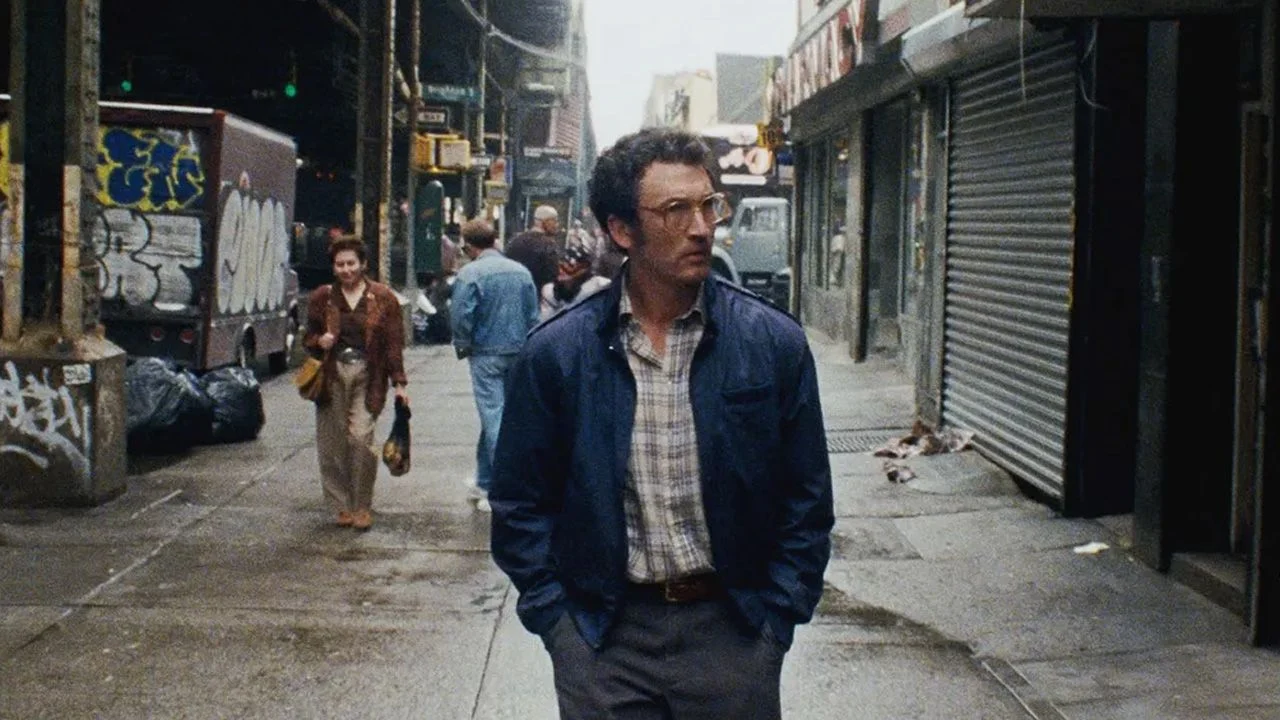
In a rapidly changing New York, Irwin (Miles Teller) looks for a way out of his seemingly hopeless situation.
It’s not just in this scene that the images are impressive. The camera of Joaquin Baca-Asay, with whom Gray is working again for the first time since “Two Lovers” (2008), moves very slowly and in a controlled manner. Again and again she captures the many details such as the little pagers, which bring the 80s to life in this film and immediately create a special atmosphere. Gray often focuses on the faces, from which one can read so much about the doubts about family loyalty and the emotional conflicts of the individual characters. Little by little, the pressure on them all increases – after all, not even the entire New York Police Department dares to confront the new criminal organizations, which act much more ruthlessly even compared to the mafia.
Adam Driver in particular takes advantage of this for one of the best performances of his career. As a big Zampano, he breaks into his brother’s house at the beginning of the film – with the staff of a luxury restaurant in tow, who heat up the star meal in the family’s modest oven. You immediately see why Irwin’s son Scott (Gavin Goudey), who is about to turn 18, and his younger brother Ben (Roman Engel) look at their uncle with such big eyes, while their father feels so small himself at the moment. But the charming Gary also has to learn his lesson over the course of the film. With words, money and his old police connections, he believes he can solve any problem. But little by little he realizes that the Russians are definitely not paper tigers.
The sensational Adam Driver covers everything
Especially in this thriller environment, which always creates tension with its polished dialogues, it is a joy to watch this character who suddenly can no longer talk his way out of situations. However, Driver’s performance sometimes overshadows everything else. Scarlett Johansson in particular has a somewhat thankless role. Already in “Little Odessa“Vanessa Redgrave’s character was based on Gray’s mother, whom he lost to a brain tumor. The fact that the filmmaker repeats himself here is less of a problem. Rather, he only makes full use of the great dramatic potential in one moving scene.
In addition, the illness primarily serves as a driving force for his actions. So he lets Hester commit an act that ultimately pushes her brother-in-law into an impossible dilemma. The fact that James Gray sacrifices the mother’s emotional fate in the end in favor of the thriller mechanics perhaps prevents “Paper Tiger” from becoming the absolute masterpiece that otherwise shines through in so many moments. But there is only a small downside in this film, which knows how to delight with its staging rigor and the acting duel between Driver and Teller.
Conclusion: With “Paper Tiger,” James Gray creates a gripping, atmospherically dense bridge between his intimate dramas and his early New York thrillers – supported above all by an unleashed Adam Driver and a splendid New Hollywood aura.
We saw “Paper Tigers” at the 2026 Cannes Film Festival, where the film had its world premiere as part of the official competition.