
The 20th century remains an oppressive, labyrinthical tangle in the films of László Nemes. Already “Son of Saul” and “Sunset” tried a game with the perspective and immersion. How can the atrocities of the past be experienced on the screen? How can a historical section be grasped in its being via the strongly subjective, cramped worldview? The Oscar-winning, from the egopher perspective of a “Son of Saul”, who was filmed “Son of Saul” in the gas chamber in the gas chamber, asked about the (un) presentability of the man-made hell of Auschwitz. Shortly before the First World War, Budapest transformed “Sunset” into a bubbling jobber full of paranoia, poisoned nostalgia and conspiracies.
Nemes' third feature film now jumps again on the time beam and again new corridors are opening up in the labyrinth of history, in which his figures are at the mercy. So the Hungarian director remains true to himself. “Orphan” tells – inspired by the filmmaker's own family history – a drama in the years after the Second World War in Budapest. Four years have passed since the end of the war. At the beginning, the camera with a young name Andor looks out of a pile of stone. The rough texture of the analog 35mm recordings creates a blurring, a noise that the eyes have to get used to. From the beginning, Nemes relies on the cropping and alienation of the perspective, which are rarely interested in wide panoramas. Instead, the 4: 3 recordings remain clausis close to the characters, to whom the world has become a confusing chaos.
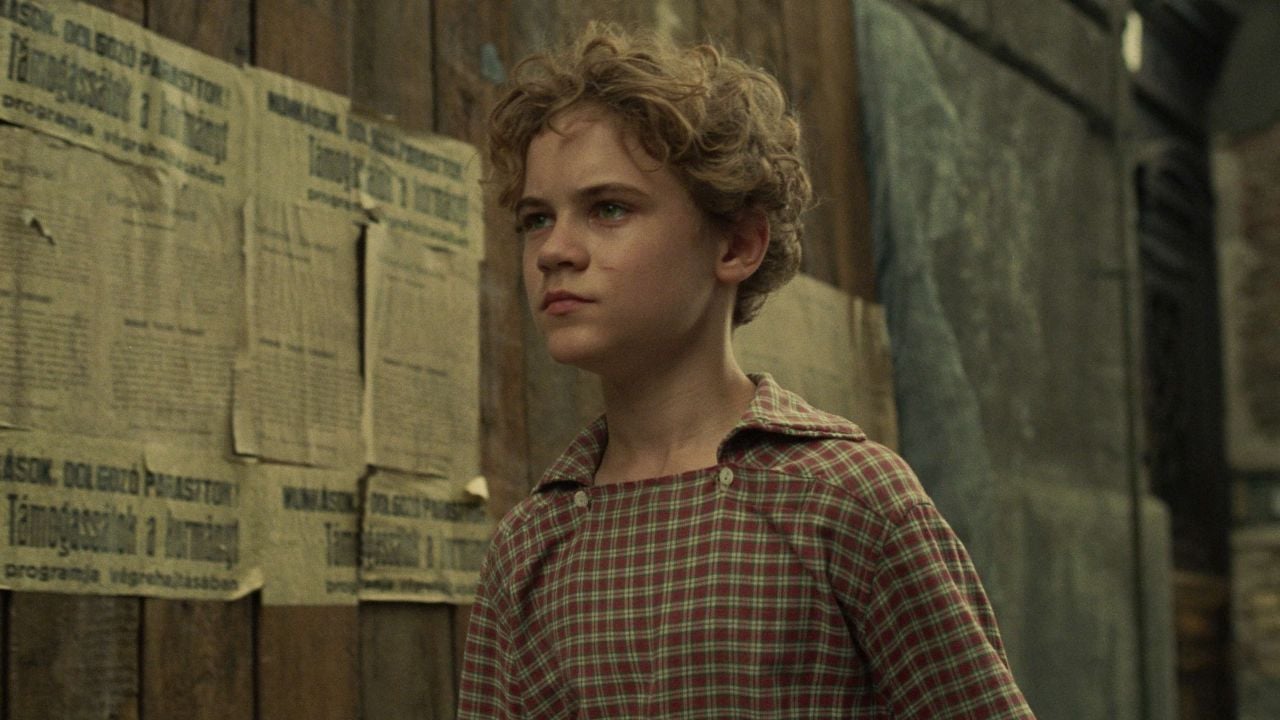
Andor (Barabás Bojtorján) learns after the end of the war that apparently no Jewish ticket seller, but a corpulent butcher is his birth father at all.
Andor (Bojtorján Barabas) is brought out of the orphanage by his mother (Andrea Waskovics) after the end of the war. He can live with her again. Only from the father there is still no trace. Andor is waiting for him. He longs for his return. However, when another man-a gross, corpulent butcher (Grégory Gadebois)-steps into the life of the family as a (replacement) father, there are horror and disappointment. Andor does not want to admit that this threatening man should be his father …
History becomes alive
After the prologue, “Orphan” jumps into the 1950s, into the time after the Hungarian uprising against the Soviet dictatorship. If the camera together with the young protagonist is now moving through the dilapidated and impoverished Budapest, you can only be amazed at these impressive images. The extracts and fragments that you reveal from your era are staged with one eye, as you can rarely experience so impressively. Regardless of whether it is about the fabrics in the cupboards, the dirty and dusty panes, the ruins, the small shops. Nemes' films want to present themselves as time capsules, as if they have captured documentary reality and not prepared artificial sets. And working with analogous film material contributes to this illusion.
The totality, which is accompanied by such historically isolated and as possible researched as possible, offers occasion for criticism every year in countless films. Even in “Orphan” when you look at how little a current point of view or aesthetic self -reflection is included in the past show. At the same time, it can hardly be denied that the pictures on Nemes recover an incredibly seductive force and atmosphere. The recordings of cameraman Mátyás Erdély are still looking for the gesture of the beautiful and picturesque in the greatest dirt, without losing a reality effect and abandonment.
Manageable family conflict
However, if you take a step back, the question remains the question of the information of this re -enactment of an era. What interests nemes about this time, apart from the autobiographical influences? “Orphan” is looking for the temporal and parabolic over his heavily compressed figure constellation, just like the previous films of the director. Unfortunately, this is exactly the point where “Orphan” is a little diffuse and sluggish after a promising start. In the end, he drops both behind the controversial aesthetic tension of “Son of Saul” and the moral painting of “Sunset”. His manageable plot and its implications are counted after a good hour.
Nemes wants to tell of a lost generation here that grows between the devastation of the Nazis and the Holocaust and the violence of the communist dictatorship. The absent father is not only the embodiment of historical trauma, but also the longing for a healed world and wholeness that is lost. He now seems to hasty like a ghost in the basement of the house. Andor climbs the steps and speaks to him. He conjures up the arrival of the mind. The political propaganda and the brutal patrols and raids of the outside world, which want to maintain the upright order, meanwhile mix with the lies and attacks within the family on a small scale.
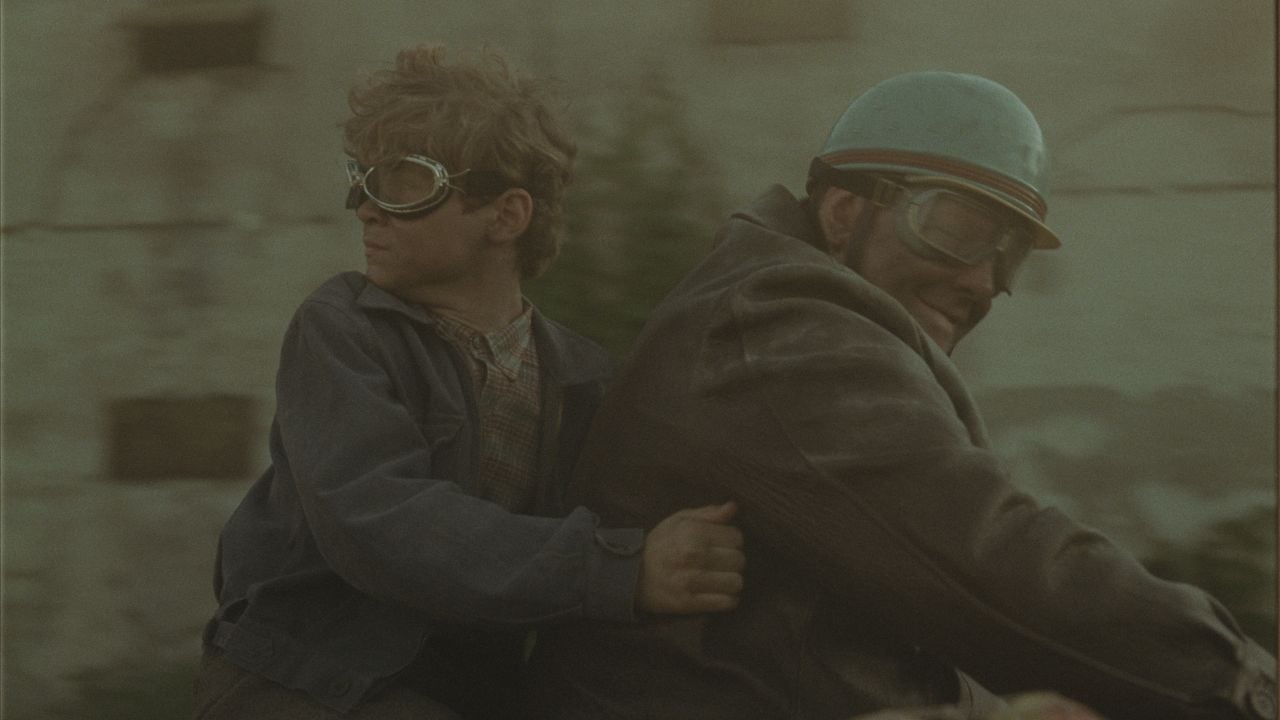
Andor is afraid of his possible new father (Grégory Gadebois), who with his günen -like shape sometimes appears like a horror film.
Did Andor be told the truth about the past? What dependencies and power relationships are unveiled there? What secret possibly does the butcher staged? Once Nemes lets his young protagonist get into the man's old house at night. And for a few minutes, “Orphan” resembles a horror film that knows how to convey the fear of the child adequately. In such tension moments, Nemes' staging championship is particularly evident. The butcher himself is transformed into a giant by shifts in the camera hinge, as if a nasty giant has emerged from a fairy tale.
However, the central conflict of the film remains thinly knitted for over two hours and it actually only asks the question of whether and to what extent the already omnipresent violence will continue to escalate. A pistol is dug out of the earth early on, which is also one of the many visits to the past. She is still sharp, can still shoot. And here is the famous question whether it will also be fired in the last act. Unfortunately, László Nemes misses his scenario one or two illuminating steps beyond. In his historicizing perspective, he remains sobering.
The eaten children
But what the film survives is primarily the reproduced loss of orientation. Figures dream of an alternative. They long for America. However, what the United States actually had for Jewish migrants and refugees after the Second World War could be experienced, for example, in Brady Corbets “The Brutalist”. “Orphan”, however, moves this world to a long time anyway. His characters keep circle around themselves and the old mistakes that do not want to heal.
The young protagonist Andor Hirsch fights for the right to his own history and identity that should not be overwritten by strangers. Ultimately, he is said to line up into a ranks of iconic, tragic film and literary children who eaten the 20th century. Be it “Iwan's childhood”, “Come and see” or “The Painted Bird”. Every high and low point in your life is overshadowed by the violence of history. At László Nemes, the latter becomes a symbolic Ferris wheel in a fair that groaned under his own burden.
Conclusion: Few European author filmmakers manage to bring the past to life as impressive and atmospheric as László Nemes. “Orphan” is no exception. Unfortunately, this time the impression arises that the director has lifted a little to the entanglement of a gruesome family drama and a larger social portrait.
We saw “Orphan” at the Venice Film Festival 2025, where he celebrated its world premiere as part of the official competition.