
The trend is obvious: more and more Nazis are being brought back from hell in order to recreate their atrocities on the big screen. The fascination with evil – that’s what “The Zone Of Interest” with Christian Friedel as Auschwitz camp commandant Rudolf Höß was all about. Afterwards, Robert Stadlober could be seen as Reich Minister of Propaganda Joseph Goebbels in “The Leader and Seducer,” while August Diehl played the inhumane concentration camp doctor in “The Disappearance of Josef Mengele.”
And now a film has been made about Hermann Göring, Hitler's right-hand man, who terrorized humanity from 1933 to 1945 and led it to World War II. However, the National Socialist politician and convicted war criminal is not portrayed by a German-speaking actor, but by the New Zealand Oscar winner Russell Crowe (“Gladiator”). Since this has now become more and more widespread, he seemed to be the ideal leading actor for “Nuremberg”, which revolves around the Nuremberg trial before the International Military Tribunal from November 20, 1945 to October 1, 1946. At that time, 24 Nazi officials were in the dock – with Göring at the head. In terms of acting, Crowe does a good job. He knows how to expose Göring's sick ego and repeatedly emphasizes the baseness and treachery of this individual. At the same time, Crowe is also the problem with the film. His face is too prominent to disappear behind his figure.
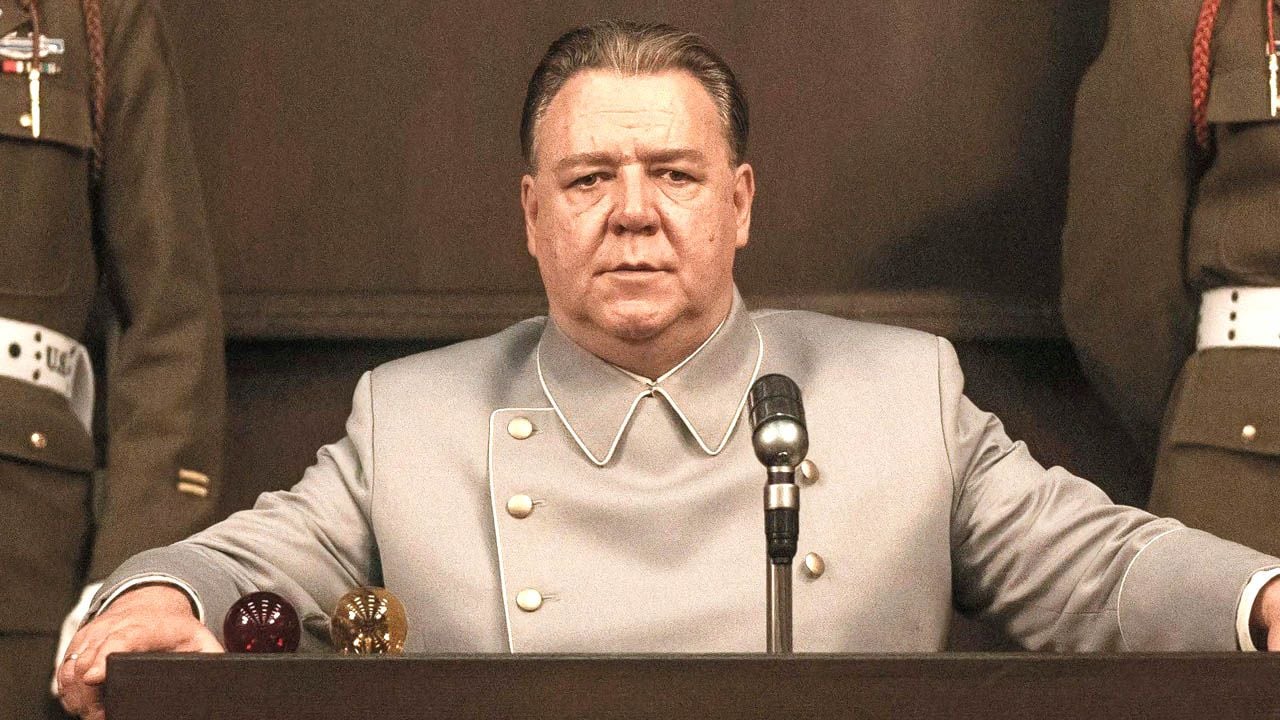
Russell Crowe makes a real effort with his portrayal of the Nazi criminal Hermann Göring – but his casting remains strange.
At the center of the film is the American military psychiatrist Douglas M. Kelley (Rami Malek). After the end of World War II, Kelley was assigned to Nuremberg to assess the defendant's mental state before trial. Hermann Göring (Russell Crowe) in particular piques his interest. He repeatedly visits the heavyweight war criminal in his tiny cell.
Kelley believes he just needs to engage Göring in conversation to gain his trust. To analyze it, he meticulously writes down every detail in his notebook. A certain intimacy soon develops between these two men. Kelley even smuggles letters back and forth between Göring and his wife Emmy (Lotte Verbeek), without suspecting that he is being manipulated by Göring. Only when the trial begins and frightening original recordings of the liberated concentration camps are shown as evidence in the courtroom does Kelley become aware of his own wrongdoing. He once again visits Göring in his cell and announces that he will do everything he can to ensure that the mass murderer is brought to justice: death by rope.

Military psychiatrist Douglas M. Kelley (Rami Malek) lets Göring wrap him around his finger for a short time.
But of course we know that Göring killed himself with a cyanide poison capsule the night before his execution. Douglas M. Kelley used his notes to publish his book “22 Cells In Nuremberg” in 1947. In 1958 he also took his own life – also with cyanide. 50 years later, US journalist Jack El-Hai began researching the relationship between Göring and Kelley and, as a result, published the non-fiction book “The Nazi and the Psychiatrist,” which served as the basis for this film. Director James Vanderbilt, who began his career in Hollywood as a successful screenwriter (“Zodiac – The Killer's Trail”) and also wrote the script for “Nuremberg”, his second directorial work after “The Moment of Truth” is not only about the psychological duel between Göring and Kelley, but also about the historical context.
For the first time in modern human history, leading representatives of a state were held accountable for their war crimes before an international court. The birth of today's international criminal law was still very politically controversial at the time, and the world public first had to be convinced. To underline the necessity of the trial at the time, Vanderbilt actually uses real archival footage of mountains of corpses that were dug into mass graves with excavators in the liberated concentration camps. These footage, which feels like it lasts minutes, is difficult for cinema audiences to endure – and yet is essential to illustrate the extent of the horrors committed by the Nazi dictatorship. Dramaturgically, this is also the turning point for Kelley, who until then wanted to believe that others, but not necessarily Göring, were responsible for the Holocaust.
Russell Crowe is both a quality and a problem
Crowe masters the perfidious psychological game with the psychiatrist perfectly. He manages to bring out his character's diabolical intelligence while also showing his falsely friendly side. Kelley falls for his charm – and when Göring smiles and even radiates sympathy, you even understand why for a moment. At the same time, it's Crowe's confident smile that we've known inside and out since Gladiator. In this respect, it is difficult to forget the actor and only see Göring – especially since there is no resemblance to be seen on his face.
The only thing Crowe brings with him is the fullness of his body, although authenticity wasn't really taken into account here either. While Göring actually lost weight in prison and looked almost like a heap of misery at the trial in his now far too large uniform, Crowe only hints at the weight loss with constant push-ups without actually making it visible. It is to his credit, however, that he rehearsed several sentences in German for the first film scenes without it sounding awkward. However, his rhetorical brilliance, with which he wants to shine in the course of the plot, is exaggerated – the real Göring's English was considered bumpy and incorrect. At least the other top Nazis were cast with German-speaking actors: Andreas Pietschmann (“Dark”) as Rudolf Heß, Peter Jordan (“Babylon Berlin”) as Karl Dönitz and Wolfgang Cerny (“The Healing”) as Baldur von Schirach. In contrast to Crowe, they always remain in the background.
The film has its place as an introduction to the topic
In the last third of the film, the courtroom becomes the main setting. Here, Michael Shannon (“The Bikeriders”) dominates the stage as the main American prosecutor Robert H. Jackson and Richard E. Grant (“The Lesson”) as the British prosecutor Sir David Maxwell Fyfe. After all, they are the ones who have to ensure that Göring convinces himself of his vanity. This is compressed in a pretty clichéd way, but serves the drama of a courtroom and psychological thriller designed for suspense. So anyone who demands more authenticity will certainly be better served with documentary films. But if “Nuremberg” manages to interest people who know little or nothing about the historical background 80 years ago, it can only be a good thing that the film was made.
Conclusion: Russell Crowe as human criminal Hermann Göring is strange – but he does his best to attract people to the cinema who first have to be introduced to the topic of National Socialism.
We saw “Nuremberg” at the 2025 Zurich Film Festival.