
Just a few days ago, in the review of another Berlinale competition entry, “In A Whisper,” I reported on a striking trend: There are more and more (festival) films that are about someone returning to their homeland after years of absence and being confronted with the ghosts of the past. This certainly has to do with an increasingly connected world and more global biographies. At the same time, there are also special funding sources that are aimed exclusively at international or even intercontinental co-productions, for which these materials are perfect.
Often it is weddings, illnesses or deaths, including inheritance matters that need to be taken care of, that lead to the (initially involuntary) return. But it is precisely at this point that Canadian filmmaker Geneviève Dulude-De Celles came up with something truly original: art expert Mihail (Galin Stoev), the protagonist of “Nina Roza,” returns from Montreal to his hometown of Sofia after 28 years because his boss has commissioned him to examine an eight-year-old child prodigy. Nina (Sofia Stanina), who lives with her single mother in a small village, has achieved a viral hit with her finger-paint paintings.
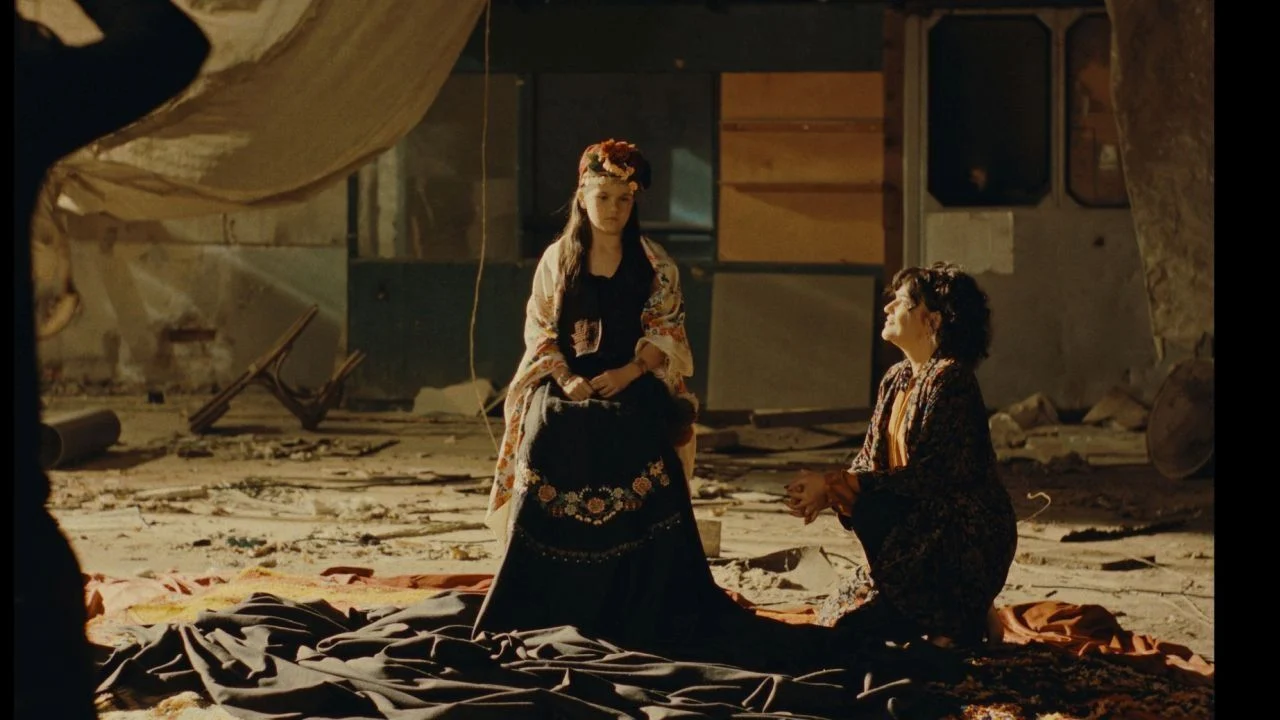
Alexandre Nour Desjardins: The photo shoot is intended to highlight Nina's (Sofia Stanina) traditional origins.
The central question is: Is Nina really solely responsible for the potentially valuable works of art? Then Mihail's boss would buy the works for his gallery in Canada – and Nina could go to Italy for further training, where a Roman art dealer (Chiara Caselli) is already ready to take the highly talented girl under her wing. Or did someone help her? Then the whole thing would have been resolved straight away. In any case, Mihail even thinks it is possible that the entire village is involved in a scam. His view of his old homeland seems to be anything but positive.
Apparently a lot has changed since then. The taxi driver (Nikolay Mutafchiev) even mistakes him for a tourist at the airport because the newcomer doesn't even know that the Bulgarians kicked Uber out of the country in 2015. More culture clash moments follow, such as when the villagers are amused by Mihail's strange accent, which he explains by saying that he now “thinks in French”.
Watch and smoke
But “Nina Roza” doesn’t slip into outright comedy because the actually great lead actor, Galin Stoev (“The Infinite Garden”), repeatedly stares into nothingness, preferably while smoking. However, you can only understand the constant, strenuous thinking to a limited extent, because Geneviève Dulude-De Celles has put everything together in her script in such a way that most of it is obvious anyway.
“Roza” from the title is not Nina’s last name, but rather refers to Mihail’s adult daughter Rose (Michelle Tzontchev), who emigrated to Canada with him at the time – coincidentally, exactly the same age as Nina. Mihail projects the fact that his own daughter, now a mother herself, is suffering from a certain sense of uprooting onto Nina. There is something definitely offensive about the fact that he presumes to decide about the little girl's future bypassing her mother just because of his own family problems.
Built box or felt art
But you can't really blame him because the parallels between Nina and Rose jump out at you so aggressively. Dulude-De Celles is definitely a more subtle director than writer – and her script may even be too neatly constructed to really get to the heart of things. “Nina Roza” is framed by scenes in which boards are cut to the millimeter and letters are printed on wood without any smudging. You immediately believe that something high-quality is being created here.
But then it becomes apparent: it is not the works of art that are being assembled here, but the transport boxes for their export. So is “Nina Roza” just a perfectly constructed package, or is there real art in it? In the end, this is probably even more important than the question of whether the girl painted everything alone or not.
Conclusion: Absolutely solid return-to-home drama, which is nowhere near as original as the eye-catching premise about an eight-year-old prodigy would suggest.
We saw “Nina Roza” at the Berlinale 2026, where it celebrated its world premiere in the official competition.