
Finnish filmmaker Hanna Bergholm was already sure to attract the attention of the horror world before the world premiere of her first feature film “Hatching”. A single, pre-published photo of the scene was enough – a twisted allusion to the iconic one Chestbusters-Scene from “Alien – The eerie creature from a strange world”: A blonde girl bends over a huge (bird) egg in her bed that has apparently burst out of her pink plush teddy bear. The coming-of-age body horror is now followed by “Nightborn,” a (predominantly English-language) maternity body horror, in the first picture of which the main actress Seidi Haarla (“Compartment No. 6”) is kneeling in front of a crib with a blood-smeared face, while the “Harry Potter” star Rupert Grint standing next to him looks rather distressed.
This picture is certainly also an announcement, although not nearly as mysteriously promising. What should we expect? Probably a bloodier Finnish version of “Rosemary’s Baby” and all the other horror babies that have made it to the big screen (and the video store shelves) since then. In a way, this assessment is actually true – and yet it only takes a few minutes until it becomes clear that Bergholm is doing everything in its power to even surpass the pure WTF factor of its predecessor. At the latest when the noticeably deformed Flora is more involved in a sex-in-the-forest scene on the soundtrack than you would actually expect, the tone is set for a thoroughly fucked-up baby-of-a-slightly-different-kind story.
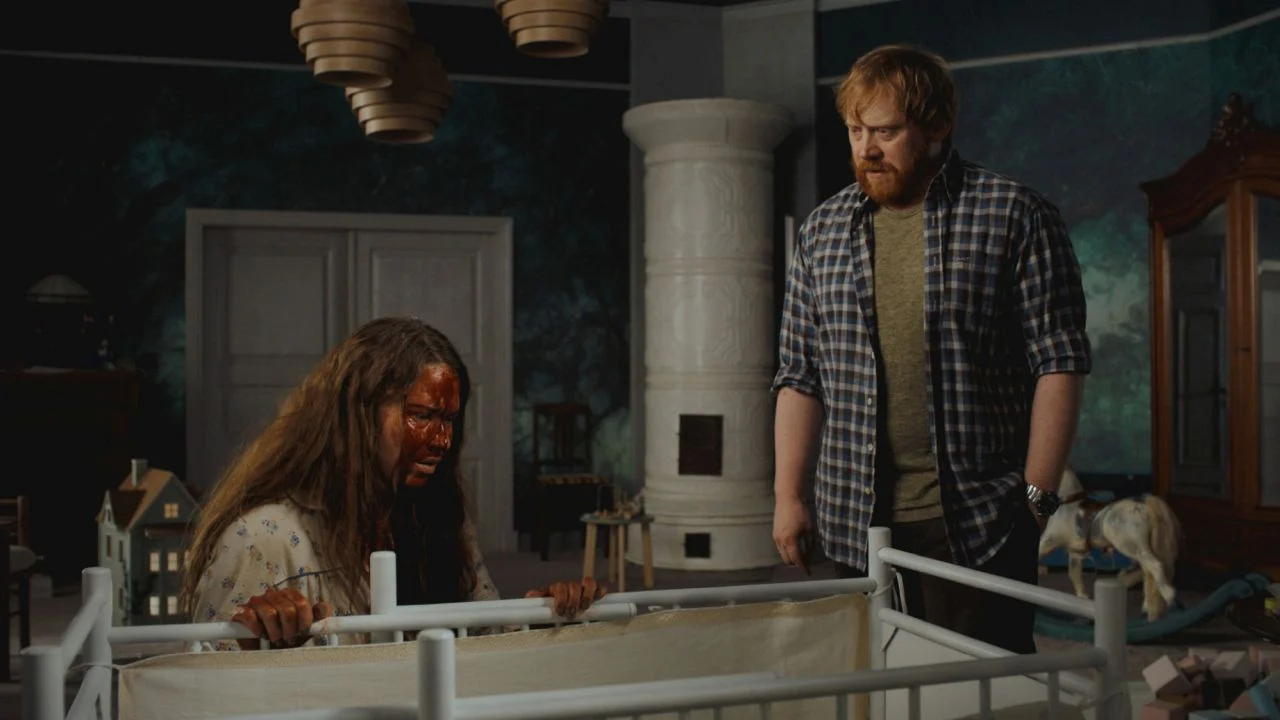
One thing is as certain as the amen in church, Saga (Seidi Haarla) and Jon (Rupert Grint) definitely imagined the first few weeks with their baby differently.
“Fuck London!” Saga (Seidi Haarla) has specifically planned a five-year break from work to start a family with her British husband Jon (Rupert Grint) – after all, there are three children on their shared wish list. Before that, however, Saga's grandmother's rotten house, which has been rotting in the middle of the Finnish forest for years, needs to be repaired. It's also really impressive what the young couple can accomplish in such a short time – even if they don't quite finish because their son Kuure was born a few weeks early.
But in addition to the early due date, there are other reasons for concern. Not only is the baby unusually hairy and sensitive to light, but when breastfeeding it also seems to be less interested in the mother's milk and more interested in the mother's blood when, instead of sucking on the nipple, it feels like it bites off half of the breast. While she has to hear from all sides that everything is okay with her son and that she is the real problem, Saga becomes more and more convinced that there must be a connection between the Kuure, which she calls “it”, and the surrounding forest…
Learning from the great white shark is actually always a good idea
If you really want to deliver another maternity horror film in 2026, you should either – like “The Babadook” – convince with extraordinary psychological precision or at least really add to everything you've seen so far. Even if themes such as postnatal depression certainly resonate in “Nightborn”, Hanna Bergholm has obviously opted for the second option, because she exploits the bloody, bizarre side of the scenario to the hilt. The way she doesn't show the baby is a real joy: instead of its face, we initially only see its hairy back – and even later, the sets are always lit in such a way that, like the first appearance of a femme fatale in a film noir, we can only make out shadowy outlines.
Of course, your own (sick) imagination is working overtime, especially since we are instead presented with the faces of the relatives who are just seeing the baby for the first time: While the adults can still bring themselves to smile in a noticeably forced manner, the cousins react (“child's mouth tells the truth”) with frightened disgust. Here Bergholm obviously learned from Steven Spielberg, who for a long time only partially or vaguely revealed his title character in “Jaws”. It actually has a completely different, particularly grotesque effect when the “movie monster” is not a monster weighing up to four tons with 300 teeth up to seven centimeters long, but a newborn that can't even crawl.
Conclusion: A terrifically nasty and incredibly entertaining horror grotesque, which, even more than the worsening climate change and the global political situation that is getting out of hand, will make many people reconsider their own desire to have children.
We saw “Nightborn” at the Berlinale 2026, where it celebrated its world premiere in the official competition.