
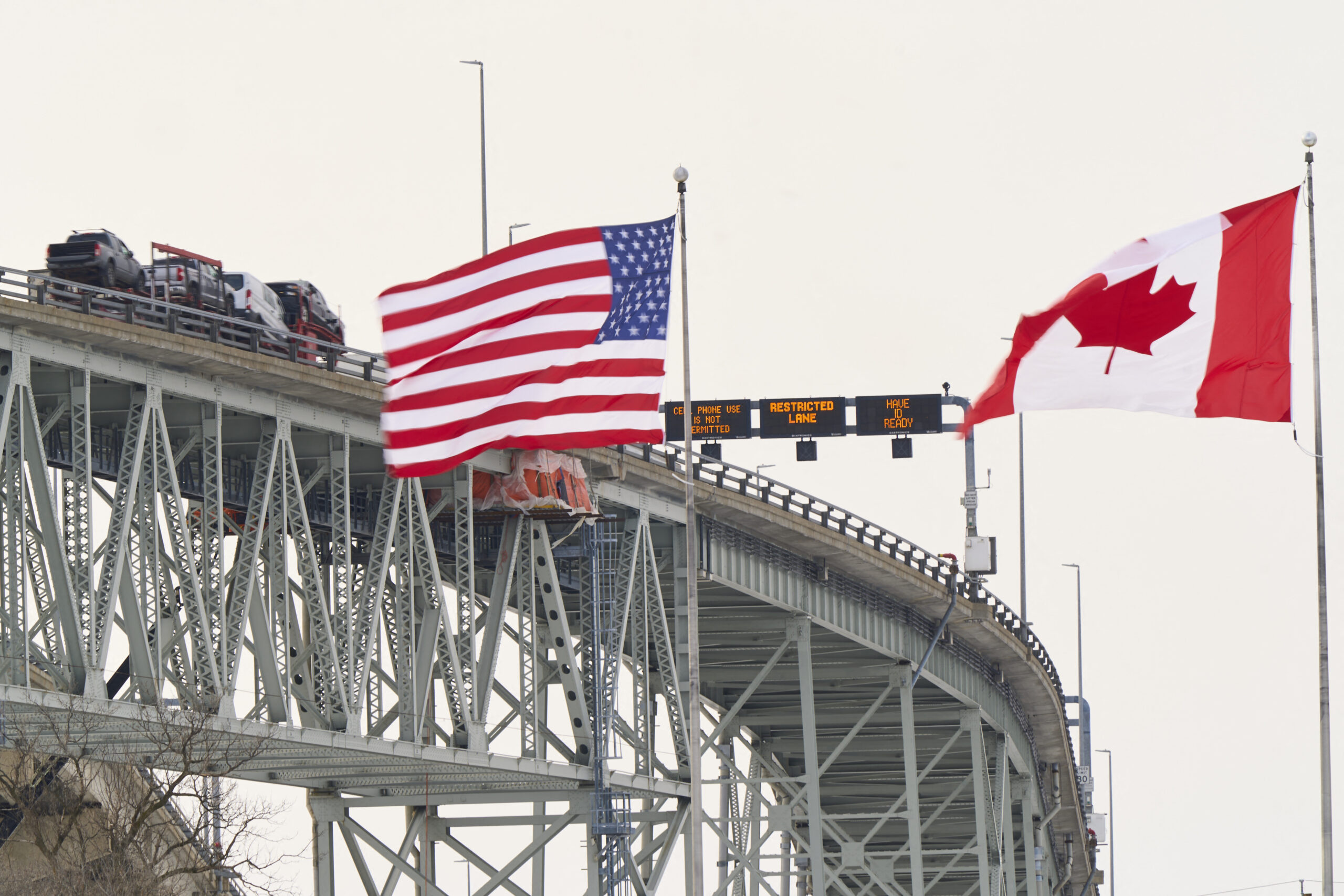
The Secretary of Commerce Howard Lutnick said that Mexico and Canada have “done a reasonable job” to ensure their borders with the United States, although the deadly drug continues to flow to the country.
The president of the United States, Donald Trump, plans to impose new tariffs on Tuesday to Canadian and Mexican exports to the United States, but the secretary of Commerce, Howard Lutnick, said Sunday that it is possible that they are not as high as the 25 % figure that Trump was planning.
“It's a fluid situation,” Lutnick told Fox News program “Sunday Morning Futures.”
“On Tuesday there will be tariffs for Mexico and Canada. We are going to let the president and his team negotiate exactly what they are,” he said.
Lutnick's comments were the first indication that the Trump administration may not impose total 25 % tariffs that announced all the goods in Mexico last week and the non -energy imports of Canada, arguing that the two American neighbors are not yet doing enough to curb the flow of illicit drugs to the United States.
Lutnick said that Mexico and Canada have “done a reasonable job” to ensure their borders with the United States, although the deadly drug continues to flow to the country.
Trump announced for the first time the tariffs a month ago, but then delayed its date of entry into force after the Mexican president, Claudia Sheinbaum, announced that she would send 10,000 soldiers to the northern border of Mexico with the United States to curb the flow of narcotics, and the Canadian first minister, Justin Trudeau, said that she would name a “tsar of the fentanil With the problem.
Trump is also adding another 10 % tariff to Chinese products on Tuesday, doubling the 10 % tariffs imposed on February 4. Trump has blamed China as the fentanyl traffic source to the US.
When announcing the new tariffs last week, Trump said: “Drugs continue to reach our country from Mexico and Canada at very high and unacceptable levels. A large percentage of these drugs, many of them in the form of a fentanyl, are manufactured and supplied in China.” Trump made the comments on his social truth platform.
Sheinbaum, whose economy dependent on trade sends 80 % of its exports to the US, said Mexico was “waiting to reach an agreement with the United States” before the new tax went into force, but that if not, it could impose retaliation tariffs on US products exported to Mexico.
When Trump first announced the high US tariff on Canadian imports in early February, Trudeau said he was “totally unjustified” and promised to impose a 25 % tax as of March 12 to American steel and aluminum products exported to Canada. Canada is the main exporter of both metals to the United States.
Economists say that Trump's tariffs are probably imposing retail prices for consumers and the cost of materials for companies. Mexico, Canada and China, in that order, are the three main national commercial partners of the United States, although collectively, the European Union of 27 nations is larger than all three individually.
Trump, at his first cabinet meeting of his new presidential mandate last week, said that “very soon” would announce a 25 % tariff on the US exports to the United States.
He affirmed that the EU was “formed (in 1993) to economically harm the United States.”
With Trump's signal about the new tariff to the goods sent to the United States, the EU promised to respond “firm and immediately” to “unjustified” commercial barriers and suggested that it would impose their own tariffs on US imports if Trump moved forward with his.
Trump said reciprocal tariffs on nations that tax US exports will remain in force on April 2. It has also suggested the possibility of imposing tariffs on imports of cars, wood, pharmaceutical products and other goods.
Many economists have repeatedly warned that tariffs could lead to higher prices, promoting problematic inflation in the United States. Trump has acknowledged that there could be a short -term pain for Americans, but has argued that tariffs would ultimately be beneficial for the US economy, the largest in the world.
Trump says that the tariffs he is imposing would be an incentive for foreign companies to make more manufactures in the United States to avoid tariffs on sending their products abroad.
More immediately, Trump has focused on drug flow to the United States.
“More than 100,000 people died last year due to the distribution of these dangerous and highly addictive poisons,” he said in his publication on social networks.
“Millions of people have died in the last two decades,” Trump said. “The families of the victims are devastated and, in many cases, practically destroyed. We cannot allow this scourge to continue damaging the United States and, therefore, until it stops or limited itself seriously, the proposed tariffs scheduled to enter into force on March 4, in fact, will come into force, as planned. ”