
The “Conni” stories by Liane Schneider are a real “giant” on the local children’s book market: more than two million “Conni” booklets are sold over the counter every year. Since 1992, more than 50 million copies based on the popular main character Conni Klawitter have been sold. Since its creation, 100 original stories have been created across all formats – and there is still no end in sight. The “Conni” series will be continued continuously to accompany future generations of children of different ages. Because that is probably the biggest secret of the success of Schneider’s “Conni Empire”: the protagonist with her striking red and white striped sweater “grows” with her readers.
That’s why, in addition to the original Pixi books “My Friend Conni”, there have been supplementary story volumes for primary school children, “Conni & Co” for readers aged ten and over, and the youth book series “Conni 15” for years. There is also a KiKA animated series and two live-action cinema adventures from 2016 and 2017 (the second by director Til Schweiger). And as if that wasn’t enough, Conni also successfully made the jump to the big screen in animated form in 2020. “My Friend Conni – Secret of Tomcat Mau” attracted almost 300,000 Conni fans to the cinemas – under difficult pandemic conditions. Six years later, the (surprisingly late) sequel “My Friend Conni 2 – Adventure with Crane Klaus” follows, which is very much based on the lovingly realized first film in terms of mood and tonality. There are still a few small drawbacks.
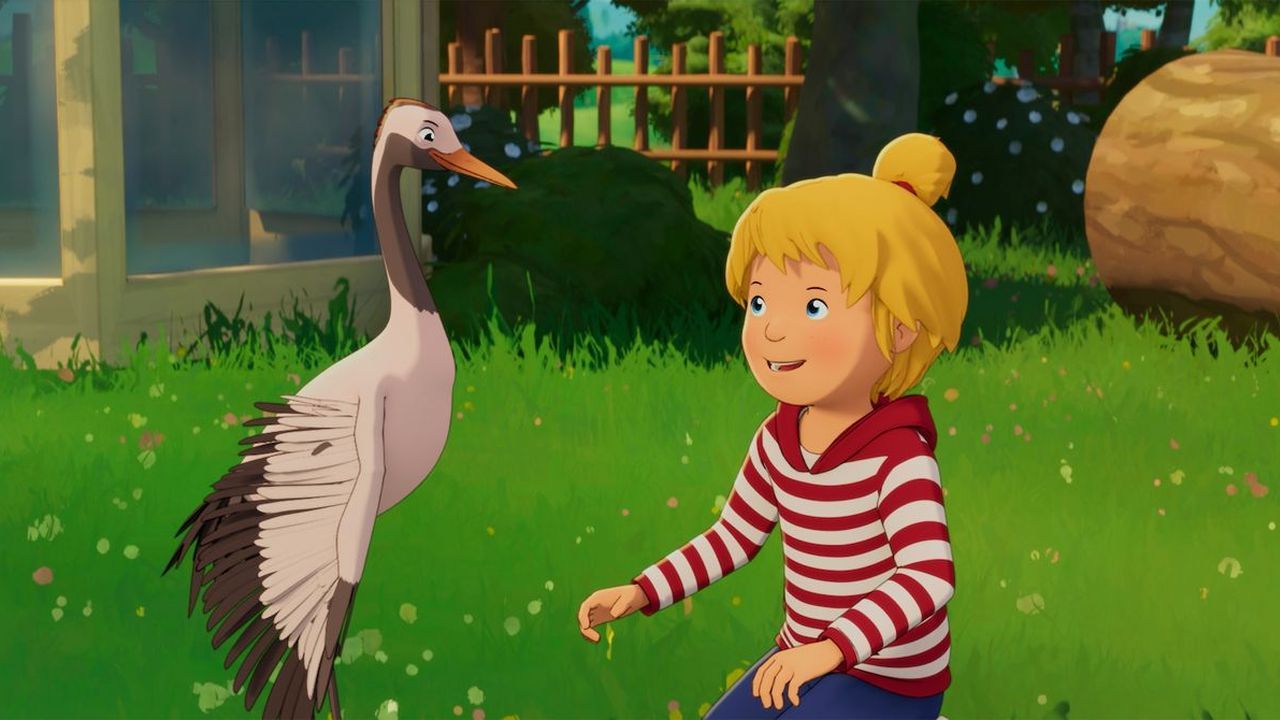
After Mau the tomcat, Klaus the crane is the main animal character this time.
Conni’s anticipation is huge: her parents are setting off to visit the family with her little brother Jakob – and she can stay at home with Grandpa Willi. Willi takes care of his granddaughter with devotion and even allows Conni’s friends Anna and Simon to stay overnight with her. The trio wants to prepare for their girlfriend Semire’s birthday party. But the three friends’ plans are suddenly interrupted when an injured crane appears.
And then there is the grumpy and pedantic Mr. Oswald, who doesn’t think much of the animal guest. Because the crane, which Conni christened “Klaus”, repeatedly devastates the neighbor’s garden. Meanwhile, the children have to nurse Klaus back to health in time so that he can start the upcoming flight south with his peers…
Conni (almost) alone at home
The most important thing first for all those who don’t know the first part: No previous knowledge is necessary for “Adventures with Crane Klaus”; the film tells a self-contained plot. Entry into Conni’s world is deliberately designed to be low-threshold for newcomers; all characters are mentioned by name (and thus introduced) early on. This means that even first-time moviegoers, for whom the film is primarily designed, will quickly find their way around the animated scenery.
Speaking of animation: Like its predecessor, “Adventure with Crane Klaus” is visually rich in detail and beautifully animated in 2D. The team therefore remains true to the visual style of the popular “My Friend Conni” book series. Often it actually feels as if the illustrations from the Carlsen books are coming to life – the animation style is so similar to the book aesthetic.
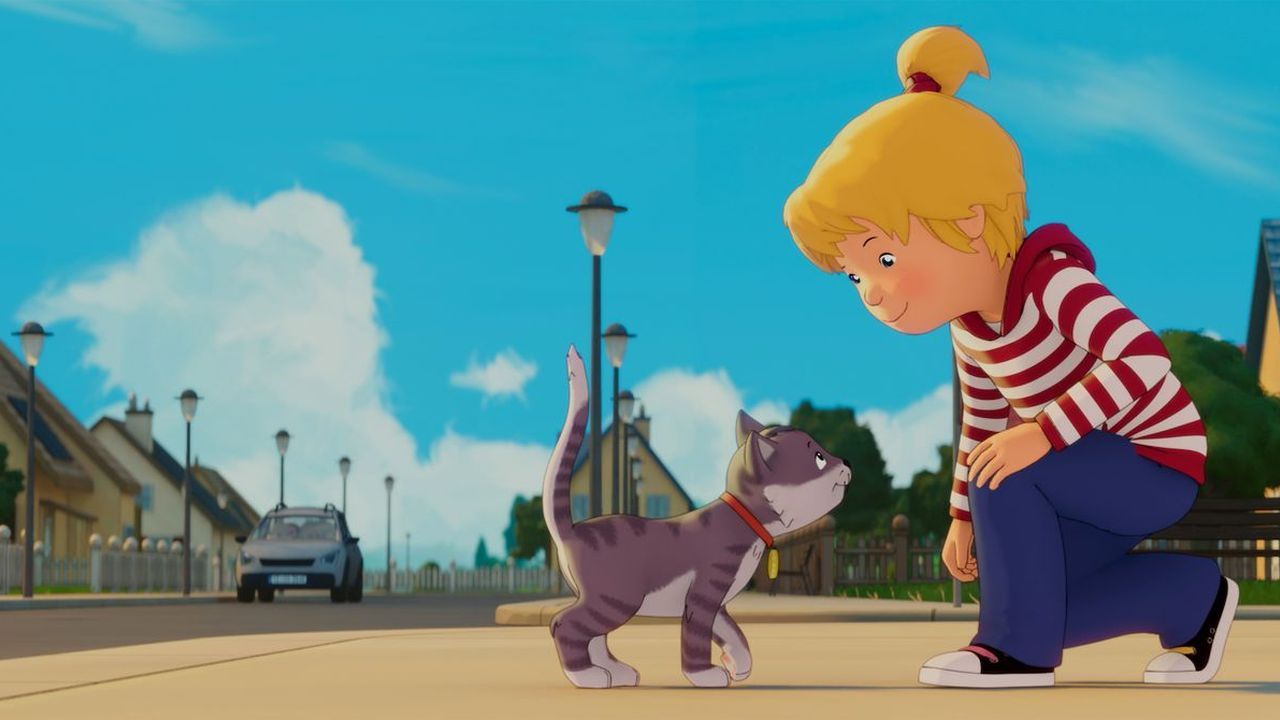
Even though he didn’t make it into the title this time, Mau the cat is of course back in the game!
In addition, filmmaker Dirk Hampel and his co-director Raquel Conde Viera rely on an age-appropriate dramaturgy and decelerated narrative, without any hectic cuts or overly violent, possibly overwhelming twists. Conni’s world is – in the truest sense of the word – colorful, friendly and life-affirming. On the one hand, this is due to the light colors, but also to the “sunny”, amiable disposition of the little, always curious heroine. As in real life, Conni faces smaller and larger challenges. This time she has stress with her friend Anna, who feels she has been treated unfairly. The dispute involves, among other things, the question of who can look after the injured crane. The friends resolve this conflict by talking about their respective needs, approaching each other openly and taking each other’s perspective.
This is just one example of how cleverly the film resolves such situations and everyday problems, especially since it is educationally valuable and has an elementary message (here: the ability to empathize). Of course, humor shouldn’t be neglected either. This time it’s the quirky sidekicks who get the most laughs, including a quirky, wonderfully nerdy wild bird expert. Or “favorite neighbor” Mr. Oswald, who calls the police for every little thing. In addition, Conni’s friend Simon attracts attention with his smart, witty comments. One of the film’s running gags is Simon’s skepticism (or should we say fear) towards animals. This is a wonderful counterpoint, since Conni – and many of the other characters – are absolutely fond of animals and four-legged friends of all stripes play a central role in almost all the stories.
Things get really exciting in the last 15 minutes
The story about the flightless bird, however, is not quite as thrilling and intense as the story of its predecessor: Conni experienced an exciting adventure in an old castle. The castle setting created a special atmosphere, which “Adventures with Crane Klaus” unfortunately lacks a bit. After all, the film largely takes place “only” in one’s own four walls, in Conni’s neighborhood and in the gardens of the Klawitter family and the neighbor. In the middle of the film there are certain lengths and the constant argument between Mr. Oswald and the children over the same topics (destroyed flowers, trespassing on the property) turns out to be redundant.
However, things get really exciting at the end when things get really tough during the fast-paced trip in different vehicles to the birds’ departure point. A finale that even adults can get excited about. This race against time in the final quarter hour is the central, highly emotional and grippingly realized climax of the film. You can also forgive the somewhat shallow, maudlin piano sounds that accompany the big farewell to this entertaining adventure story.
Conclusion: The second animated “Conni” adventure this time takes place in the “home environment” of the bright and usual adventurous protagonist. As with its predecessor, the youngest cinemagoers of kindergarten and early primary school age can easily get excited. The story has become a bit tame at times. The humor and the pedagogically cleverly packaged messages and themes that revolve around cohesion, charity, conflict resolution and farewells are convincing.