
The Japanese cult director Shinya Tsukamoto has never shied away from cinematic extremes. After all, we’re talking about the artist whose career began, among other things, with the completely crazy cyberpunk nightmare “Tetsuo: The Iron Man”. Over the years he has repeatedly pushed his characters and his audience into borderline experiences and the edge of being overwhelmed, albeit with fluctuating intensity. Also in “Mr. Nelson, Did You Kill People?” Tsukamoto’s penchant for the drastic and sensory overload is still clearly noticeable when he once again approaches the dimensions and consequences of war. It is his fourth historical story in a row, but his first in English. Right from the start, Tsukamoto’s new film rushes forward with powerful energy, but also great vulnerability. His protagonist, Allen Nelson (Mark Merphy), wakes up in the dirt, bathed in sweat. Tin cans everywhere, a half-burnt candle. A rat is looking for food.
Allen’s walk through the city becomes a gauntlet: the call of a neighbor or a honk in traffic echoes so loudly that you experience real shocks together with the character. During a panic attack, bright lights dance and flicker on the screen. Allen flees under a car. As quickly becomes clear, the African American suffers from post-traumatic stress disorder. He fought as a soldier in Vietnam. Now he is on his own, a neglected and troubled outsider whose trauma should be socially and politically suppressed. When a former classmate abandons him, she persuades him to share his experiences with a school class. He stammers out heat, animals and a few other catchphrases in front of the children. But then comes the central question from a little girl: “Mr. Nelson, have you killed people?”
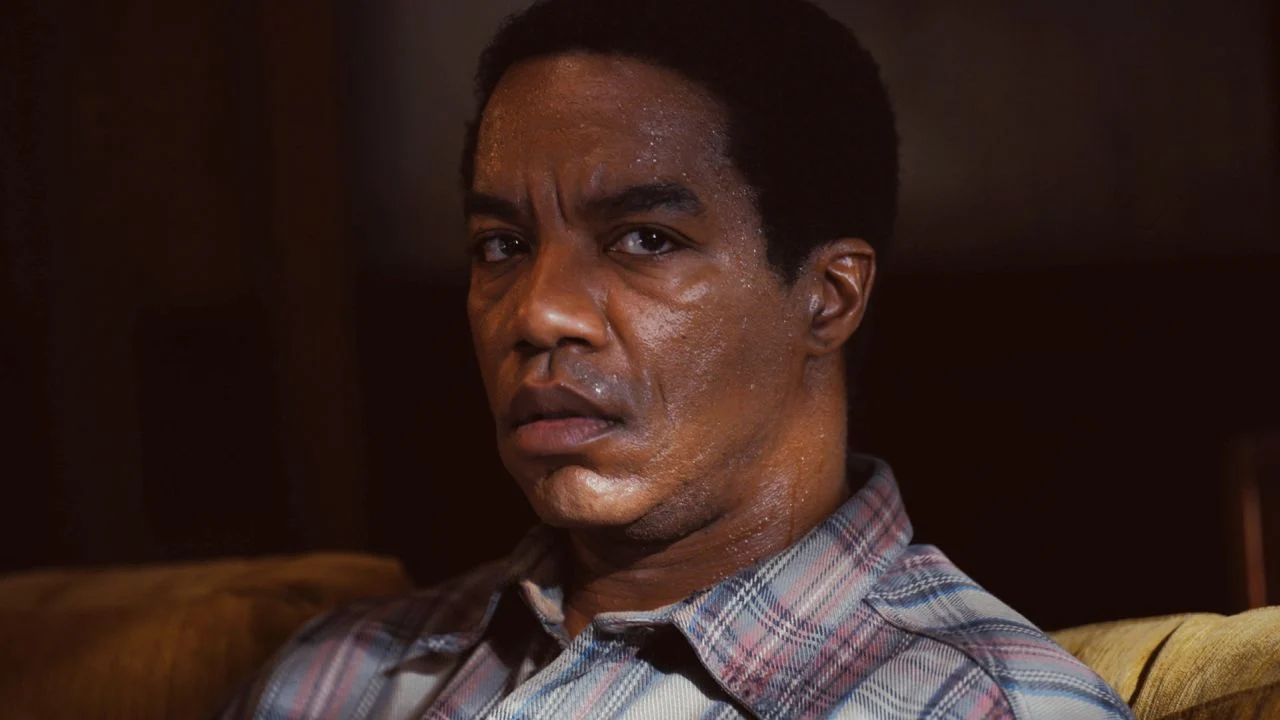
It takes Nelson (Rodney Hicks) decades to fully process the impressions from Vietnam (including his own cruel deeds).
Shinya Tsukamoto films the life of a man who spoke publicly about his war experiences thousands of times. According to his own statements, the director came across Nelson’s story while preparing the war film “Fires On The Plain”. But the journey to all the public appearances was pure torture for the protagonist, as Tsukamoto demonstrates to us over the course of around two hours. The filmmaker chooses a non-linear form for this. It jumps between times and shows how Nelson is repeatedly haunted by his actions. He follows how Nelson’s domestic family life stumbles and how he fears repeating the horror of his parents’ generation and passing it on to posterity.
The narrative levels of therapy sessions are held together. After Nelson choked his own wife during panic attacks, he met with therapist Dr. Daniels and the film can rely on two very strong character actors: Rodney Hicks, who plays the older Nelson, and Geoffrey Rush. Hicks embodies the deep-seated pain with strained, uncertain speech, with glassy eyes, but also sudden, impulsive outbursts. With Oscar winner Rush, simply playing with composure and control is enough. Calmly but persistently, he probes inside his counterpart.
Why do people kill?
The film thus performs an interesting pendulum movement between two questions. On the question of “If?” the question “Why?” will soon be added. of killing. It was just his job. True to the motto: If you don’t kill, you will be killed yourself. However, neither Dr. makes excuses about the alleged necessity and lack of alternatives. Daniels is still happy with the film.
When Shinya Tsukamoto depicts war itself, he indulges in lurid horror. Not just with loud noises, but also with shaky camera and painfully explicit shots. It shows spurting blood, a head that collapses after a shot like a balloon being let out of air. The American soldiers fall into brutal traps. They carry out one massacre after another. What remains are burning villages and piles of corpses.
The camera is fully focused
That’s not particularly original. Such images have often been seen in films about the Vietnam War, but here they are particularly consistent in their blatantness. Tsukamoto relies on the striking. There are no big secrets or too many alienations. He shows the atrocities in bright colors, in broad daylight and in ultra-high-resolution digital images. Of course, the film also enjoys the creepy spectacle of this violence to some extent. But its anti-war character only emerges from the context anyway.
“Mr. Nelson, Did You Kill People?” Fortunately, it’s not one of those films that ultimately glorifies camaraderie, sacrifice or patriotism. Despite all the horrors one may have caused. No, there are no illusions here, because war has no winners among those involved, only devastating consequences for everyone. Tsukamoto perhaps presses the tear duct a little too pathetically in his four or five consecutive final scenes when it comes to all sorts of gestures of rapprochement and understanding. But these are more cosmetic flaws.
The war business goes on and on
Until then, the film gives you some stimulating thoughts, questions and observations about participating in wars. For example, he is concerned with the interconnectedness of racist discrimination, poverty, domestic violence and the military’s promise of advancement and escapism. He explores the dehumanization of others as an outlet. And suddenly it’s no longer just about Vietnam. As part of the drill and brainwashing, the violence becomes an intoxication and a compensation. And these uncertain tipping moments are particularly impressive.
At the latest when it comes to recruiting even more young people for the military and thus also for potential wars, the film takes on an incredibly explosive and urgent nature. Because how does this advertising happen? Of course with blank spaces and trivializations. That is also a theme of this film. As if the offspring were old enough for the fight, but too young for its importance. Allen Nelson intervenes in this principle. He becomes a guilt-ridden hero by publicly and repeatedly owning up to his own crimes.
Conclusion: Shinya Tsukamoto is by no means reinventing the anti-war film genre. But he manages to create a complex, sensitively told and consistently disillusioning approach to a personality who learns to transform his own guilt into a warning for everyone.
We have “Mr. Nelson, Did You Kill People?” seen at the Venice Film Festival, where it had its world premiere as part of the official competition.