
Minnie (Katherine Mallen Kupferer) and Callie (Chloe Coleman) were best friends, but Callie never said “Minnie Mouse” to Minnie. Nevertheless, Minnie answers Callie's mother Helen's question about the supposed nickname in the affirmative. Callie had recently died in a car accident, and Helen, in her desperate grief, consulted a medium to get in touch with her deceased daughter. And now she longs for confirmation that all the outlandish nonsense she was served at the séance could actually be coming from her beloved Callie.
One could logically understand the title of the film by the American directing duo Kelly O'Sullivan and Alex Thompson as Minnie's attempt to make her own inner “Mouse”, which never existed in her relationship with Callie, become reality – even if the shy, self-doubt-plagued girl actually has something mouse-like about her. The focus of the film is Minnie's relationship with the mother of her deceased friend, to whom she feels drawn in their shared grief. She would love to move into Callie's empty room straight away and once shows up unannounced at Helen's door with her bag packed. It already dawns on him that the closeness into which the two mourners throw themselves quite unreservedly is not necessarily a healthy one.
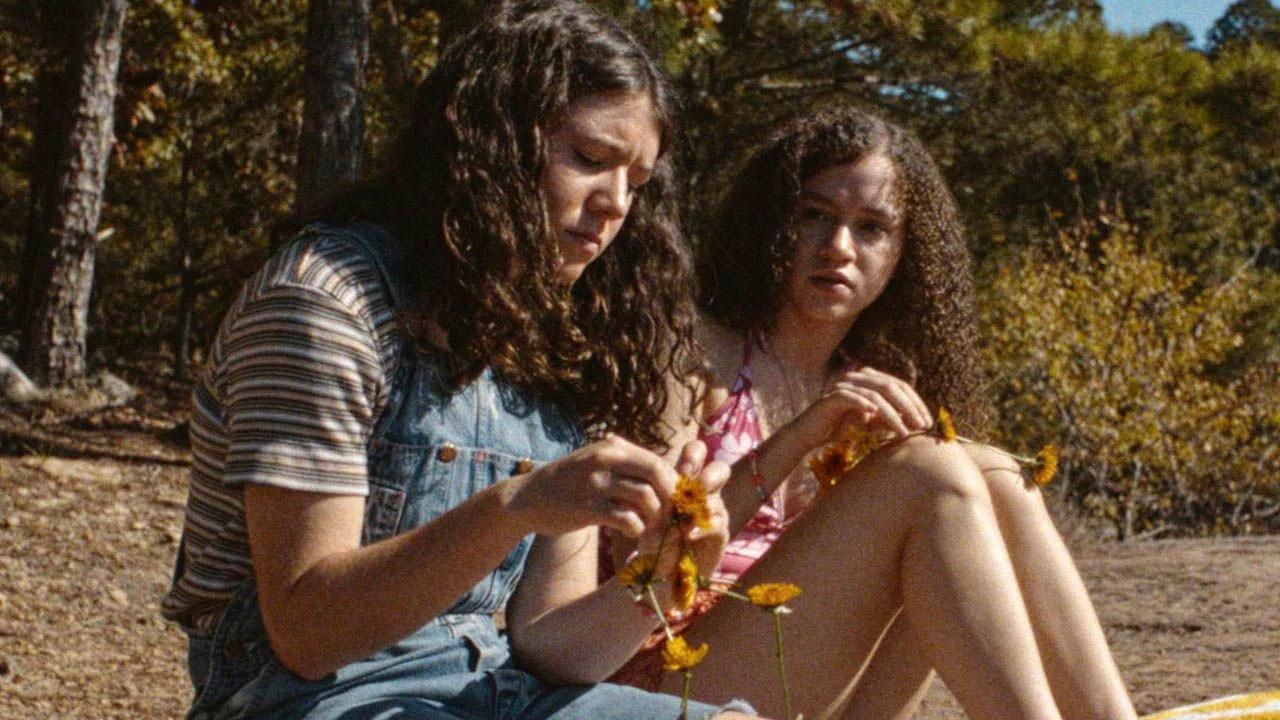
A tenderly told lesbian love story also finds its place in the grief-processing drama of “Mouse”.
For Minnie, Helen's middle-class house is also a welcome escape because she already feels out of place in her own family. Her single mother works hard in a veterinary practice for little money. With a compassionate heart, she looks after stray dogs as well as a baby who also appears to have run away, to which Minnie once says in surprise that she now has a little brother. She by no means lacks the will to become a mother, but she does lack some parental talent: Minnie's home is one of those precarious American families of which US Vice President JD Vance (who at the time was not yet a fascist power politician, but the feature section darling of the left-wing intelligentsia) wrote in his memoirs “Hillbilly Elegy” that they ate at Taco Bell for lunch and at Wendy's in the evening.
Of course, this complicated escape into a mother-daughter surrogate relationship characterized by grief and pain cannot go well. And the common thread that initially ties them together – the singing lessons for Minnie, who really wants to sing a song for Callie at a (quite grotesque) school performance, despite her lack of singing talent – gradually dissolves. It's good that “Mouse” also takes time for secondary storylines, including a really sweet and charmingly unproblematic lesbian love story between Minnie and Kat (Iman Vellani), a young woman who also has an experience of loss.
Emotional indie standard – or will it still be dark?
This love story makes the second joint directorial effort by Kelly O'Sullivan and Alex Thompson a kind of rollercoaster of different emotions, most of which seem believable and definitely pass on to the audience. “Mouse” is, first and foremost, an empathetic film that tries not to lay it on too thick. This kind of understated lo-fi feeling is definitely part of a certain emo mainstream within American indiewood cinema – but a film like “Mouse” doesn't have to be that original or even groundbreaking.
Although: There are a few moments in which a different, darker tone seems to flash through for brief moments. In which one has the impression that from now on a more cynical, malicious, condescending perspective on the protagonists could emerge. In view of the hated classmate Cara (Audrey Grace Marshall), for example, who turns her mourning for the deceased Callie into an unpleasantly narcissistic self-portrayal. In Minnie's mother too, when the film looks at her through the eyes of her daughter, who hopes to escape the precarious redneck clichés and barely tries to hide the contempt in her eyes.
Nobody is convicted here
In these moments, “Mouse” is almost reminiscent of the works of the US independent director Todd Solondz (“Happiness”) and there are hints of a different, darker film. But then again it seems as if the film actively decides against the darkness in order to keep its characters lovable and, perhaps more importantly, capable of love, even in their complexity and contradictions.
And they are all complicated. Nobody here always acts well or sympathetically or rationally or comprehensibly, but “Mouse” doesn’t entirely condemn any of them. Not even Cara, who is difficult to bear, is completely rejected. And how could one judge these people in the face of death and grief and loss and their own unique damage? Death is great, we are his own.
Conclusion: A sensitive indie drama about death and grief and loss that combines its dark themes with a hopeful and charming lesbian youth love story. Sometimes “Mouse” seems a bit conventionally sentimental, but in the end it leaves its characters with a certain stubbornness that sometimes gives the film surprising rough edges. Worth seeing!
We saw “Mouse” at the Berlinale 2026, where it celebrated its world premiere in the Panorama section.