
“”Moon, the panda“Is the latest feature film by the French documentary filmmaker Gilles de Maistre. The trained journalist started his career with television reports until he finally moved to the narrative subject (and to the cinema) in 2018 – with the groundbreaking animal film“ Mia and the White Lion ”, on which he was as authentic to the up -to -be friendship between a young girl and a lion to be able to tell. With “The Wolf and the Lion” and “Ella and the Black Jaguar”, De Maistre followed two more films that were equally simple, but the increasing audience with charm, wit and sentimental family gang were able to take for themselves. “Ella and the Black Jaguar” in 2024, with more than 1.1 million viewers in Germany, even made it to the top 20 most visited movies of the year.
At “Moon, the Panda”, however, de Maistre has now calculated for the first time – and instead of spectacular animal pictures, primarily provides a tirelessly lengthy family drama. Unfortunately, the focus of the unexpected history is rarely the very cute baby panda moon, but above all his human savior Tian (Noé Liu Martane). The teenager searches between his modern -oriented parents, his ambitious sister and his old -fashioned grandma for his family. But between the completely predictable action, the wooden spectacle and the clumsy dialogues, in which everyone repeats what they feel and how they stand by the other people, Maistre increasingly stumbles when trying to create any kind of excitement.
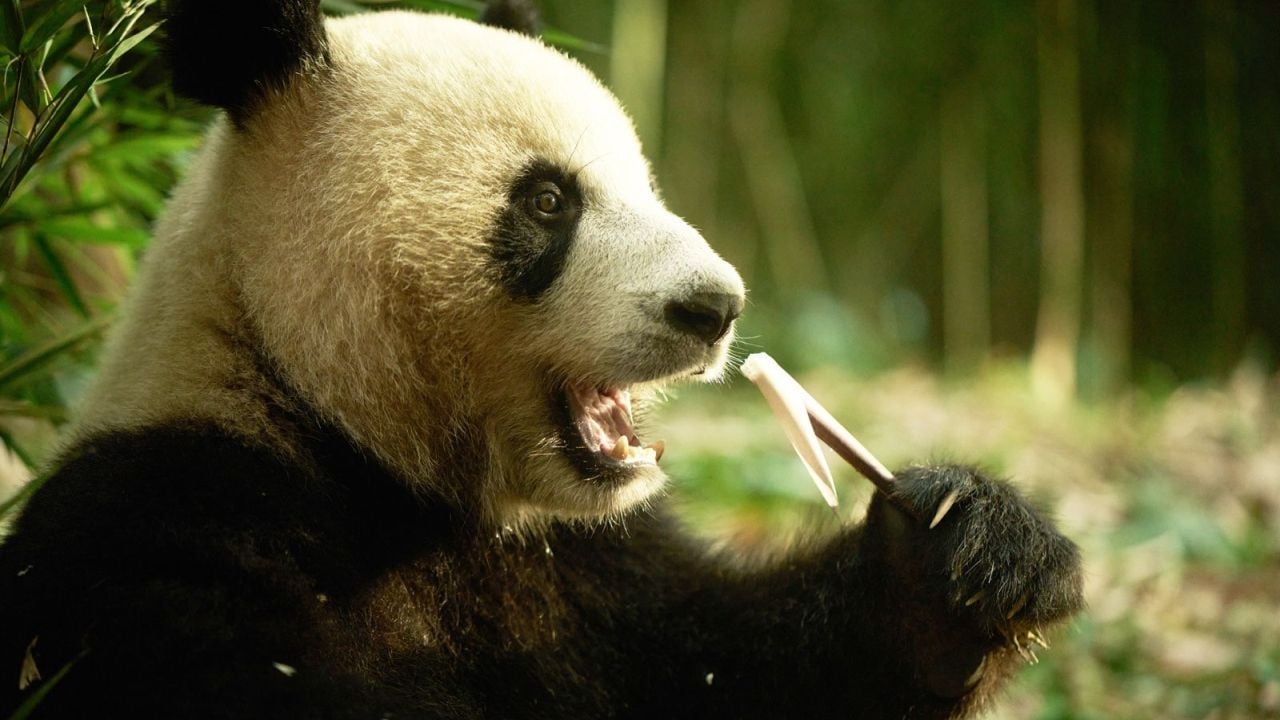
We would actually like to have seen a lot, much more from Panda Moon.
As usual from his previous films, Gilles de Maistre also begins in “Moon, the Panda” with a direct comparison of the urban and rural habitats of his characters: the camera jumps into the bright nightlife of the city of Chengdu from the picturesque backdrop in the area of the Panda family, which rolls around on the sunny mountains of the Chinese Sichuan region, where the Tian family Come together to celebrate his birthday. There his grandma Nai Nai (Sylvia Chang) found that all family members live past each other: Tian is always distracted by his game console, father Fu (Ye Liu) comes too late for all family events and then continues to work on his cell phone, daughter Liya (Nina Liu Martane) only thinks of her dance training – and mother Emma (Alexandra Lamy) is trying to To hold family together.
In order to bring nature closer to them, Nai Nai invites her grandchildren to the country. On his forays through the dense bamboo forests, Tian discovers a lost panda baby that he brings back to his animal family. From then on, teenagers and the Panda, which Tian baptized “Moon” because of his moon face, repeatedly meet in the forest – and close a secret friendship that will soon be put to the test by Tian's unobstructed father and the other dangers of the forest …
The weakest of the four animal films
Gilles de Maistre also works with his wife Prune de Maistre, who contributed the script with his Moon, the Panda. Unfortunately, the film cannot be convinced as a drama about a fragmented family that has to grow together again, nor as a classic animal film about the friendship between a child and a wild animal. In general, “Moon, the Panda” has much fewer show values than offering the previous films by de Maistre.
Perhaps this is also due to the fact that the terrain that forms the background of history is far less dramatic and dangerous than the African steppe in “Mia and the White Lion”, the Canadian wilderness in “The Wolf and the Lion” or the rainforest of the Amazon in “Ella and the Black Jaguar”. In the long run, the cozy panda around is a less impressive scene partner than the predators who served as protagonists of the earlier direction of de Maistre.

Tian (Noé Liu Martane) secretly makes friends with Moon, but this will soon be put to the test.
The title of Panda bear is wonderfully cute, but at the same time so calmly and relaxed that it is not particularly remembered as a wild animal or personality. The foreseeable plot and the clichéd figures as well as the unlike spectacle of non-mother speakers, who have to deal with wooden English dialogues, at least in the original version, brake the film again and again. The childish forest and meadow slap stick of the baby panda, which is constantly chewing around, does not go over over these weaknesses. The canvas veteran Sylvia Chang, unforgettable in “Eat Drink Man Woman” when Grandma Nai Nai still struggles to get some life into the action. In the end it is not enough.
Conclusion: Even the very sweet Panda protagonist does not deceive the narrative weaknesses and lack of show values. According to his previous cinema hits, Gilles de Maistre simply does not succeed in finding a path to bring his badly constructed plot on the screen.