
The fact that monsters are now completely present in children’s rooms is thanks above all to “Where the Wild Things Are” by the US author Maurice Sendak from 1963. The story was first adapted as a short film, then as an opera and in 2009 as a feature film (directed by Spike Jonze) and is now considered one of the best picture books of all time. It was quite controversial when it was published – it was too scary, they said. But the success couldn’t be stopped, the children simply loved it!
The basic pattern of monsters, who lead a free, adventurous life, has been varied many times since then. The “Monster Mia” book series by British author AB Saddlewick also takes up this motif. This is now finding its way to the cinema for the first time – as a German-Austrian-Spanish co-production directed by Verena Fels (“The Little Raven Socke”). The effort was definitely worth it, because the film adventure about a brave girl who wants to bring people and monsters together is not only impressive, but visually it even keeps up with the big competition from Disney and Pixar. “Monster Mia” offers great entertainment for young and old and is just a lot of fun!
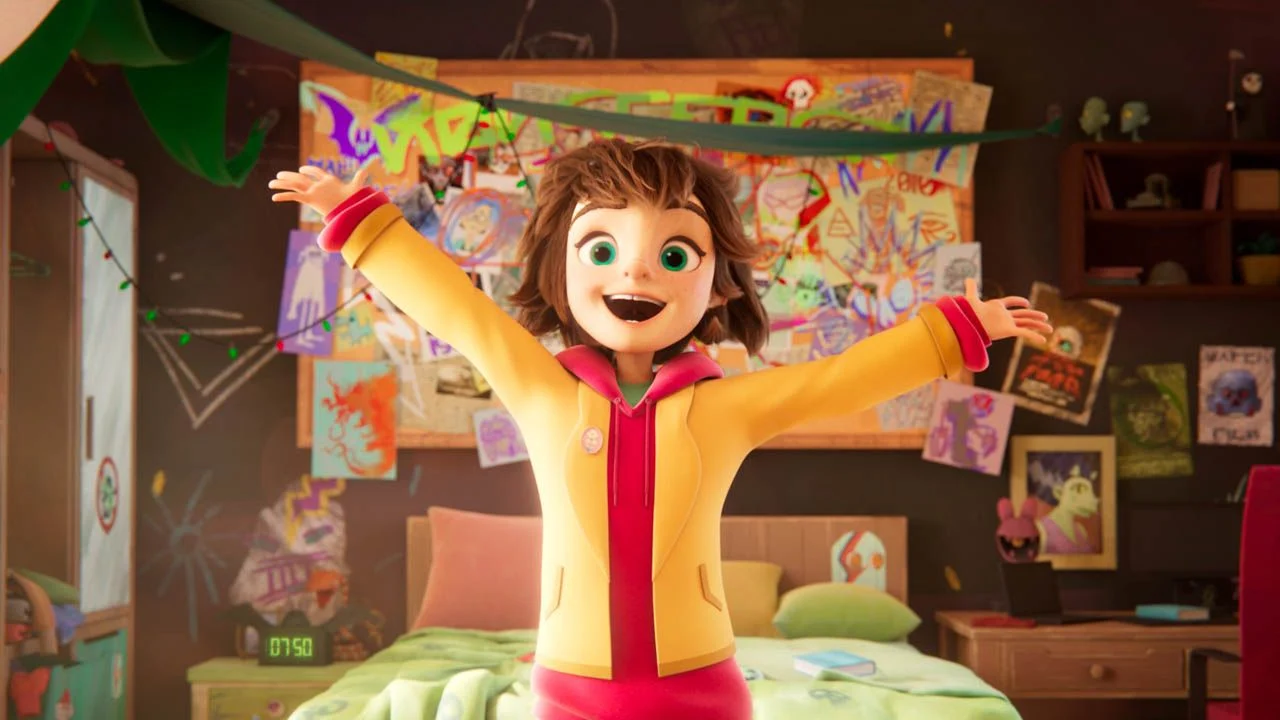
Mia is the exact opposite of her good sister: chaotic, impulsive and more interested in skateboarding than ballet!
At the beginning we go with a lot of momentum and speed to the guaranteed monster-free city of Lilienthal – a place with the somehow frightening motto: “Be normal, orderly and pure, because that’s how it has to be in Lilienthal.” The dominant colors in this model town full of harmony and unity, where the most exciting radio reports are about waste separation, are baby blue and pink. Only Mia is different. She is chaotic, impulsive and wild, the complete opposite of her good twin sister Marie, who is not only completely conformist, but has already been Student of the Month 12 times and is currently rehearsing a ballet solo for the upcoming 500th anniversary of freedom from monsters. Mia rejects classical dance; instead, she is incredibly good at skateboarding. And she has a tame rat.
But that’s not all: Mia believes in monsters and wants to present her well-researched results in a presentation. But that’s not desirable because no one is allowed to even talk about monsters. But Mia doesn’t want to remain silent and is sent to the notorious Finsterwald School as punishment. A few brief moments in her new class and she immediately realizes that she is surrounded by monsters. A dream could come true – but as the only human, she quickly realizes that she would be better off pretending to be a monster, because Finsterwald is the mirror image of Lilienthal. There the monsters are the enemy, and in Finsterwald it is the people. “Humans are evil, their blood is ice cold,” it says here, and there is a human alarm once a week.
Humor meets subtlety
Eating spider stew, graveworms and stinky cheese in the school canteen isn’t her thing, but otherwise Mia finds it quite good in Finsterwald, especially since she immediately makes friends: the lovable Oskar, who can remove his head, and the vegan vampire boy Paprika, with whom Mia immediately develops a bit of a crush. Suddenly Mia really enjoys going to school! However, there is also a rival, the witch Penelope, against whom Mia has to defend herself – and then Mia discovers that the obscure headmaster van Vlad is hatching a nasty plan…
The story itself is cleverly conceived – with a lot of humor and just the right amount of mystery. Because of course this is about tolerance, acceptance and peaceful coexistence, and also about the fact that sometimes you have to make compromises in order to approach each other. After all, no matter how opposite Mia and Marie may be, in the end they are still twin sisters who love and need each other. Lilienthal and Finsterwald are like the two opposing sides of a coin, each wanting to stand on its own but still belonging together.
Between “Hotel Transylvania” and “Nosferatu”
This message is packaged so nicely and casually in the film that not even the tip of a pedagogical index finger is visible anywhere. On the contrary: there are a lot of little jabs at a society of over-conformists who want to please everyone. Clearly, the sympathies belong not only to the imaginative and very stubborn Mia, who successfully asserts herself in her new surroundings as a “tutu monster” in her sister’s stolen outfit, but also to the countless, imaginatively designed monsters. At the Finsterwald School everyone is allowed to be as different as they are and want to be, which is why it never gets boring there.
Some plot elements and monstrosities are reminiscent of the popular “Hotel Transylvania,” but that’s no wonder. After all, there are also media norms and rules for werewolves, vampires and witches that are already known to younger children and with which – just like in films for adults – they can happily play. This applies not only to the vegan living vampire (see Ulrike Ottinger’s “The Blood Countess”, which opens on October 29, 2026), but also to the entire look of the Finsterwald School, which with its crooked walls and Gothic windows could certainly be reminiscent of expressionist silent film classics such as “Nosferatu” or “The Cabinet of Dr. Caligari” – if it weren’t for the pretty straight color scheme in green and violet tones and a pleasant sense of humor, that shines through everywhere.
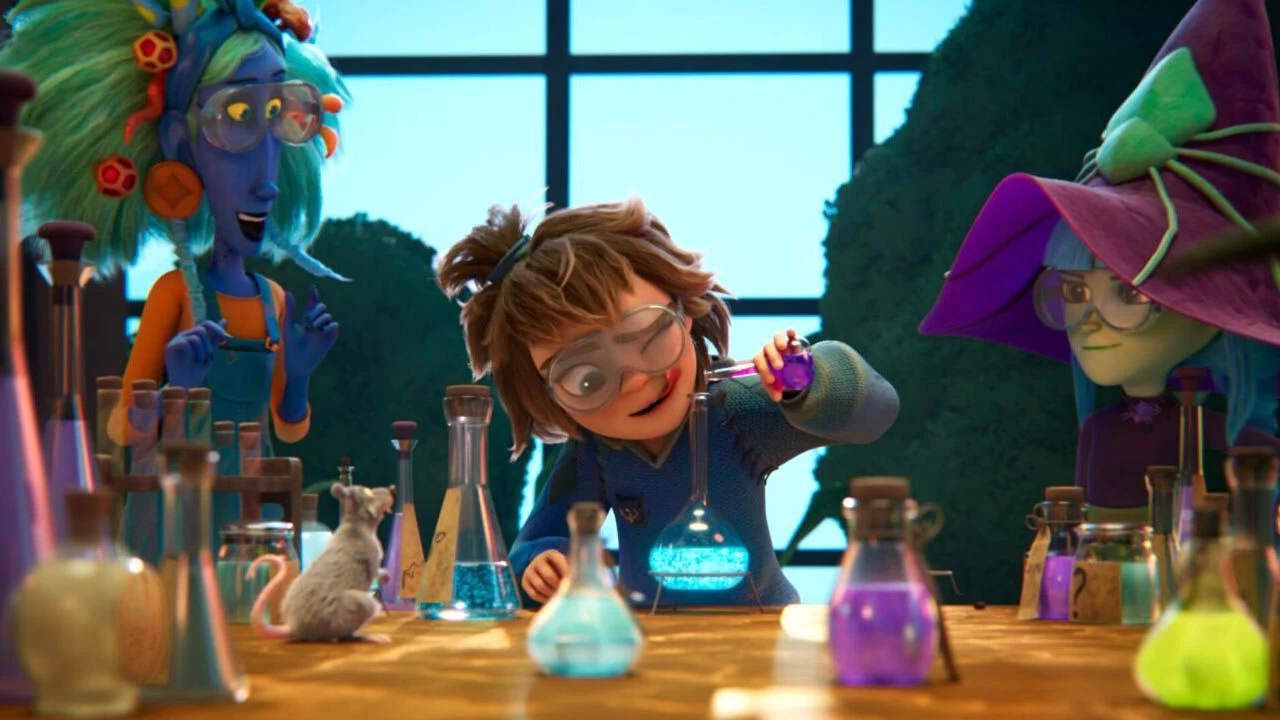
Mia likes it much better among the monsters of the Finsterwald school than in the adapted Lilienthal!
Of course, due to the genre, borrowings from Harry Potter can’t be missing here and there, including in the form of a rather original air race with flying foxes. However, the many small details in both the story and the design are particularly successful. For example, there is a love story between a rat and a bat that takes place in the background. Or the apparently scribbled, comic-inspired emanata that appear around Mia’s head every now and then, casually revealing her feelings in the form of rain clouds, stars, hearts or exclamation marks. There is also a lively soundtrack between disco and rock music, which is basically the icing on the cake (yuck, man-eater!) on top of the whole spectacle.
Conclusion: Suitable for Halloween, “Monster Mia” is an imaginative, very amusing animated film that offers entertaining entertainment not only for children but also for adults and also addresses social topics such as tolerance and courage in a pleasantly casual way.