
Charles Aznavour is probably the world's best known French chansonnier to this day. In his career, which stretched over more than 70 years, he wrote more than 1,000 chansons, and he also played in numerous films, including as the main actor in “Shoot on the pianists” by François Truffaut. He was born in France, but as the son of an Armenian refugee family, he remained connected to the home country of his parents for life, and once he even represented Armenia with the United Nations. Charles Aznavour was an enthusiastic performer who still gave live concerts even in old age. He did not celebrate his 90th birthday with friends and family, instead he was on the stage of the O2-Arena in Berlin. He died in 2018 at the age of 94 – but from the creation of the biopics “Monsieur Aznavour“Until then, he has actively participated in his life and his chansons.
His story begins in the Parisian artist district of Quartier Latin, where the parents run a poorly walking bar in which the Armenian community meets Jewish immigrants and the manusch (Sinti) based in France. Charles (Norvan Avedissian) grows up with his sister Aïda (Aaliyah Kerekdjian) in a loving but very poor environment. As Armenian refugees, the parents narrowly escaped the genocide. As a small boy of seven years, Charles gets the chance to play a mini role at the Champs Elysee Theater for a little money. Without any idea what to expect, he accepts the offer. His first sentence on stage is: “Yes, I arrived.”

Only on stage Charles Aznavour (Tahar Rahim) feels comfortable!
During the German line -up, the now almost adult Charles (now: Tahar Rahim) sings in front of Wehrmacht soldiers and secretly supports resistance to the Nazis. He finds a partner for his singing jobs: Pierre Roche (Bastien Bouillon), who becomes his best friend. The two appear as a duet with funny couplets in dance restaurants and bars. And then they meet Édith Piaf (Marie-Julie BauP) …
Marie -Julie Baup (“à la carte! – Freedom goes through the stomach”) she plays with a lot of sensitivity and vigor as a spacious, sharp -tongued diva with tyrannical features. She takes the inexperienced Charles under her wing. The famous singer is impressed by Charles' Rauer and scratchy voice – he always sounds like someone who has had a bad night: his grater voice sounds somehow sandy and rusty – a few ripers could also be there. This voice and his romantic and at the same time melancholic texts have a very special magic that Édith Piaf recognized as first.
Rusty grater with tears
In the film, Charles Aznavour sings his chansons himself. Tahar Rahim (“Madame Web”) has taken dance and singing lessons for the role, but he doesn't even try to sing with Aznavour's voice. With an effective make-up, he even succeeds a certain similarity, also in his movements and in his way of speaking, but almost more important: Tahar Rahim gives the great artist the right portion of courage-and sometimes high spirits-spiced with a subtle, noticeable vulnerability and fragility. Tahar Rahim draws a lot of strength from these contrasts, from the energy of a determined, courageous thoroughbred artist who knows about his weaknesses, but does not want to fail at any price.
This becomes even clearer in his later years, the strongest after the loss of his son Patrick. Charles Aznavour is already a world star and has just married his third wife Ulla (Petra Silander). Patrick's death threatens to pull him into an abyss. And as always, he tries to save himself with work: the stage as a lucky drug, music as medicine. Charles Aznavour actually wanted his biopic to end with the first successes. But there was a problem: all of his big chansons who brought him world fame have only been created later – unmistakable titles such as “She” or “Comme Ils Disent”, and of course they should be embedded in the plot. The two directors Grand Corps Malade and Mehdi Idir, who have also worked together as authors for a long time (“Dear Life”), decided to actually accommodate Charles Aznavour's life in their film.
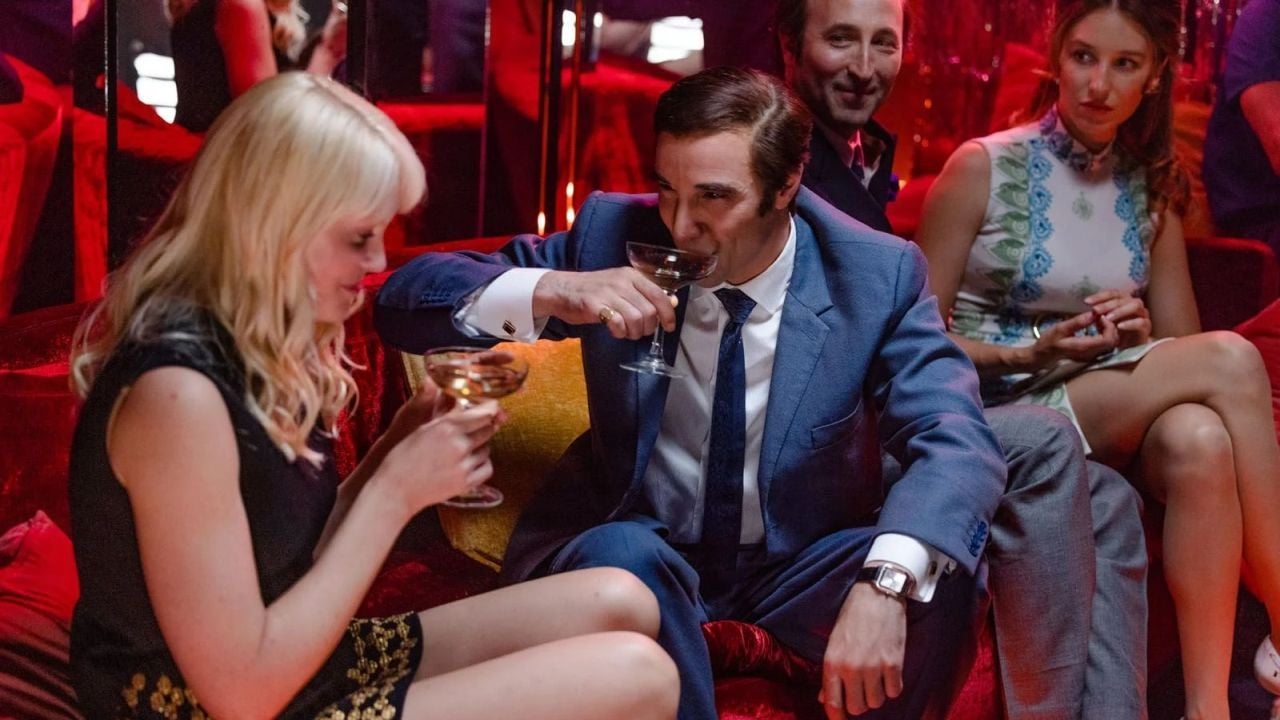
Alcohol and women were never averse to Charles Aznavour.
An ambitious undertaking. However, this concept was largely successful, with the second half of the more than 130 -minute film behind the first part. It just happens much more at the beginning – how Charles Aznavour struggles from the bottom to the top is much more interesting than the success. The atmospheric pictures from the Paris of the poor people in the 1930s and 1940s were really very successful. Accompanied by his music, they also document the struggle of the Armenian people against his extinction and the misery of the refugees in moving black and white scenes. But also happiness to live. Between these two extremes, Charles Aznavour's life also moved as a child and young man.
After meeting Édith Piaf, the pace of the film attracts significantly: sometimes the plot looks almost rushed, but strangely, this fits quite well with the life of an artist who is always on the move. After deciding to give up everything else for his career because of the advice from Édith Piaf – even his (first) wife, the child and his best friend Jean Roche – Charles Aznavour finally becomes an obsessed worker. He has a difficult time to assert himself: the reviews are sometimes devastating, it is literally bullied, not only because of his Armenian origin, but also because of his unusual voice, because of his height (1.61 m) and even because of his eyebrows. This is fatally reminiscent of today's unspeakable social media debates.
My Way or better Ma Façon
But he made it to the top – that he was proud of it and sometimes speated out with his successes, but that he never forgot where his roots were, the film shows as well as the difficulties at the beginning. The large chansons often serve to bridge larger periods, but also to impart atmospheric vibrations. So the first part is filled with a very loving, sometimes nostalgic mood – Charles Aznavour is a fun but rather inexperienced showman. It is striking how completely fearless he occurs. This man is convinced of himself, which also says his attitude, his often spread arms, with which he makes himself wider. He was born for the stage and the stage becomes home for him.
The music meant everything. This message conveys the biopic with emotional swing. For many years, Charles Aznavour has neglected his family to devote himself to music, but also to lead a magnificent Bohemian life in which he had fun. Especially in his youth he behaved like the cliché of a French artist – he was (many) as well as alcohol (plenty) and overall good life (Savoir Vivre). Nevertheless: his sympathy for resistance during the German occupation of Paris becomes as clear in the film as its commitment to the Armenian people and for minorities. He moved into a position. In his chanson “Comme Ils Disent” he solidarized in the early 1970s with transvestites and gays-at a time when it was a scandal that he wrote the chanson in the first-person form. But none of this didn't stop him from going his way.
Conclusion: “Monsieur Aznavour” shows Charles Aznavour in many facets and, as the title suggests, is especially the tribute to a great artist.