
He only has exactly 90 minutes to convince an AI of his innocence – otherwise he will be executed on the spot! With this succinct one-sentence premise, it's no wonder that “Mercy” got the green light from Amazon executives – especially since “Wanted” director Timur Bekmambetov was able to cast Chris Pratt (“Jurassic World”), one of the planet's most popular action actors, in the lead role. Nevertheless, “Mercy” is not a conventional blockbuster – and that’s not just because the otherwise physical “Guardians Of The Galaxy” star is tied to a chair most of the time. Rather, Bekmambetov highlights the so-called Screenlifegenre, which he himself has significantly shaped over the past 15 years, to a new level, at least technically, with “Mercy”.
In films produced by Bekmambetov such as “Unknown User”, “Searching” or “Missing” (almost) the entire plot takes place exclusively on screens. The filmmaker himself is of the opinion: If in real life we spend a third of our waking hours staring at screens, then that should also be reflected in the cinema! As an audience, we see protagonists watching videos on their computers or cell phones, making phone calls, and Googling for information. Especially the artificial restriction that you can no longer simply show everything, but only what can be shown on a screen, provides an extra dose of thrill in the best case scenario! In “Mercy,” however, we no longer look at the screens we know from home – but rather at the visual output of an almost omnipotent AI. This is a blessing and a curse at the same time.
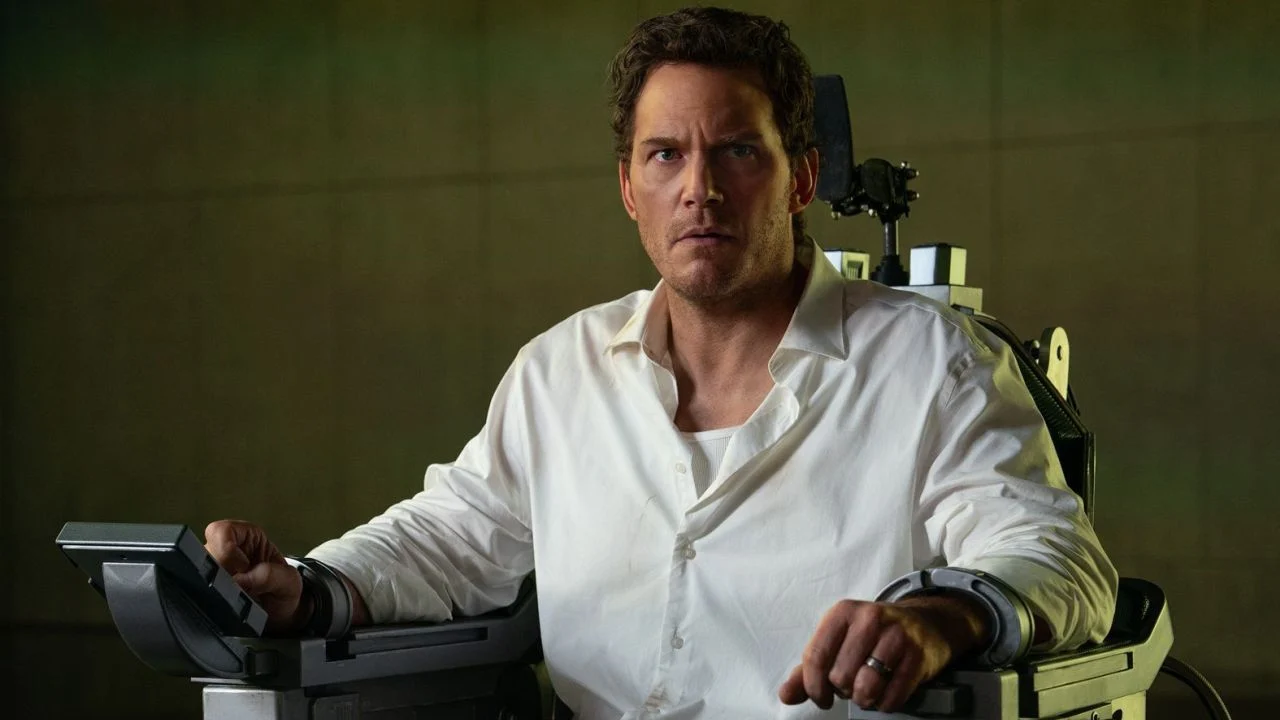
Actually known for his physical performances, Chris Pratt, who is tied to a chair, has to focus on other strengths this time.
Police detective Chris Raven (Chris Pratt) wakes up tied to a chair in the courtroom of the titular Mercy program. There he is alone with the AI judge Maddox (Rebecca Ferguson), who, after a countdown that lasts exactly 90 minutes, will decide whether the defendant will be executed with an electric shock. The “Mercy” program was once introduced to provide deterrence in crime-plagued Los Angeles by quickly convicting and executing criminals – with the AI as judge, jury and executioner all in one!
Ironically, it was Chris himself who caught the first potential murderer and put him in the dock where he himself is now stuck: In a rage-fueled alcohol intoxication, he is said to have brutally stabbed his wife (Annabelle Wallis) in the home they shared – and because no one else was at the crime scene until his daughter (Kylie Rogers) arrived, there are no other suspects. It is the 19th case to be heard as part of the “Mercy” initiative – and of course Chris knows full well that the previous 18 charges have all ended in a guilty verdict and immediate execution…
Everything is at least one size larger
Until now it was just the concept of the Screenlife-Films that have you staring at a flat screen, the display in “Mercy” is more reminiscent of augmented reality: When Chris scours the crime scene reports or social media footprints of suspects for exculpatory evidence, the AI can arrange the various image elements throughout the room around the defendant – or even place him directly in the events of the videos being played. This makes “Mercy” the first film of its kind that is not only designed for a large screen, but even specifically for IMAX megascreens – and in fact, with the windows constantly popping up everywhere, the film constantly balances on the thin line of being completely overwhelming.
“Mercy” literally races through the court hearing and the parallel investigations, for example when Chris orders his colleague (Kali Reis) to follow up on certain leads in the real world for him. Thanks to her quadrocopter, which is equipped with video cameras, she can get anywhere in the city quickly, so that virtually any image can be created in the courtroom – and this means that all the restrictions that come with this are removed Screenlife-genre otherwise entails. That's a shame, because it was so exciting to accompany John Cho on the search for his missing daughter in “Searching” because he couldn't get all the information straight away. In “Mercy”, however, ominous server failures now have to be attempted in order to withhold certain information for at least a few minutes.
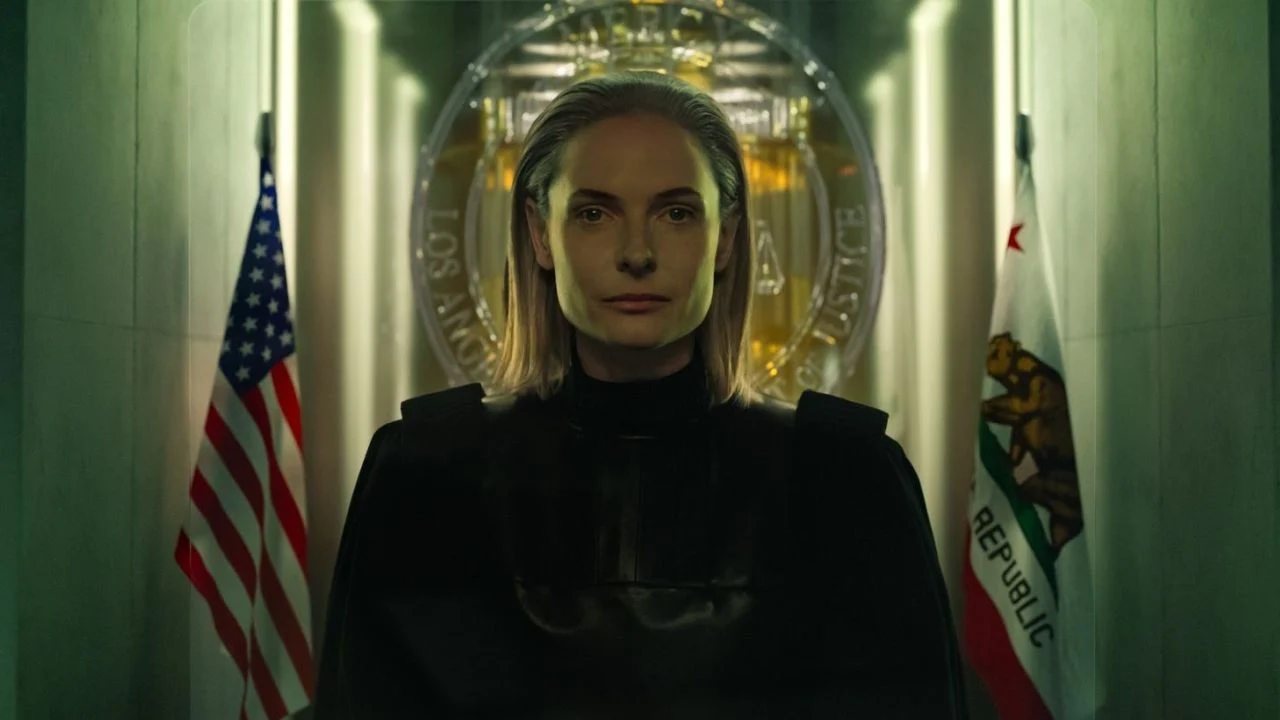
As if it wasn't already hard enough to embody an AI, Rebecca Ferguson also gets thrown a few sticks between the legs by the script.
At the center of “Mercy” is the question of whether (and how) it could be that Chris was the only one in the house but still didn't kill his wife. Such crime thrillers based on the locked room principle are currently very popular again, not only thanks to “Knives Out 3” – and the resolution in “Mercy” is not exactly groundbreaking, but it is still completely okay and useful (including an explosive showdown, which still brings with it the usual blockbuster spectacles). What, on the other hand, seems far less consistent (and sometimes creates logic holes as big as barn doors) is the behavior of the AI itself. For example, it is constantly displayed how high the probability is, given the current facts, that Chris committed the crime. His goal is to get this below 92.5 percent in order to be acquitted due to “reasonable doubt.”
But the changes in the percentages rarely seem logical, but rather due to the requirements of the plot. The AI should represent cold logic. It was certainly not an easy job for Rebecca Ferguson, on the one hand personifying the cool, calculating AI, but at the same time allowing a very human doubt to shine through. The “Dune” actress certainly doesn’t do a bad job overall, but the script simply has too many inaccuracies to allow for a completely coherent presentation. But she still does better than many of the supporting actors, whose incredibly wooden performances torpedo the authenticity of the live streams broadcast in the courtroom. The only positive surprise is Chris Pratt, who, based on his facial expressions alone, does much better than one might have expected in advance.
Conclusion: A film like scrolling through a TikTok feed for 90 minutes. Because of the breakneck pace alone, “Mercy” is always enthralling, even if not everything makes sense and you might feel a bit empty afterwards.