
Stephan Komandarev (multi-award-winning for “A Question of Dignity,” about a pensioner who takes on phone scammers) would like to continue to bring more Bulgarian stories to a global audience in the future, while continuing to focus primarily on professional groups that otherwise hardly have a voice in social discourse. In principle, this is an extremely laudable project, but he should approach it a little more carefully, because the director, who is certainly capable of great things, made a mistake with “Made in EU”.
The story about a seamstress in a textile factory loses its focus (too) quickly: sometimes it's about the exploitative conditions in one of the poorest EU countries, sometimes it's about Covid-19, sometimes it's about the hell of the province. There are also under-complex characters and a television film-like aesthetic that focuses primarily on images of misery. The absolutely convincing actors cannot hide the impression that “Made in EU” was certainly well-intentioned, but in this form it only just missed the mark Social Porn scrapes by.
In the shadow of the EU
“Made in EU” takes place in March 2020 and tells the story of Iva (Gergana Pletnyova), who sews “Made in EU” labels into clothes every day in a textile factory in rural Bulgaria and is struggling to make ends meet with her job: the days are long, overtime is a given, half of her wages count as a “bonus” (if she misses work, this is generally withheld). In order to keep the number of absences at an all-time low, the company's Italian-born boss (Francesco Frattini), who is also the region's largest employer, has ensured that the resident doctor is no longer allowed to issue sick notes to his company's employees.
As a result, Iva drags herself to work sick and ultimately even collapses, whereupon she is diagnosed with Corona. The seamstress is the first recorded Bulgarian Covid case outside Sofia. So Iva becomes the scapegoat of her hometown, which is plagued by more and more Covid cases. Even her relationship with her son Misho (Todor Kotsev), who actually wanted to move to Germany but now can't because his mother and he are quarantined, is taking a hit…
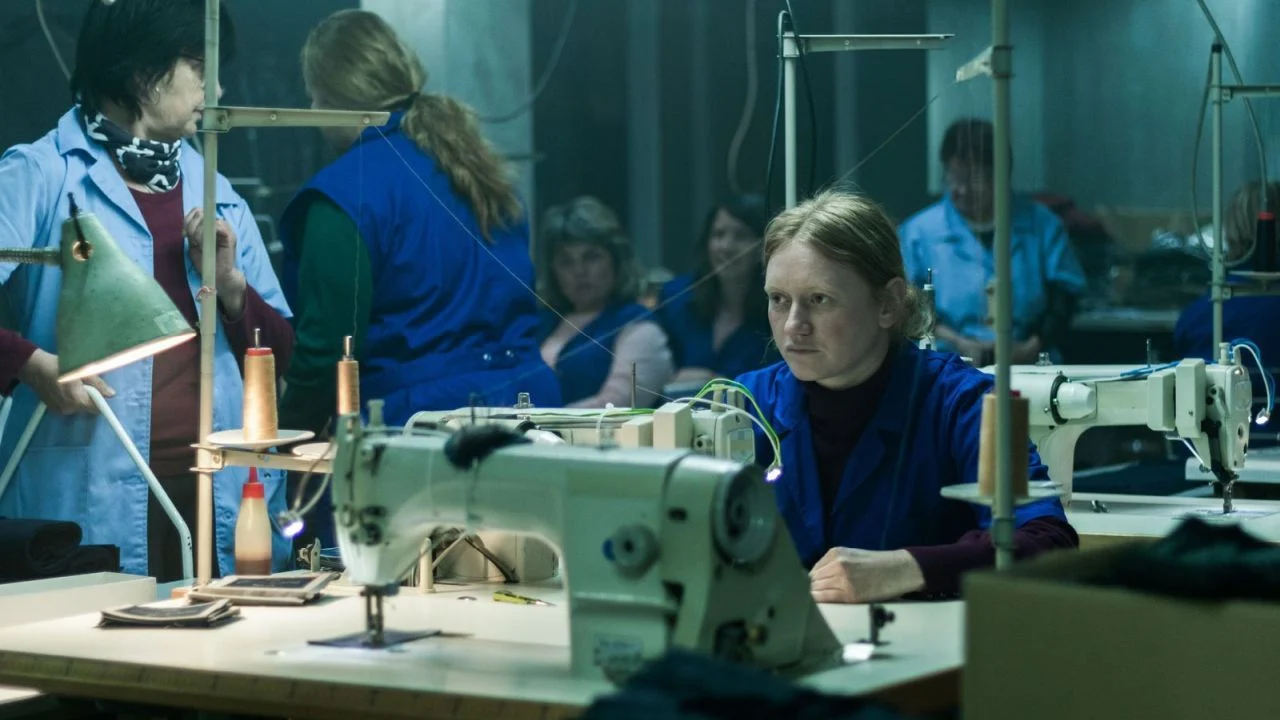
Iva (Gergana Pletnyova) is the first official Covid patient in her region.
First of all, it is brave to make a film now that takes place at the beginning of the corona pandemic. For many, this time was a turning point that they certainly don't want to be reminded of so quickly – not even in the cinema. But especially from the wealthy Western perspective, it is important to understand that in the face of the catastrophe, a large part of the world could not simply retreat to the home office or rely on short-time work benefits, but had to continue to work under unchanged poor conditions, simply function, and struggle to survive. These are people who have barely been mentioned despite countless talk shows on the topic of Covid-19. People like Iva, who sews a seal into clothing that signals a commitment to European values and fair production conditions.
At the beginning of “Made in EU” you immerse yourself deeply in the oppressive world of the protagonist. Experience the narrow, windowless production facility lit by neon lights as well as the quiet rides on the company bus that transports her and her colleagues to work at the crack of dawn through a desolate landscape. Add to that the exhausted journeys home in the middle of the night, not long before dawn. But Iva's health is also not good. In the first few minutes we find out that she is sick, the doctor reassures: “Just an infection. Nothing serious.” Paracetamol and vitamins will do the trick.
Brave but nervous…
The first half hour is captivating, but Komandarev's film gradually falls apart – even if you swallow that Iva's full name is simply mentioned on television in the course of reporting on the Covid outbreaks. The drama that follows has little to do with Covid or capitalism, but rather with typical human behavior that is not uncommon, especially in a provincial environment:
Someone is always to blame and when the media says it only three times. The script doesn't go into detail about her surroundings, but the visual design misses no opportunity to point out that Iva's homeland is a paragon of desolation. There is also a subplot about Misho, who is a YouTuber and wants to go to Germany because he sees no future in the eternal village dreariness. In such an environment, pent-up fear and anger is released particularly quickly, regardless of who it is against.
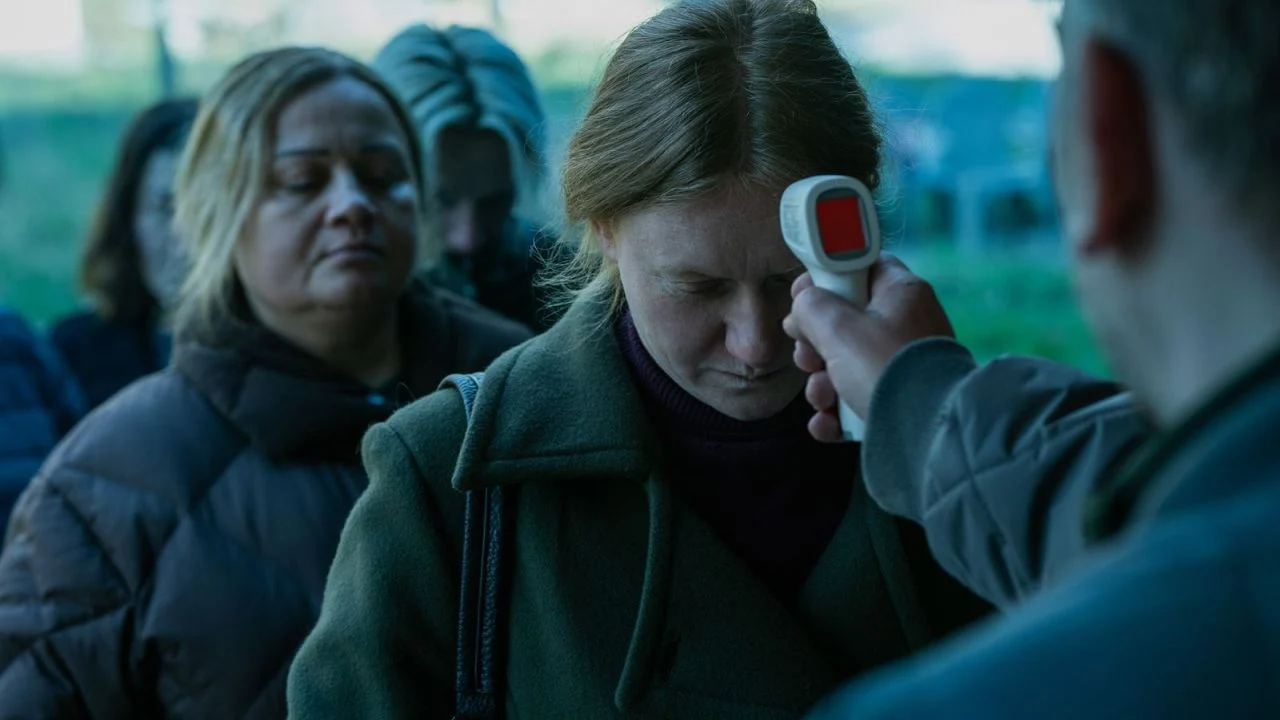
Taking your temperature before starting work – many people will still remember this.
However, the topic of capitalism is not completely forgotten, but rather shifted to the old doctor Doctor Rusev (Ivaylo Hristov), who returns from retirement due to the shortage of skilled workers and, in a one-take sequence (a walk with the head of the health authority), talks about the EU, which does not want to do without cheap labor. Then all of a sudden the real culprit is pulled out of the hat (of course the owner of the company, who was in Bergamo).
His conversation partner then makes it particularly clear to him what capitalism is: If someone says something against the company boss, the company will be relocated. A dialogue in which you can just hear the script pages rustling could hardly be more clumsy. The doctor also has an unspecified close relationship with Iva and repairs the relationship between mother and son with a conversation with Misho, which leads to a David vs. Goliath happy ending that undermines the film's intended social realist tone.
Conclusion: “Made in EU” was certainly made with the best of intentions. But these don't change the fact that the film seems as if puzzle pieces were put together with a hammer. Covid-19, capitalism, provincial hell – the film opens up important thematic issues, doesn't put them together properly and also lacks subtlety. In any case, Komandarev should have set a clear focus or given his film more running time, but as it is, the social drama seems erratic and also unbelievable towards the end. Thanks to the actors, you stick with it, but that's not a good thing, which hurts, because the concern is fundamentally right and important: more films are needed that give people on the outermost margins of our society a voice.