
After its world premiere in the midnight section of the Sundance Film Festival, “Leviticus,” which was often compared in reviews to David Robert Mitchell’s “It Follows,” celebrated its German premiere as the opening film of the Fantasy Film Festival. The hype about Australian horror cinema that was started by “Talk To Me” continues! (In fact, “Leviticus” comes from the same production team, and the main actor Joe Bird was already seen in the aforementioned hit.) The demon-free documentaries (“Pray Away”) and feature films (“The Prodigal Son”) about conversion treatments are horror enough.
Based on the assumption that any deviation from a heterosexual orientation is an illness or a sin, attempts to “reorient” people in this way culminated in often radically aggressive behavioral therapies, especially between the 1950s and 1970s. In his feature film debut “Leviticus,” director and screenwriter Adrian Chiarella leaves out the details of such re-education programs. Instead, a Christian priest appears who simply waves a lighter in front of the faces of the young people who are being “healed”. But the consequences are equally devastating.
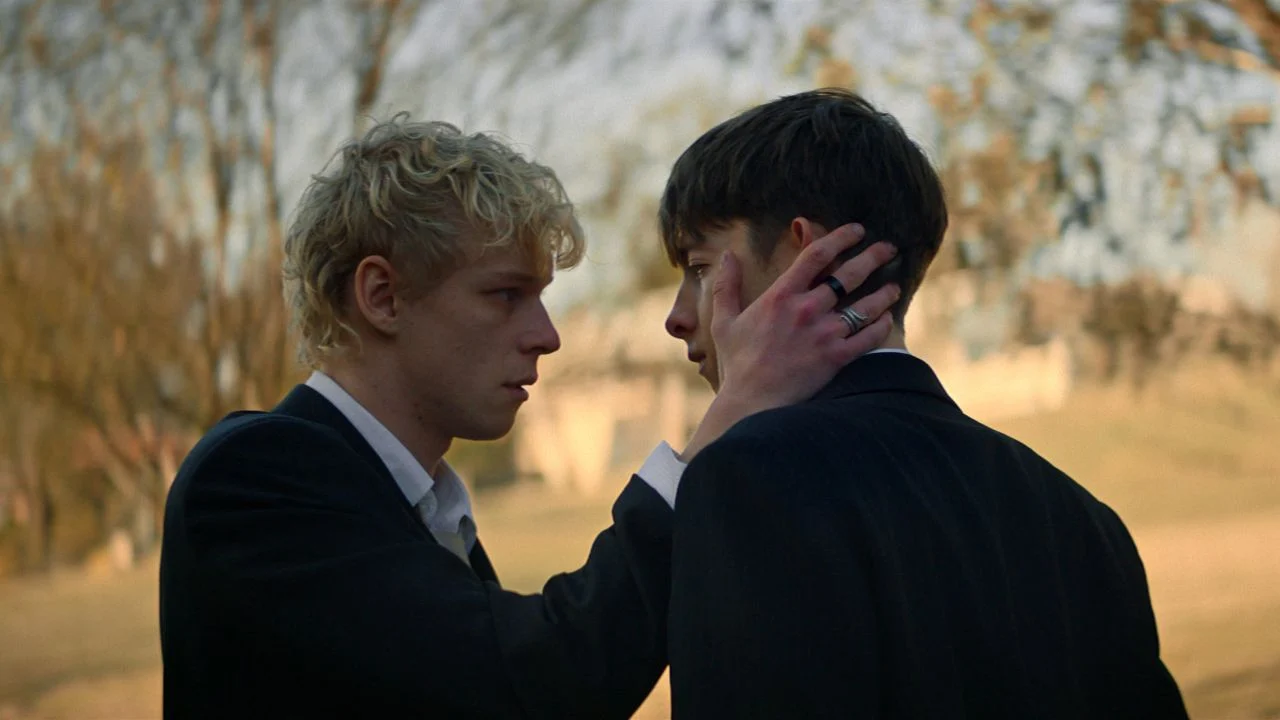
As if Naim (Joe Bird) and Ryan (Stacy Clausen) didn’t already suffer enough from the small-minded narrow-mindedness of the evangelical desert town…
Apparently his single mother Arlene (Mia Wasikowska) moved to a small desert town with Naim (Joe Bird) because she no longer saw any other way to deal with her son’s homosexuality. After all, there is a strong Christian community here – including a so-called Deliverance Healer (Nicholas Hope), who, if necessary, drives out the young people’s queer tendencies with prayers in the firelight. When he starts something with his classmate Ryan (Stacy Clausen), Naim also ends up in front of the spiritual faith healer…
… only the exorcism of demons seems to have exactly the opposite effect: the teenagers are then pursued by a violent entity that brutally beats them up on the street or rips off half of their ear in the school toilet. The particularly perfidious thing about it: the demonic appearance takes the form of the person you desire most – in the case of Naim and Ryan, the appearance of each other…
In the Bible it is written in black and white
The Latin title ensures that you don’t confuse the film with an off-the-shelf mainstream exorcism shocker. At the same time, he refers to the book of the same name, Leviticus, which has been used by evangelical groups for centuries to justify their homophobia: “You must not sleep with a man as one sleeps with a woman; that would be an abomination.” And two chapters later it is added again: “If anyone sleeps with a man as with a woman, then they have both committed an abomination and will surely die; let their blood be on them.” No wonder then that violence is the order of the day in such a society.
So Naim and Ryan not only have to endure the “usual” bullying of their classmates. Even if the supernatural entity has long since opened the hunt for them, the demonic and the very real social violence continue to bleed into each other: the teenagers act as human frustration diverters for what feels like half of the village youth. The demon only appears when no one else is there – but seeking the proximity of other people is not a solution in this constellation. An oppressive metaphor for the destructive isolation of queer young people.
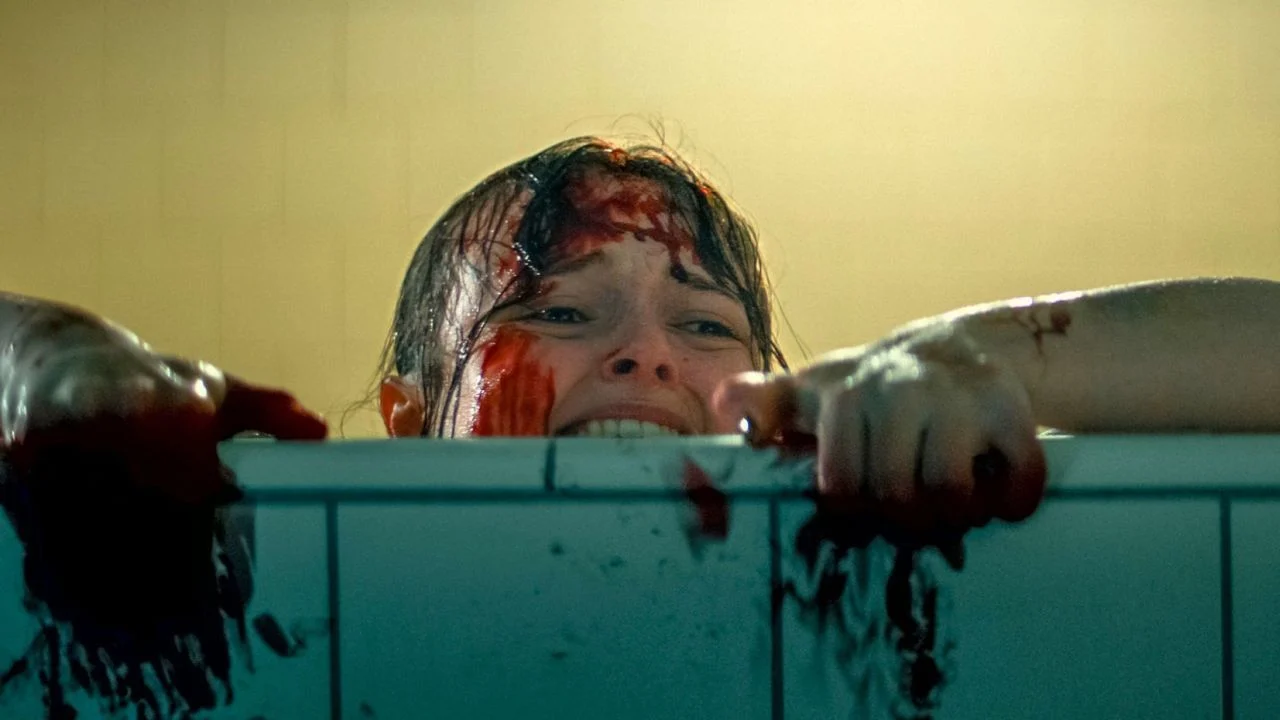
Lesbian teenagers also have to deal with the murderous demon.
In addition to the strong newcomers Joe Bird and Stacy Clausen, a real coup has been achieved, especially with the casting of “Alice in Wonderland” star Mia Wasikowska. As usual, she exudes such maternal empathy that you just wait until she finally realizes what’s going on with her son – and then sorts things out somehow. But she obviously already knows a lot, but she still consciously chose a haunted and maltreated son rather than a gay and free son. A real pull-the-ground-away moment. The often-used comparisons with “It Follows” are obvious:
Where the victims back then were haunted by a humanized venereal disease that could only be gotten rid of by passing it on to someone else, the demon in “Leviticus” cannot simply be shaken off unless you bury all of your desire and with it your own self. But where “It Follows” followed clear rules despite its allegorical nature, in “Leviticus” much remains deliberately vague. Adrian Chiarella has shaped the oppressive feeling of a queer coming-of-age in the midst of an intolerant community into an oppressive mood piece, in which the functionality as a horror shocker is not necessarily at the forefront.
Conclusion: Atmospherically outstanding, at times heartbreaking horror allegory, which would probably be even more convincing in terms of suspense if Adrian Chiarella hadn’t expanded his demonic conversion concept so vaguely.
We saw “Leviticus” at the Fantasy Filmfest 2026, where it celebrated its German premiere as the opening film.