
Anyone who gets lost in this film because they confuse it with the announced “The Mummy” reboot will definitely experience their bloody miracle! That’s why the production studio Blumhouse is currently publishing daily warnings on Twitter that you really shouldn’t expect Brendan Fraser’s return here. But even so, there are two things that are immediately remarkable about the title “Lee Cronin’s The Mummy” alone: On the one hand, it is a bit of a surprise that after the catastrophically flopped Tom Cruise vehicle “The Mummy” from 2017, a Hollywood studio is so quick to try its hand at the classic film monster again. And on the other hand, Lee Cronin is mentioned in the title even before the mummy, although the director’s name is probably hardly known to anyone outside the horror bubble. After all, after his debut “The Hole In The Ground”, which received a lot of attention, especially at fantasy film festivals, the Irish filmmaker has only directed the gore sequel “Evil Dead Rise” – which goes really well towards the end.
The exclusion of the risk of confusion certainly plays a role in the decision to place the director so prominently. But after seeing the film, we also have to admit: After last year’s successes of “Blood & Sinners” and “Weapons”, Warner Bros. is apparently still on the trip of letting horror auteurs just do their thing, even if their ambition goes (far) beyond the usual level in the genre: “Lee Cronin’s The Mummy” is – unlike the action or adventure-focused earlier “Mummy” films – a dark one Horror family drama interspersed with some damn nasty violence. In addition, with its opening in Cairo, the shocker not only opens up a storyline that expands in time and space; The running time of 134 minutes also suggests a certain epicness. However, in contrast to “Blood & Sinners” and “Weapons”, this time the concept only works to a limited extent. Because in the end you have to say that this mummy takes a whole corner too long to unwind completely.
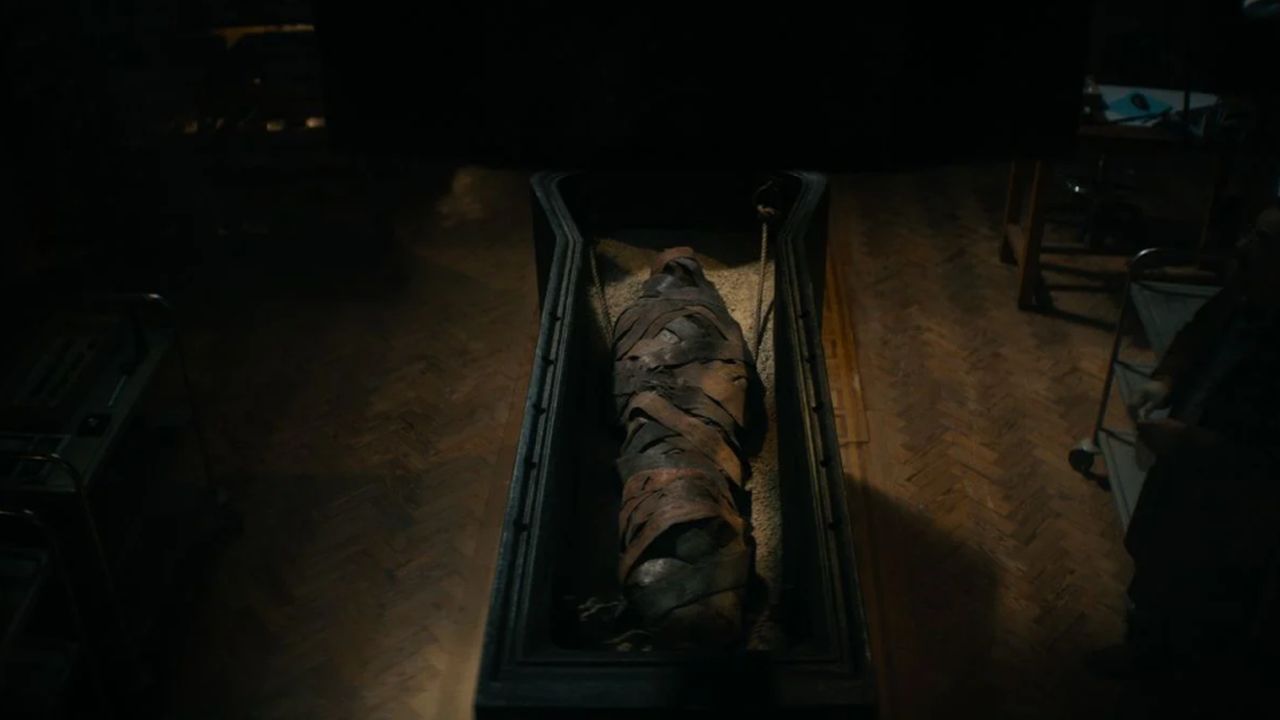
The missing Katie (Natalie Grace) is found in this sarcophagus.
TV journalist Charlie Cannon (Jack Reynor) moved to Cairo with his wife Larissa (Laia Costa), daughter Katie (Emily Mitchell) and son Sebastián (Shylo Molina) six months ago for his job. Not an easy situation, especially since the family is currently expecting their third child. But then her happiness suddenly breaks when one day Katie is kidnapped by a mysterious woman and initially disappears without a trace. But life has to go on somehow – and so the Cannons move back to the USA, where their parents still ask themselves eight years later: Could the accident have been prevented? Who is to blame? And what else was done to her daughter after the kidnapping?
When a plane crashes in Egypt at the same time, a sarcophagus is found among the rubble – for inexplicably undamaged. This is immediately passed on to the responsible archaeologists, who are amazed when they open it and unwrap it: inside the stone box is not a millennia-old mummy, but the embalmed Katie (now: Natalie Grace)! Although she is badly scarred and is in a kind of catatonic state, the Cannons are still overjoyed to have their girl back home. However, the joy doesn’t last too long, because apparently Katie has brought a dark force with her across the Atlantic…
(Over-)ambitious
The introduction to “Lee Cronin’s The Mummy” is tough. The director and screenwriter creates an extremely extensive narrative, which subsequently never fulfills the initial promise of a certain complexity. After Katie’s disappearance in Egypt has already been described in great detail, we first get to know the family in a post-traumatic state. At the same time, the story of the young Egyptian investigator Dalia (May Calamawy) is told, who continues to try to get to the bottom of the secret of the child who disappeared eight years ago in Cairo. However, all of these levels, each with their own tonal moods, only harmonize with each other to a limited extent. It feels like an eternity passes before Katie is reunited with her family and the film really gets going.
But even then, despite the extremely entertaining (and sometimes quite disgusting) horror inserts, the film always drives with the handbrake on. While in “Evil Dead Rise” Cronin at some point was unable to stop himself and threw himself uncompromisingly into a pool of blood and madness, here the director slows down the action after every spike in violence – either by changing the location or by focusing on the family drama, which at some point hardly develops any further.
One of the nastiest horror scenes of the year
The fact that the film should give gorehounds a certain amount of enjoyment is primarily due to Lee Cronin’s palpable joy in tormenting his audience – in the best sense of the word. For him, horror is always a physical experience. Just looking at the teenage Katie, played by Natalie Grace, is painful: she is covered from head to toe with wounds and signs of years of torture in which not a single ray of sunlight has reached her now papery skin. When she sits in a strangely contorted position in her wheelchair, the walls of the stone sarcophagus still seem to enclose her in a merciless grip.
In addition, Cronin already delivers one of the nastiest scenes of the cinema year, which leaves a lasting impression on even die-hard horror fans and turns the next pedicure into a sweaty test of courage! A sequence in which a funeral increasingly descends into macabre madness is similarly successful – and at the same time we are served the extremely cleverly arranged visually shocking version of the “Spider-Pig” ceiling-crawling scenes from the “Simpsons”. In these moments, the escalating disgusting horror of the “Exorcist” series meets the profoundly nasty humor of “Evil Dead”.
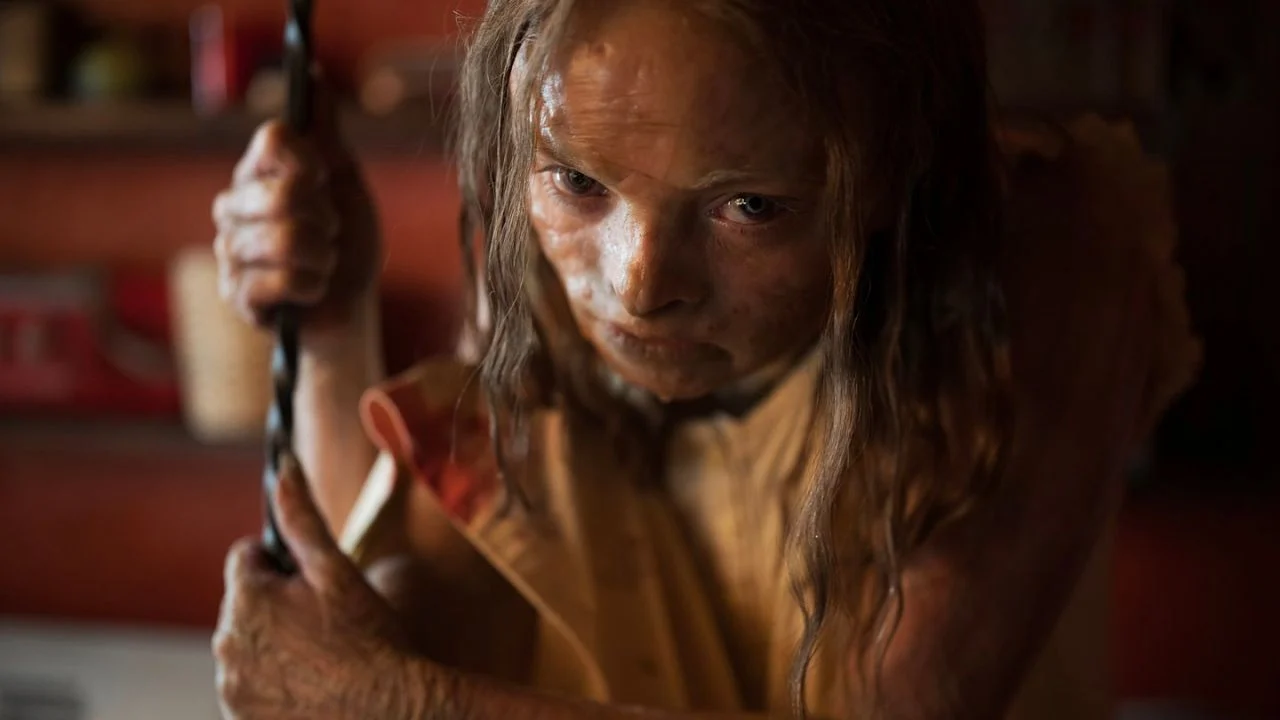
The traces of captivity can be clearly seen on the daughter who has been found again.
Conspicuously absent, however, is any real Egyptian flair – usually an indispensable key feature of any “Mummy” film. Anyway, the antagonist is only theoretically a mummy. Ultimately, we’re dealing with a representative of the possessed child genre – and even then the vengeful demon still seems damn interchangeable. In addition, most of the action takes place in the USA, which means that the setting doesn’t particularly stand out. Many of the mummy references inserted often feel like mere decoration that only serves to give the film an unusual mythological touch – but at its core it is a fairly conventional exorcism story.
Luckily, the film ends with a final bang, with all the horror and family drama elements finally coming together. After nearly two hours of speculation about Katie’s fate, a mysterious VHS tape finally provides the long-awaited answers. Of course, what exactly can be seen on the tape should not be revealed at this point. Nevertheless, parents in particular may feel a heavy lump in their throat at this moment. The fact that this scene works so well is also due to Jack Reynor and Laia Costa, who as desperate parents give the horror shown a personal, almost intimate level.
Conclusion: In its strongest moments, “Lee Cronin’s The Mummy” is a truly nasty ride and a successful mix of “The Exorcist” and “The Evil Dead”. Unfortunately, the overlong shocker never gets going, which is why the longed-for mummy madness – unlike in “Evil Dead Rise” – can never develop sustainably.