
The title “La Bola Negra” (“The Black Ball”) refers to a legendary work by the Spanish poet Federico García Lorca. But it’s not a film adaptation. That would also be impossible, after all, the original work was never published. In the film by the directing duo Javier Calvo and Javier Ambrossi, Glenn Close, in the role of a Lorca expert, explains that only four pages have been preserved. The lost work and “The Dark Stone,” an award-winning play by Alberto Conejero that deals with the gay love story between the poet Lorca and a soccer player, form the starting point for an epic triptych.
The film, produced by Pedro Almodóvar and enhanced by his muse Penélope Cruz in a supporting role as a nightclub dancer, is very grand. Visually, the result – from the set to the costumes to the camera – doesn’t have to hide from Hollywood epics. In addition, the 155-minute-long “La Bola Negra” is packed with themes and feelings – a melodrama that is not afraid to lay it on really thick. The directors not only want to make a lost literary original and a true love story visible again, but also show in general how repressed history continues to have an impact today.
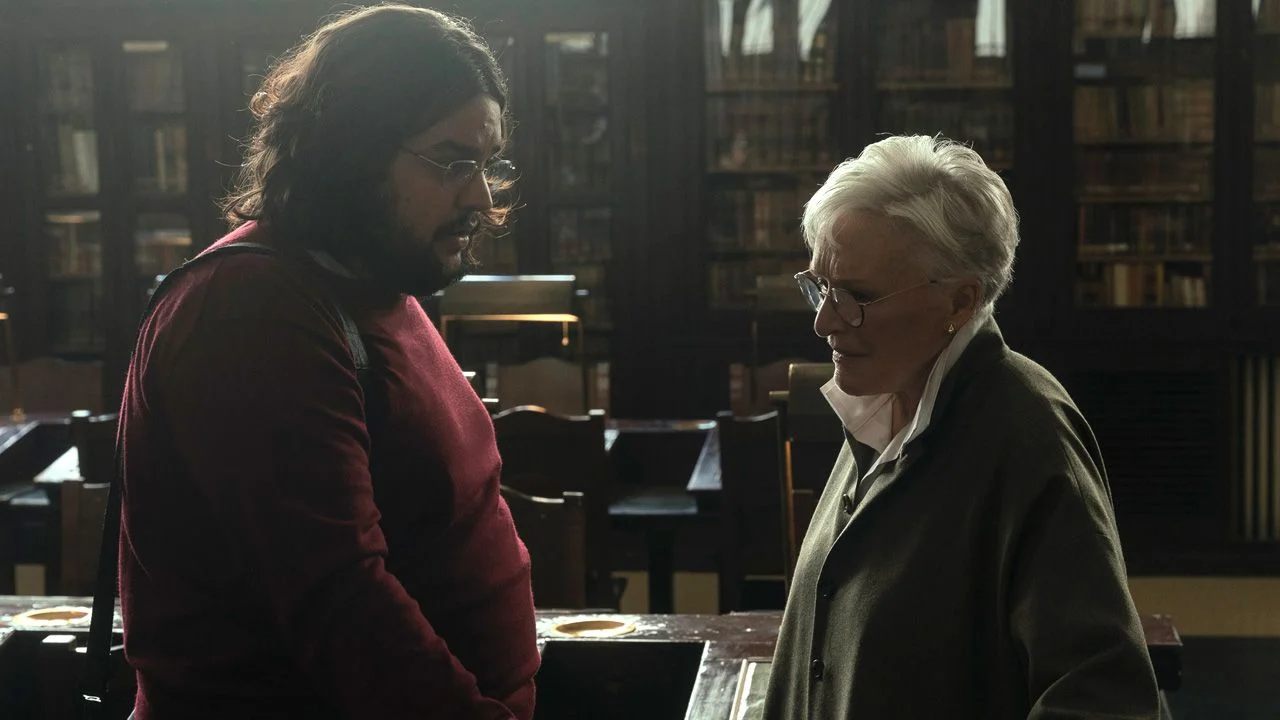
Hollywood legend Glenn Close as a literary scholar for whom Alberto (Carlos González) has a special surprise in store.
In 1937, the naive Sebastián (Guitarricadelafuente) and his village wait with anticipation for the approaching Italian army with a band. But the supposed fascist saviors respond with machine gun fire and bombs. Only Sebastian survives. But because that was certainly an accident, he soon joins Franco’s army. There he has to guard the seriously wounded Republican prisoner Rafael (Miguel Bernardeau) and is also supposed to get some information out of him. But little by little he falls in love with the former actor and Atlético Madrid footballer.
In 2017, the unhappy Alberto (Carlos González) numbs himself through tough one-night stands with other men. As a historian, the failed playwright also researches queer traces in the music and culture of the 1920s. Then one day he receives news that his grandfather, whom he never met, has died and surprisingly left him an inheritance. Although his mother Teresa (Lola Dueñas) is strictly against it, he sets off…
Epochs in Trialogue
In addition to these two storylines, we also repeatedly see parts of the historical fragment that gives the film its title in the first place. In 1932, young Carlos (Milo Quifes) wants to become a member of a secret society. The vote on his inclusion takes place using white and black balls. Although he comes from a good family and the men in his family have always been accepted, he is “blackballed”. Because there are rumors that he is homosexual.
While the other two levels are captivating from the start, this segment remains somewhat abstract in space for a long time – and for good reason. After all, this is an adaptation of Lorca’s work of the same name – and there were only four pages of it. So there isn’t that much to tell here. Only when everything comes together later in the film and this story-in-the-film is further expanded with elements from “The Dark Stone” and the true story behind it does this part become charged with great emotions.

Penélope Cruz delights the soldiers and the cinema audience as nightclub performer Nené.
Before that, the different times are allowed to flow into one another again and again. We still hear the sound from one era while we already see the images from the other. This ensures that the levels are in conversation with each other. As different as Sebastián and Alberto are and how differently they deal with their homosexuality, the similarities are also clear. The filmmakers’ greatest achievement is that the intricate construction never feels like a mere screenplay trick, but rather develops a touching pull right from the start.
Clearly, “La Bola Negra” is a film that doesn’t want to be small. The sets, costumes, camera work and score literally convey the fact that what you are watching is an epic. This also includes the intense, dark war scenes or the many moments in the hospital where seriously injured prisoners are repeatedly brought. Penélope Cruz’s appearance as nightclub performer Nené is also a spectacle. The Oscar winner (for “Vicky Cristina Barcelona”) only has two musical appearances, but they are so impressive that they alone justify watching them.
Great pathos and intimate romance
Despite all the opulence, the heart of the film remains the intimate relationship between Sebastián and Rafael, which largely consists of small, reserved scenes. After all, in their position as guards and prisoners in the middle of a military hospital, they have no room for big vows of love. A lot is said through small gestures, looks or even pauses. The only time they can come into close contact is when Sebastián has to dry the freshly washed prisoner for the nurse who is needed elsewhere. The Spanish singer-songwriter Guitarricadelafuente, who will have his first two acting roles in this film and a mini-role in Pedro Almodóvar’s “Bitter Festival” in 2026, shines in these gentle moments.
The present level is captivating not so much through the act of searching for literary clues, but through a further act of self-discovery. For Alberto, this is about accepting himself, his body and his shame. The difficult relationship with the mother plays a key role. Lola Dueñas (“Bird Box: Barcelona”) delivers a furious performance as this seemingly tough and terrible woman who, when visiting a restaurant with her son, not only drinks one beer after another, but also briefly disappears to the toilet for a line of coke.
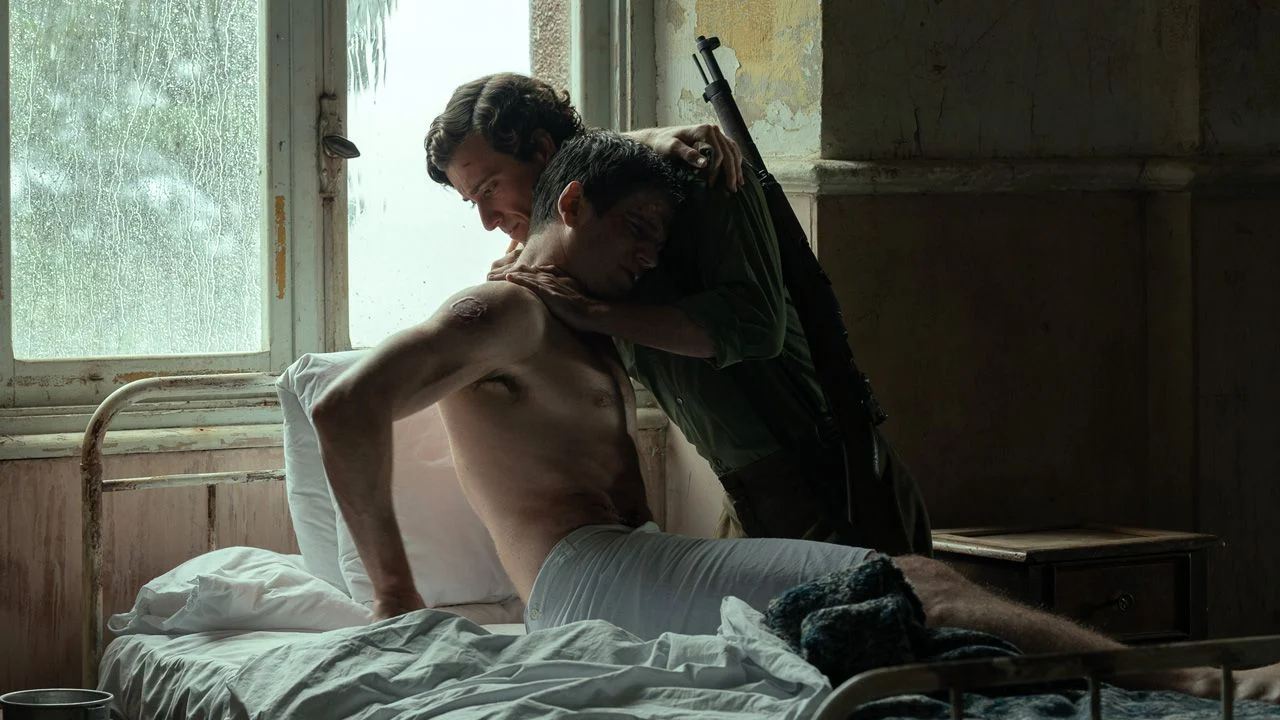
Sebastián (Guitarricadelafuente) takes care of the prisoner Rafael (Miguel Bernardeau).
It’s not just at this moment that “La Bola Negra” is sometimes too much and too clear. Exclamation marks are repeatedly used very loudly and dialogues underline what the pictures have already revealed to us. There are so many topics that those responsible want to bring us closer to. There are the biographies of the real-life Federico García Lorca and Rafael Rodríguez Rapún. We get a drama about the Spanish Civil War as well as several queer love stories at once. Dealing with family legacy, the question of whether mere silence can be an act of violence, and art as an aid to memory – these are all other important elements that many other films would focus on alone.
But it is precisely this excess that creates its special power. In this melodrama characterized by great passion, clarity, pathos and occasional kitsch ensure that we remain involved for the entire 155 minutes because we are not following a sober lesson, but rather a rousing epic. There is no attempt here to carefully uncover repressed history; instead it is thrown onto the screen with full force. That may sometimes be too much of a good thing, but it never matters and is always overwhelming, especially in the strongest moments.
Conclusion: “La Bola Negra” is a truly epic, sometimes somewhat overloaded, but deeply moving queer historical melodrama.
We saw “La Bola Negra” at the 2026 Cannes Film Festival, where it had its world premiere as part of the official competition.