
The beautiful and the terrible already merge into one in Kikuo’s childhood trauma. Director Sang-il Lee (“The Unforgiven”) stages one of the darkest hours in the life of an adolescent in irritatingly pretty images. Outside the night shimmers in bluish colors. The snow falls from the sky and at some point slows down even further in slow motion. Meanwhile, violence rages inside. A raid. Then it goes to the front of the house. A dying man lies in the corner of the picture while his red blood spreads in the powder snow like on a white canvas.
“Kokuho – Master of Kabuki” begins as a brutal tragedy. Kikuo’s father, a Yakuza boss, is murdered in front of the boy in Nagasaki in 1964. From now on the teenager is on his own. He is drawn to Osaka because of his talent for the performing arts. Once there, respected performer Hanjiro Hanai (Ken Watanabe) takes him under his wing to train him in the art of Kabuki theater. As Kikuo (Ryō Yoshizawa) grows older, he becomes a rising star, but conflicts don’t take long to arise. In the midst of his life’s dream, he clashes with his friend and rival Shunsuke (Ryūsei Yokohama), the son of his teacher…
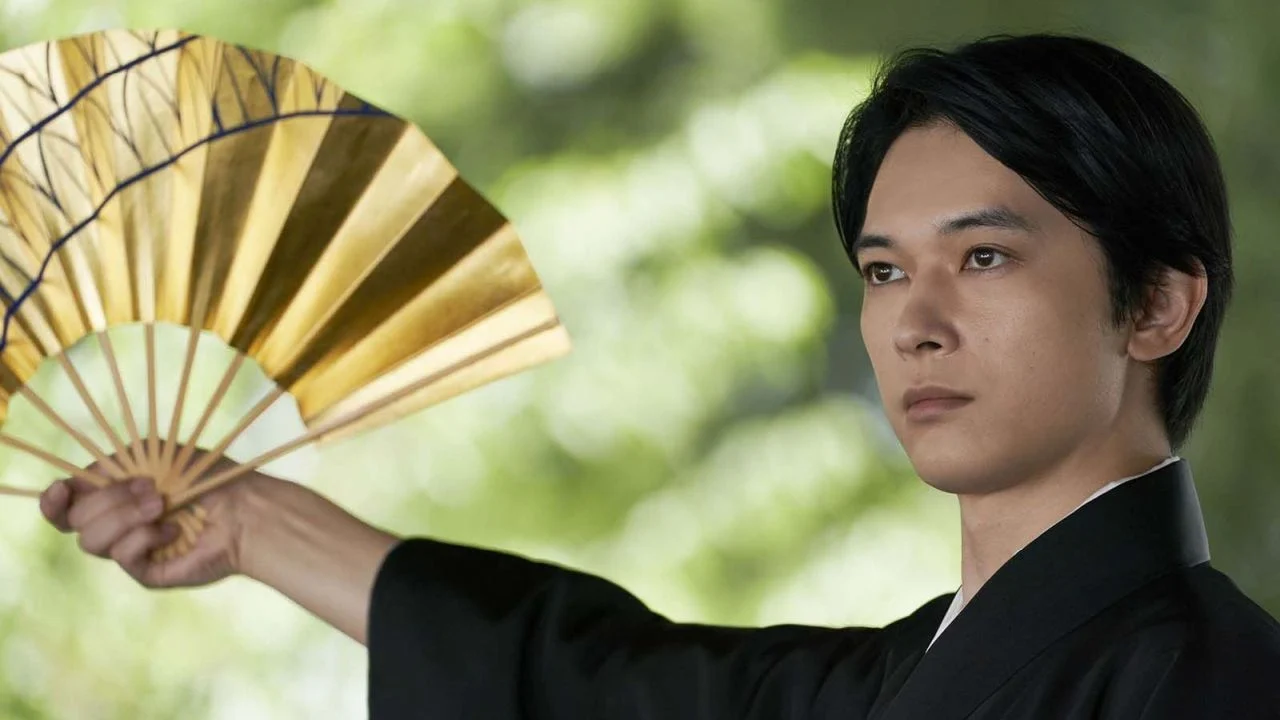
In Kabuki, every seemingly small movement counts with absolute control and precision.
Sang-il Lee and screenwriter Satoko Okudera tell this story in an epic setting, divided into several chapters. The plot spans half a century. “Kokuho – Master of Kabuki” unfolds as a cinematic educational novel about the apprenticeship, advancement and competition of the two young protagonists Kikuo and Shunsuke. This adaptation of the novel “Kokuho” by Shuichi Yoshida lasts almost three hours. A first version is said to have even broken the four-hour mark. And one can directly speculate heretically: perhaps an even longer term would actually have been a better decision!
As ambitious and exuberant as the theater epic is, it occasionally breaks down into individual episodes and highlights from different decades. It is a very fragmentary, sometimes overly functional form that “Kokuho” takes on. It only allows a brief and perhaps too little time to indulge in the living conditions and everyday life of the characters. With such an extensive study of artists and milieus and such a historical panorama, that is exactly what would be appropriate.
Is even three hours too short?
However, that should not diminish the impression that you can experience an aesthetically outstanding, rousing work here, which became a huge box office hit in Japan with more than 13 million visitors and even received an Oscar nomination in 2026 for its make-up and hairstyles. In fact, some of the most captivating moments feature the makeup and costuming itself.
That’s actually how “Kokuho” begins: with a tactile close-up of an exposed neck. A brush approaches and applies cool, white paint. A twitch goes through the actor. The biography and art in front of and behind the scenes are always understood as an act that is inscribed in the body’s memory.
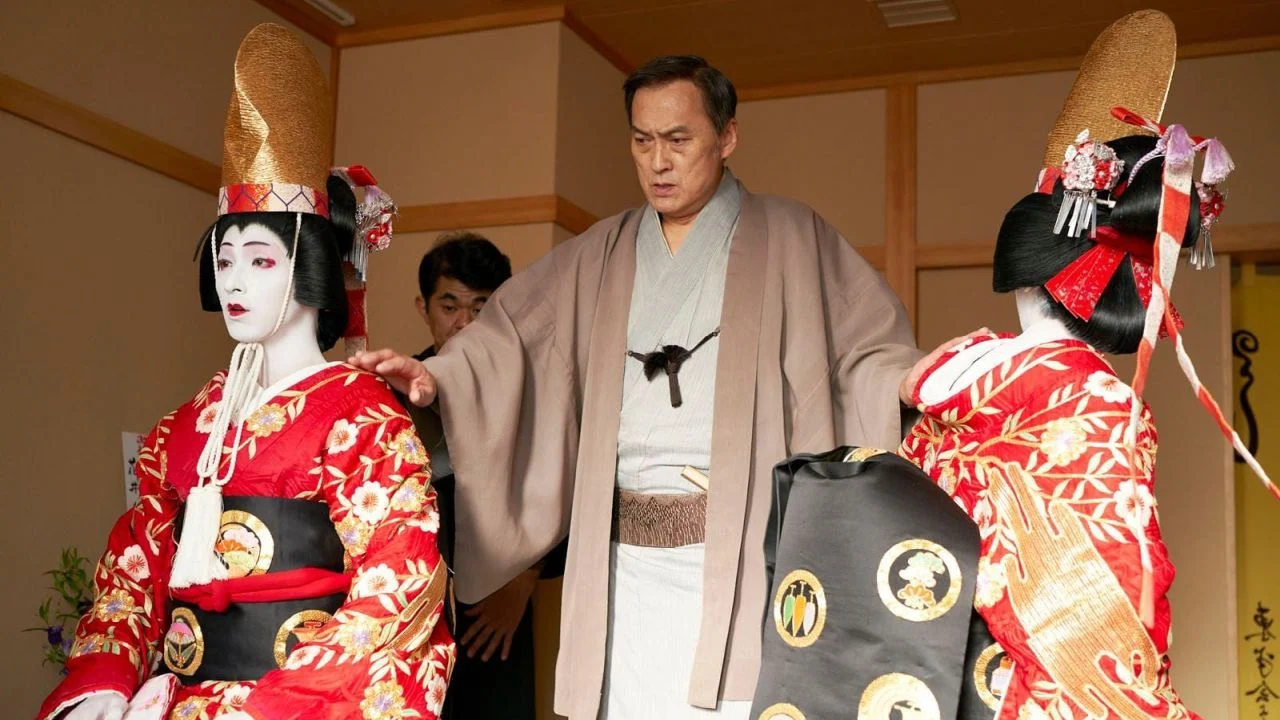
Hanjiro Hanai (Ken Watanabe) instructs his two students in the fine art of Kabuki theater.
It is a complex subject matter that “Kokuho” lays out in all of this. Family dramas are intertwined, jealousies, power struggles, the historical upheavals in Japan in the second half of the 20th century. The core conflict seems somewhat conventional and cliched. It refers to nothing less than the price of fame and honor. “Kokuho” asks and makes its characters doubt how their art, dreams and careers affect their environment, their own existence and ultimately the family structure. At the same time, the film also manages to create impressive reflections, which fortunately do without external classifications or comments at the crucial points. Instead, they simply let the audience watch, feel, interpret.
This mainly applies to the theater performances, and they are spectacularly captured on film. “Kokuho” makes the art form of Kabuki theater, which originally emerged in the 17th century, legible in its details and rituals. Of course, an interesting experience of strangeness is guaranteed, especially for Western viewing habits and a classically dramatic understanding of theater! You get a lot of time here to admire the gestural inventory, the use of sounds, the controlled movements, the expressive masquerades and costumes as well as all the artificiality on display.
“Kokuho” lets the theater speak for itself
This also includes playing with gender roles – and you’re back to the inscription in the body. “Kokuho” primarily highlights the game and artistic craft of the so-called Onnagata. So the men who slip into female roles. He repeatedly shows how the characters rehearse, pretend, adopt postures, and use a different voice. When the men then enter the stage, “Kokuho” finds impressive settings. The cameraman Sofian El Fani captures the performances in numerous long shots and wide, calm shots. The spatial dimensions and width of the tableaux created on the stage become visually noticeable.
Of course, he also uses the intimacy of close-ups and thus a closeness that is reserved for the film medium. The individual Kabuki scenarios are repeatedly made understandable using short text panels. But how subtly the action on stage absorbs the plot of the film and projects it outwards not only requires concentrated observation skills, but is also staged in a highly sophisticated and stimulating way. “Kokuho,” which translates as “national treasure,” ultimately relies entirely on its character dramas being absorbed into the art form it portrays and letting it speak for itself. This ultimately leaves a reminder of the power of the physical game.
Conclusion: “Kokuho – Master of Kabuki” sometimes races a bit superficially through its epic story of a boy on the way to becoming a theater star. As a historical and artistic drama about driven ambition and the price of fame, it still manages to produce many visually stunning scenes that give an impression of the fascination of the traditional Kabuki theater.