
Laughing about the Holocaust without losing sight of respect for the victims and the historical dimension – is that even possible? Yes that works! As is well known, the humorous approach to the darkest chapter of history also has a long tradition in cinema. Masterpieces such as “The Great Dictator” by Charlie Chaplin, “To be or not to be” by Ernst Lubitsch or “Spring for Hitler” by Mel Brooks have proven that the incomprehensible can be approached very well with biting irony. And maybe sometimes you even have to in order to be able to endure the suffering and horrors.
The Oscar winners “Life is Beautiful” (1997) and “Jojo Rabbit” (2019) also presented the fight for survival during the “World Conflagration” as a strong mix of drama and comedy. The actor and filmmaker Pascal Elbé now chooses a similar approach in his historical dramedy “Just a Little Bit of Luck”. The Frenchman’s fourth directorial effort is a tragicomic, bittersweet satire of confusion with many creative ideas, which stars a brilliant Benoît Poelvoorde. On the other hand, there is a script that doesn’t always make sense and seems frayed in places.

“Oh, officer. By the way, I’m Jewish!” – his dangerous lack of knowledge gets Jean Chevalin (Benoît Poelvoorde) into trouble again and again.
France 1940: Jean Chevalin (Benoît Poelvoorde) has only been in the French army for a day and has already had enough. He deserts and flees back to his wife Paulette (Audrey Lamy) and his son Marcel (Louis Douce Lagorce) in northern France, which is already occupied by the Nazis. He would ideally like to travel to the unoccupied south with his family, the only question is: How will that work?
Then the blue-eyed Jean comes up with the idea of pretending that he and his loved ones are Jewish. After all, there are special underground networks that only help Jews to escape. What begins as a seemingly simple plan to get to the “Free Zone” quickly turns into a trip full of strange coincidences, naive mistakes and dangerous situations. And did Jean even think that as a Jew he would actually have to be circumcised…
The absurd basic idea works!
During the Second World War, the protagonist pretends to be a Jewish resistance fighter in order to save his life. After all, deserters at that time faced the death penalty or lifelong forced labor, or at least years in prison. So why not, as a persecuted Jew, give yourself the chance of life-saving escape by pretending to be a victim? This actually completely outrageous basic premise is the hook of the story and serves as the basis for the humorous implementation – which usually works really well. Using fake passports, the family makes their way to the other side of the demarcation line. There, however, she realizes how life-threatening being a Jew is.
Elbé, who also takes on the supporting role of the Jewish refugee Sam Goldstein, plays pointedly and with a wink, with prevailing resentment. After all, Jean, who is only interested in his own advantage, only has a dangerous lack of knowledge and actually has no real idea of what Judaism is all about. The ironic, almost cynical tone is exemplified in the scene in which the family has their identification papers issued. Jean chooses a name that he thinks sounds “distinctly and traditionally Jewish.” The same applies to the choice of career, which once again shows Jean’s clichéd thinking. In the end he chooses the profession of dentist. A decision that he regrets when more and more people demand dental treatment from Jean.
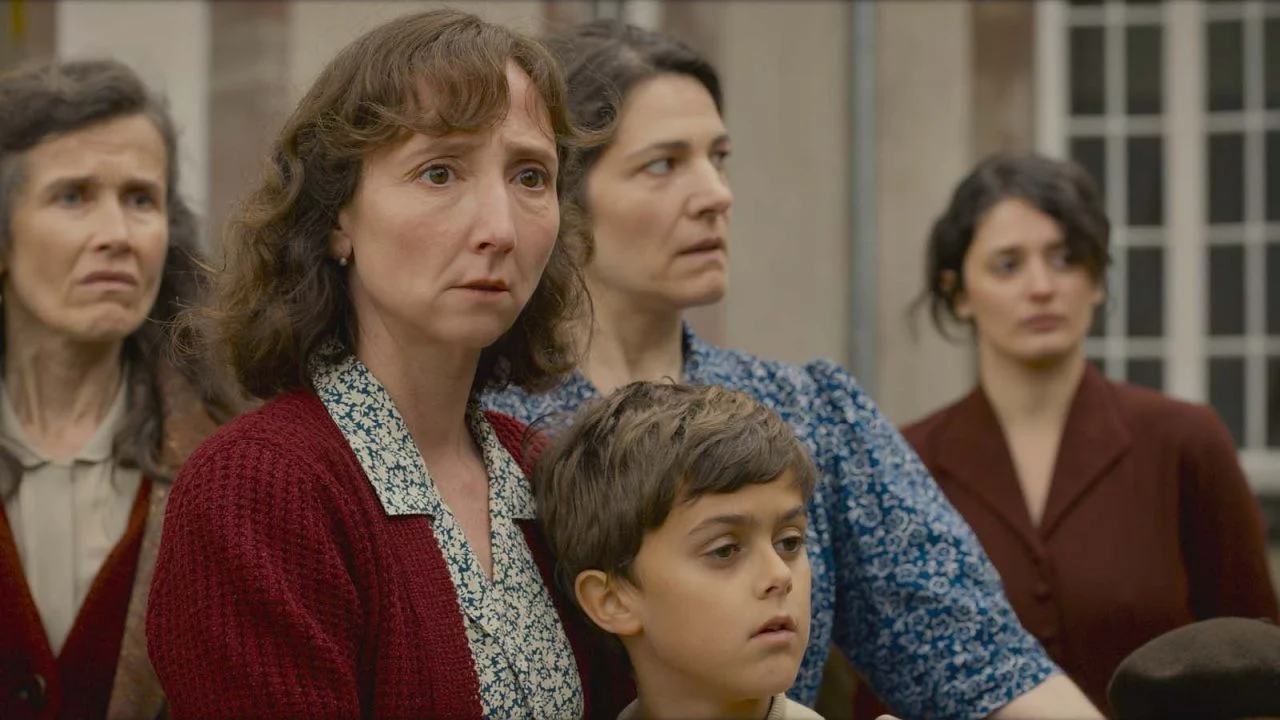
Wife Paulette (Audrey Lamy) and son Marcel (Louis Douce Lagorce) are drawn into their father’s “brilliant” escape plan.
The film also plays with anti-Semitic stereotypes and the reservations of a narrow-minded, ignorant society as the plot progresses. Jean and his family end up stranded in a stately villa that serves as a hiding place for a covertly operating smuggling network. There and on their further flight south, the family tries everything to appear as believably Jewish as possible. This frantic dissembling and appropriation of previously unknown behaviors and rites leads to many cheerful misunderstandings and amusing moments. The goal is not to be exposed by neighbors, resisters and escape helpers. But this is harder than expected, especially if, like Jean, you don’t know the Jewish dietary rules (kashrut) or get confused about the Jewish holidays.
In addition, the Nazis also get a lot of fat when Elbé shows them as submissive, cognitively limited recipients of orders who sometimes confuse the Jewish star with a poinsettia. The mix of those humorous tips and darkly humorous elements with thoughtful, oppressive scenes is almost entirely successful. Elbé incorporates them in dramaturgically cleverly chosen places. The terror of the occupiers and the collaborating Vichy government is evident in the sequences in which the threat to the “real” Jewish people becomes tangible. For example, with the selections at the checkpoints and the brutal raids in the transit camps. The danger of exposure and deportation hangs over large parts of the plot.
There is a surprise at the end
At times, however, the film gets lost in unnecessary subplots, including the subplot about Sam Goldstein, who becomes Jean’s close confidante. Goldstein is looking for his son who was lost while on the run, but this fate doesn’t really get close to you – the film stays far too much on the surface for that. Goldstein’s desperation peters out in husks of dialogue and assertions that keep the audience at a distance. The director also frequently touches on the background stories of some of the other supporters and resisters, including the wealthy owner of the villa. “Just a Little Bit of Luck” only touches on their biographies, motivations and character traits, which is why the supporting characters never really seem tangible.
The transformation and purification of the main character are moving. The charismatic Belgian mime Poelvoorde proves to be the ideal choice for a hopelessly naive character who only gradually gets into an ethical and moral conflict. Jean develops from a narrow-minded, bumbling opportunist and cynic into a lovable, empathetic fighter for moral courage and humanity. Elbé’s courageous decision to surprise with a dreamlike, surreal insert at the very end also deserves special mention. This poetic moment breaks with the previously established style and tonality of the film, but still fits harmoniously into the overall effect. He shows Elbé’s courage for the unexpected and his unconditional affection for his own characters, who behave anything but impeccably.
Conclusion: “Just a Little Bit of Luck” tells the story of a anything but morally impeccable deserter in the turmoil of the Second World War who pretends to be a French Jew. The tragicomedy thrives on unintentionally funny encounters and cheerful misunderstandings that arise from the bizarre basic constellation. She skilfully combines humorous, absurd and far-fetched elements with tragic touches and serious themes such as fear of death, terror, escape and anti-Semitism. It just didn’t need the sometimes fraying subplots.